![Magyarbusz [Info]](/mbi/header-logo.png)
BKK and BKV prepare procurement of hundreds of new electric buses
 Ludányi József
The Budapest Transport Centre (BKK), with the involvement of BKV Zrt., has prepared the largest electric bus procurement in the history of the Hungarian capital to date. The project covers the purchase of at least 250 new fully electric buses, as well as the construction of the charging infrastructure needed to operate them, making it potentially the largest investment of its kind in Hungary so far, planned to be financed from European Union funds.
According to the parties, BKK and BKV have been working on preparations for the large-scale project since March 2026. Beyond the procurement and entry into service of the new vehicles, the development also includes the creation of the necessary energy and charging infrastructure. As part of this, the conditions for operating electric buses must be established, which means several of BKV’s bus depots will have to be made suitable for receiving and operating the new vehicles. According to BKK, the company has in recent years contributed to the preparation and implementation of several major tram and trolleybus procurements; the current project, however, represents a new milestone for the capital’s transport organiser, as this is the first time it is preparing a bus procurement of this scale.
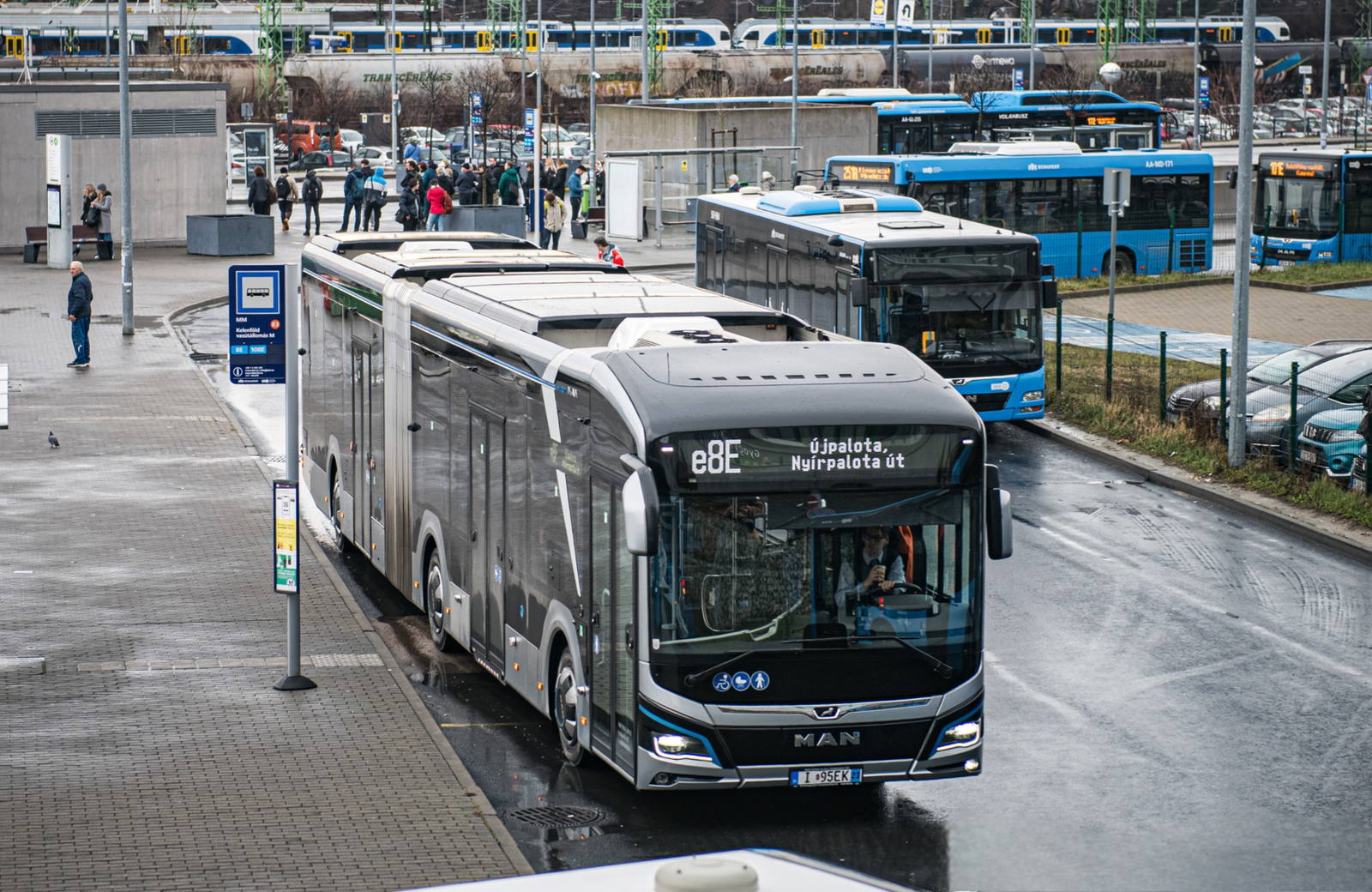
The procurement is expected to cover several hundred new low-floor electric city buses, including midi, standard and articulated vehicles. The new buses could gradually replace the capital’s ageing diesel-powered fleet. More than 400 buses over ten years old are currently operating in Budapest, and without fleet renewal this figure could rise to more than 600 by 2029. Electric buses are already in service in the capital: BKK’s operator ArrivaBus Kft. currently runs 54 fully electric BYD buses, to be followed by a further 28 by 2027, meaning that, including reserves, the fleet will comprise 82 vehicles in total – including 58 standard and 24 articulated versions. BKV’s fleet also includes a small number of electric Modulo C68 E midibuses that have been in service for more than a decade, mainly operating in the Buda Castle area. However, based on their technical reliability and operating experience, the domestically developed vehicles with composite bodies failed to live up to expectations, so their role in Budapest transport has remained limited, and the original 20-strong series has by now been considerably reduced.
With the arrival of the new electric buses now to be procured, there could be an opportunity to gradually replace diesel buses primarily on high-ridership inner-city routes and main transport corridors – such as the Rákóczi út–Thököly út axis. In addition to the purchase of vehicles, the investment also includes significant infrastructure development: the project will see the construction of the complex power supply system required for charging the buses, the charging equipment, and the energy management system responsible for optimising charging and energy use. Developments at BKV’s bus depots may also be carried out, enabling operation of the electric bus fleet.
As part of preparations for the procurement, BKK has launched a preliminary market consultation, which provides much more detailed technical and public procurement requirements than those set out in the current press release. According to the document, the public procurement could enable the purchase of 250–300 fully electric city buses, including midi, standard and articulated vehicles, all of them 100% low-floor. At the same time, BKK is committing to an order for 100 buses – 50 standard and 50 articulated – while the remaining quantity is included as an option. The vehicles are expected to come with at least a four-year comprehensive manufacturer’s warranty, with longer warranties required for certain major components. For the traction battery, a capacity warranty of at least eight years or 480,000 kilometres must be provided, under which the battery must retain at least 80% of its original capacity even after 4,000 full charging cycles. A long service-life requirement has also been set for the traction motor: it must provide a mileage of at least 1 million kilometres without overhaul, and with no repair requirements other than bearing replacement. Evaluation criteria include, among others, purchase price, additional warranty and the range measured according to the SORT 2 cycle, which must be at least 250 kilometres.
In parallel with the vehicles, the complete charging infrastructure is intended to be procured in a separate tender lot. The tender covers not only the installation of charging equipment, but also the development of the electricity supply, the transformers and supply network, the IT back-end system, a charging management system capable of real-time communication, and the long-term operation and maintenance of these systems. In this area, BKK is committing to an order for 100 charging units and the associated energy management system.
The document also states that the electric buses are intended to be stored, charged and serviced primarily at BKV’s Cinkota and Óbuda bus depots, each with infrastructure capable of serving at least 125 vehicles. In addition, the involvement of the Dél-Pest and Kelenföld bus depots is being examined as supplementary sites, each of which could serve the charging of 20–30 buses, as well as the Kőbánya bus and trolleybus depot, which would mainly be used as a daytime charging location.
Under the basic concept, the vehicles would primarily be charged overnight in the depots using plug-in CCS Combo 2 standard charging, although BKK is also considering the possibility of using pantograph and inverted pantograph fast charging, stationary two-pole charging using trolleybus overhead wires, and inductive charging. For the electricity supply of the two main depots, a connection capacity of 3×5 MVA is planned for each, while 2×5 MVA is envisaged for the supplementary sites and 2×10 MVA for the Kőbánya depot.
According to the technical description, the infrastructure must enable the simultaneous charging of at least 95% of the buses at each site. The minimum charging power is 70 kW for midibuses, 150 kW for standard buses and 250 kW for articulated buses, with the system based on an 800 V DC architecture, CCS Combo 2 connectors and communication in accordance with the ISO 15118 standard. The project also includes the installation of battery energy storage systems (BESS) with capacities of 2–7 MWh, which are capable of ensuring bus charging for at least two hours in the event of a power outage. Optional elements also include the construction of solar canopies and an intelligent charging management system connected to the FUTÁR traffic control system.
BKK is conducting the preliminary market consultation in two rounds. In the first phase, it is seeking comments from market participants on the various energy supply solutions and technical concepts, while in the second round the final technical specification may be prepared on the basis of the selected solution or solutions. After the consultation is closed, BKK may finalise the technical and professional requirements of the public procurement on the basis of the comments received, after which the conditional public procurement procedure can be launched. According to the preliminary timetable, the participation phase could begin at the end of 2026 or in early 2027, contract signing is expected in the second quarter of 2028, and delivery of the vehicles could take place between 2028 and 2029. If the public procurement procedure is successfully completed and the required European Union funding is available, the first new electric buses could enter service in Budapest in 2029.