![Magyarbusz [Info]](/mbi/header-logo.png)
A hundred-million-euro burden and a fragmented legacy – this is what remains of Van Hool
 Ludányi József
More than two years have now passed since Van Hool’s spectacular collapse, but what is left today of one of Europe’s longest-established bus and trailer manufacturers? The answer is far more complex than saying Van Hool simply “survived” or “ceased to exist”. The name lives on, and the industrial business – above all the production of semi-trailers and tankers – has also been preserved, but the once-unified company has definitively fallen apart. The family has been pushed out of the company that bore its name for 77 years, the bus and industrial activities have gone to separate owners, entire model ranges have disappeared, and the former manufacturing and development base has been broken up. In Belgium, what remains of the former industrial giant is essentially a truncated Koningshooikt site and a mounting body of creditor claims, running into several hundred million euros, in the liquidation process.
The immediate cause of Van Hool’s downfall was ultimately the “running out” of liquidity, but the problems that led to that point had begun decades earlier. Some of them stemmed precisely from the distinctive family-business model on which Bernard Van Hool built the company he founded. When he retired in 1969, he divided management of the business among his eight sons, entrusting each of them with a specific area. His two daughters, however, received no shares: in line with the family thinking of the time, Ingrid and Simone were compensated with property and money. Bernard’s original aim was to keep the business in the family and intact, but as the decades passed, this very structure became one of Van Hool’s greatest weaknesses.
With the emergence of the second and third generations, an increasing number of heirs, divergent interests and different business ideas appeared among the owners. For a long time, Van Hool did not operate as a single, centrally managed company: even when Filip Van Hool, the founder’s grandson and the family business’s first – and, as later became clear, last – chief executive, was appointed in 2015, the group still consisted of eight parallel corporate units, each pursuing its own interests and not necessarily always working for the benefit of the others. Filip began centralising these units, but a more unified way of operating only became possible in 2017, when the founder’s last sons still active in the business also retired.
The financial consequences of the tensions within the family, however, had become apparent much earlier. One of the heaviest burdens was the ownership restructuring of 1999, when three of the founder’s eight sons were bought out of the business for a total of €180 million. Moreover, the sum was not determined on the basis of the company’s actual market value: it was calculated from the results of the previous three years, which had been exceptionally profitable because of the extraordinary boom in the US market, and then a multiplier of ten was applied to the figure obtained. According to Filip Van Hool, even half of the amount ultimately paid would have been excessive.
The €180 million buyout caused a huge financial haemorrhage for Van Hool, the consequences of which the company carried for many years afterwards. Following the transaction, other family members also indicated that they wanted to cash in their holdings, but the company’s weakened financial position meant this was no longer possible; the resulting claim of around €100 million was eventually recorded in the company’s books as a current-account liability. Instead of settling the ownership situation, the buyout also triggered another family conflict. After learning of the €180 million payout, Bernard’s two daughters, who had been left without shares, concluded that they too should have received a stake in the company, and took the matter to court. The inheritance and ownership dispute that unfolded as a result dragged on for almost a quarter of a century, while the shares concerned were meanwhile placed under court attachment.
By then, the conflict was far from being a simple family feud: it directly restricted Van Hool’s financial room for manoeuvre. The disputed and frozen shares made it harder to bring in an external investor, while the fragmented ownership structure became a critical problem precisely when the company needed fresh capital, bank financing and state support.
In this way, a decades-long inheritance dispute ultimately became one of the defining factors in Van Hool’s collapse. Of course, this alone did not bring the company down: it also required the huge losses suffered during the coronavirus pandemic, when the coach market – traditionally extremely important and profitable for Van Hool – collapsed practically overnight. Orders stopped, while around 500 completed buses and a huge inventory built up at the company; during the pandemic period, Van Hool suffered total losses of roughly €250 million. This was compounded by the breakdown of supply chains, inflation, the surge in energy, parts and wage costs, and the liquidity crisis that followed.
At the end of 2023, the situation still did not appear hopeless. Van Hool still had adequate liquidity at that point, but restructuring had become unavoidable in order to put its finances in order. The family could have mobilised around €90 million from its own resources, and a further €30 million made available temporarily – for example for two years – could have been enough for the company to get through the critical period. The reorganisation, however, failed because of the inheritance and ownership dispute that had been dragging on for decades: both the banks and the Belgian state made settlement of the issue a condition for any further assistance, but the family was unable to reach an agreement within the time available.
The collapse was ultimately accelerated by the enormous publicity surrounding Van Hool’s financial difficulties. Details of the negotiations with the banks and the state kept leaking to the press, and in view of the uncertainty, some suppliers became willing to deliver only against advance payment. The domino effect was ultimately set in motion by an unpaid invoice of just €10,000: one supplier filed a collection order against Van Hool’s bank accounts, after which the company applied for protection from creditors. From that point, however, events spiralled out of control, creditor claims came in like an avalanche, Van Hool’s liquidity collapsed, and the company became insolvent within a short period. Bankruptcy was finally declared on 8 April 2024 – even though the manufacturer had orders worth more than €620 million for 2024 and 2025.
By now, Van Hool has passed entirely out of the founding family’s ownership. The bus manufacturer had previously been owned by the Van Hool heirs through the family holding company Immoroc; this company included the plants in Belgium and North Macedonia, as well as sales activities in the United States and other export markets. With the 2024 bankruptcy, however, not only did the unified company fall to pieces, but the Van Hool family’s ownership role of more than three-quarters of a century also came to an end. Immoroc went into liquidation, the bus business was bought by the Dutch VDL Groep together with the North Macedonian plant, while the industrial activity, focused primarily on the manufacture of semi-trailers and tank vehicles, continued under another owner.
This, however, by no means marked the end of Van Hool’s liquidation. Over the past more than two years, the remaining assets have been sold off continuously: alongside real estate, machinery, equipment and other movable assets, some of the company’s demonstration and prototype buses also found new owners, as did vehicles that were in production at various stages of completion at the moment of bankruptcy. The monetisation of the former Van Hool’s assets still cannot be regarded as fully complete, just as the final balance on the creditor side is not yet known. According to the data available to the liquidators in the summer of 2026, the reported stock of claims amounted to around €316 million, although this cannot yet be considered a final figure.
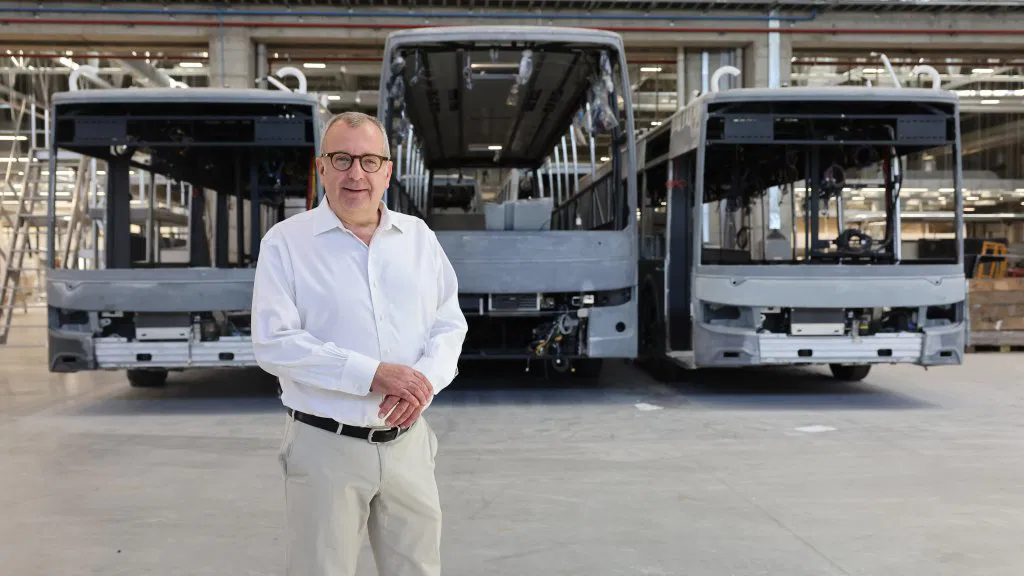
Filip Van Hool in front of the company’s newly renewed city and coach range
After the bankruptcy, Filip Van Hool also withdrew from business life. At the same time, it would be difficult simply to judge the former chief executive’s role in the same way as that of the family members responsible for the company’s downfall. Under his leadership, it was precisely he who tried to dismantle Van Hool’s fragmented management system, which had developed over decades, and he had previously succeeded once before in steering the company out of an extremely difficult financial situation. Filip was also one of the main initiators of the establishment of production in North Macedonia, which made the company more competitive again thanks to lower manufacturing costs: between 2009 and 2019, Van Hool’s equity increased by around €88 million, almost tripling, while its debt burden fell. In the months leading up to the bankruptcy, he was again working to save the company, but resolving the financial and ownership problems accumulated over several generations, as well as the conflicts within the family, ultimately exceeded the room for manoeuvre of a single company leader.