![Magyarbusz [Info]](/mbi/header-logo.png)
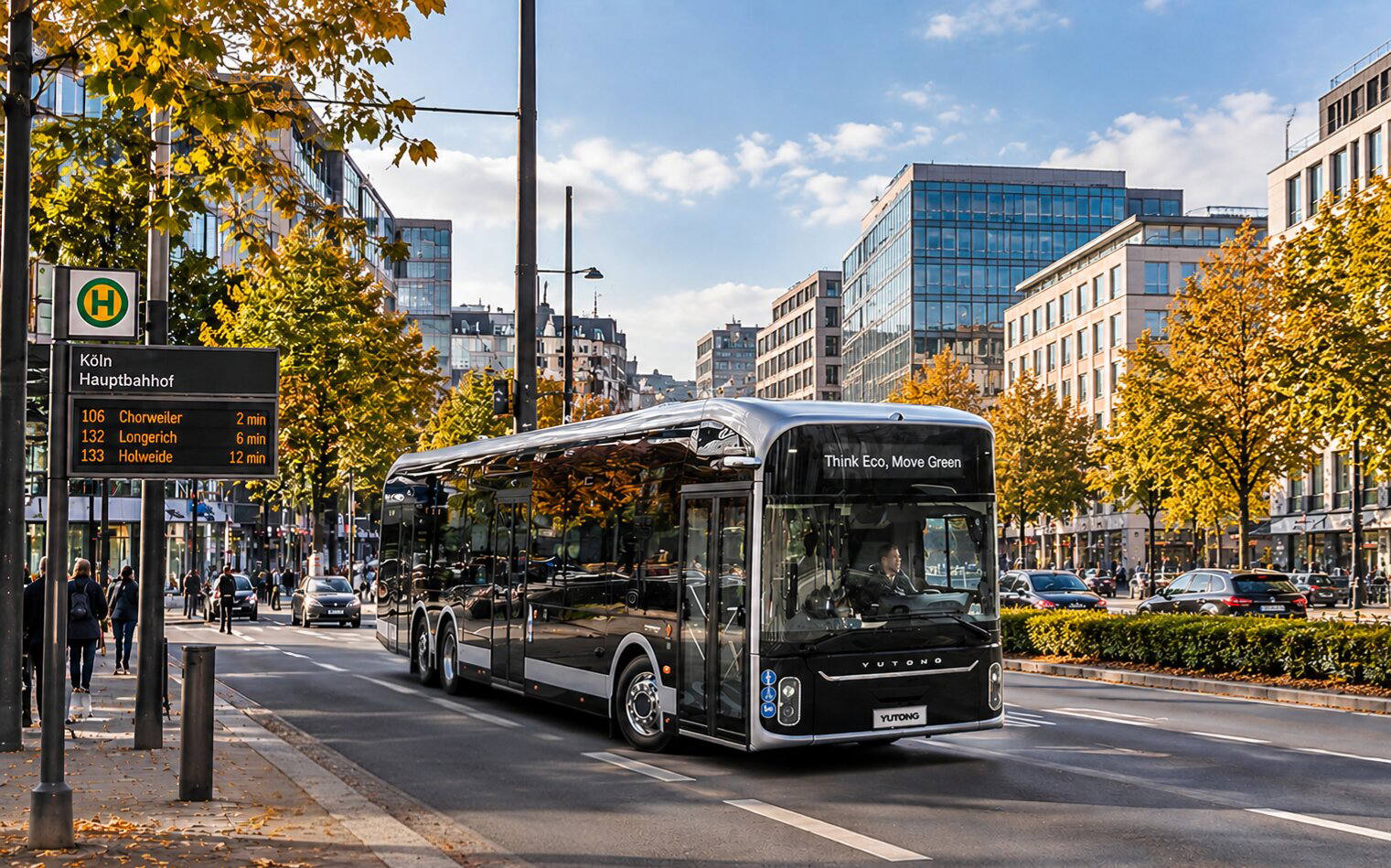
Yutong continues its European expansion, with Germany the next target market
 Ludányi József
Yutong is setting its sights on one of Europe’s largest bus markets: after rapid growth in several countries across the continent, the Chinese manufacturer is preparing to establish a lasting presence in Germany as well. According to information from our German trade partner publication Omnibus.news, one of the first tangible steps in this process is the appearance of a German service partner in Yutong’s official European network, while the brand has also been preparing its entry with vehicle tests and by taking part in the UITP Summit trade fair in Hamburg. The development is particularly noteworthy because, in recent years, Yutong has no longer focused solely on a few traditionally strong western and northern European markets, but has increasingly and visibly sought to cover the continent as a whole.
Germany is a particularly important step in this respect. In 2025, the country was the largest bus market in the European Union: according to ACEA data, a total of 6,890 new buses were registered, 28% more than a year earlier. Growth was even more striking among electrically powered vehicles. Registrations of electrically chargeable buses rose from 876 to 1,808 units, an increase of 106.4%, meaning they already accounted for more than a quarter of the total German market. In addition, 974 hybrid and 128 other alternatively powered buses were registered, while 3,980 diesel models entered service.
The size of the German market and the accelerating pace of electrification make the country an especially attractive target for Yutong. Based on ACEA data, Germany not only topped the EU ranking for the overall bus market in 2025, but also recorded the highest number of electrically chargeable buses: the German market alone accounted for around one-fifth of the EU’s total volume of roughly 9,100 units. The longer-term growth potential is also significant: according to the PwC E-Bus Radar survey, German public transport operators have concrete plans to procure a further approximately 9,660 buses.
At the same time, the expansion into Germany represents a further broadening of an already extensive European presence. Yutong officially entered the European market in 2004 after obtaining EU whole-vehicle type approval, while its sales began to grow more rapidly from 2011 onwards. According to the manufacturer’s own figures, it has so far delivered 7,898 buses to Europe, its presence extends to 27 countries, and vehicle operations are supported by a network of 31 official service points.
The growth in volumes has been particularly striking in recent years. In 2022, with 479 battery-electric buses above eight tonnes gross vehicle weight, Yutong briefly became the leader of the European market; in 2023, it slipped back to third place with 483 vehicles, but in 2024 it became market leader again with 1,092 registered buses. In doing so, it more than doubled its European volume in a single year and achieved a 14% market share.
Growth has not slowed since then. In the European markets analysed by DVV Media Group, 1,801 Yutong electric buses were registered in 2025, followed by a further 1,636 in the first six months of 2026. The latter figure is almost twice the 852 units recorded in the same period of the previous year and represents a market share of more than 20%. Yutong therefore came close to matching its full-year 2025 volume in just half a year.
In parallel, it is also continuing to expand geographically, and in recent times it has entered western European markets that have traditionally been difficult for new players to access because of strong domestic and established European manufacturer positions, as well as high technical and operational requirements. It appeared in Austria for the first time in 2025: seven U10 battery-electric buses were put into service in local transport in Amstetten, after which it also gained a foothold in the coach segment, with Dr. Richard taking delivery of three T12E electric coaches this year. At the beginning of September, it took another important step in Switzerland, where Eurobus expanded its fleet with a three-axle T14E electric coach, while Zurich’s VBZ ordered eight 12-metre Yutong electric buses. The expansion into Germany could be the next stage in this process, and in terms of market size an even more significant one than those seen so far.
The brand itself is not entirely unknown in Germany. Yutong vehicles have previously undergone trial operation with several German operators, and in June 2025 the company held the world premiere in Hamburg, at the UITP Summit, of the IC12E battery-electric interurban bus developed for the European market. The manufacturer already confirmed to Omnibus.news at the time that it intended to market the model in Germany as well. Following its presentation, the IC12E completed a 1,272-kilometre demonstration run from Hamburg through Denmark and Sweden to Norway.
The latest development, however, goes beyond presentations and trial operations. According to Omnibus.news, Yutong has also begun building up its after-sales support in Germany. The manufacturer’s official European service network already includes C-Ideal GmbH, based in Hoppstädten-Weiersbach in the state of Rhineland-Palatinate. In March 2026, the company’s scope of activities was expanded to include the sales and customer service of electric buses and their components, as well as services related to batteries and battery systems. The site’s geographical location is also favourable for Yutong, as it lies in south-western Germany, close to the French and Luxembourg borders, meaning it could also play a role in serving neighbouring countries in addition to the German market.
The development of local support fits well with the new phase of Yutong’s European strategy. On 8 September, the manufacturer opened its first wholly owned, full-service European service centre in Stokke, Norway. The nearly 39,000-square-metre site is already far more than a conventional repair workshop: vehicle handover, maintenance and repair, diagnostics, spare parts supply and specialist training are all carried out in one location. Within the 6,074 square metres of buildings, a 2,300-square-metre parts warehouse has been created with around 4,500 different part numbers, while the workshop has seven general service bays as well as dedicated workstations for repairing drivetrains and larger assemblies.
The significance of the Norwegian investment is clearly illustrated by Yutong’s own statement that more than 1,200 of its electric buses are already operating in the country. With a fleet of this size, local parts supply and technical support are no longer merely tools to encourage further sales, but become a fundamental prerequisite for long-term operation. With the Stokke centre, Yutong is seeking to reduce its disadvantage against European manufacturers precisely in the area often cited as one of the most important issues in the rapid expansion of Chinese brands: local service, parts and technical support guaranteed throughout the entire vehicle life cycle.
From this perspective, Germany could be one of the serious tests of Yutong’s European expansion. While the size of the market offers significant growth opportunities, competition is also considerably stronger than in many of the countries where the Chinese manufacturer has been able to build up large fleets quickly in recent years. Alongside domestic players Daimler Buses and MAN, Solaris, Iveco Bus and several other European manufacturers also hold strong positions, while other Chinese brands are also trying to increase their presence.
For Yutong, the stakes of entering the German market are therefore much higher than simply whether it can sell a few electric buses. In recent years, the company has already proven that it can deliver large series to Europe; in the next phase, it will have to show that it can build an equally durable local sales, parts and service background behind those vehicles. The appearance of the German partner and the establishment of its own service centre in Norway suggest that this is increasingly coming to the fore in the manufacturer’s European expansion.