![Magyarbusz [Info]](/mbi/header-logo.png)
Metz to launch another BRT corridor based on Solaris hydrogen buses
 Ludányi József
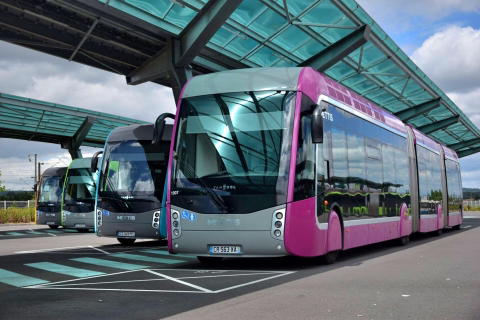
Within Europe, BRT systems offering a higher standard of service and carrying heavy passenger volumes – known in French as BHNS lines – are perhaps most widespread in France. One example is the METTIS network operating around Metz, a city whose central role is better known to the wider public for its historic sights and urban landscape, but which in the transport industry has become much more closely associated with its multicoloured, bi-articulated Van Hool hybrid buses. These vehicles currently serve a bus rapid transit network consisting of two lines – corridors A and B – which will soon be expanded with a third route, line C. This time, however, the expansion will no longer be based on the Belgian manufacturer’s portfolio – although that was the original plan – but on Solaris hydrogen-powered buses.
METTIS lines A and B were launched in the Metz metropolitan area on 5 October 2013. The network was developed according to a BRT concept instead of the tram lines originally planned for the area, with the aim of achieving a service level close to that of a tramway, but without building fixed-rail infrastructure. Line A is around 14.7 kilometres long and links the main districts of the conurbation on an east–west axis, while route B forms a north–south corridor over approximately 11 kilometres. The two lines share a several-kilometre section through the city centre.
The METTIS lines do not run on segregated infrastructure for their entire length, but do so for the most part; the infrastructure includes physically separated busways, dedicated bus lanes and traffic-signal priority at junctions. To operate the system, a total of 27 Van Hool Exqui.City 24 bi-articulated buses with series-hybrid drivetrains were purchased in 2013, followed by three more in 2020. Their replacement is already on the agenda, as the region is preparing to replace the fleet with zero-emission vehicles.
Based on operational experience, Metz Métropole – the metropolitan intermunicipal authority bringing together Metz and its surrounding municipalities – had already put the possibility of creating a third, cross-city BRT line, designated C, on the agenda by the end of the 2010s. Preparations for the project accelerated in the following years, with construction work beginning in 2023. The opening was originally scheduled for the mid-2020s, but depending on the progress of construction, commissioning is now expected around 2027.
The forthcoming C line will provide a direct link between the city’s southern suburban area and central Metz; starting from the P+R terminus being built in Marly, it will run along the main axis of densely populated Montigny-lès-Metz, following Rue du Général Franiatte, before reaching the eastern edge of the city centre around Mazelle via the area of Metz-Ville railway station. The roughly 10-kilometre route will thus connect three municipalities along a single corridor, with a total of about 21 stops and an average stop spacing of 400 metres.

Photo: Hugo Azmani
The alignment of the corridor largely follows the route of the current L2 bus service, but will be created by “upgrading” it: as part of the project, new physically separated busways will be built on several sections, junctions will be reconstructed, and traffic-signal priority will be provided for vehicles along the entire corridor. The development is not only a transport investment, but also a comprehensive urban renewal project, including the refurbishment of public spaces, improvements to pedestrian and cycling infrastructure, and stronger accessibility measures.
Within the line’s direct catchment area – along the route, in a corridor of around 500 metres – approximately 38,000 residents and nearly 27,000 jobs will become directly accessible. The new link will also deliver a meaningful reduction in journey times: between Marly and Place de la République, the current travel time of around 32 minutes on the L2 service is expected to fall to 22 minutes. According to preliminary estimates, daily ridership could reach 12,000 passengers on working days.
From an operational perspective, line C will be integrated into the existing Mettis network and will operate to the same standard of service, with frequent headways, high-capacity vehicles and direct connections without the need to transfer. Direct service to the Metz-Ville railway station area will play a key role, as this has been one of the missing elements of the current network.

To provide the vehicle fleet for the new line, the city originally stayed with Van Hool, the manufacturer whose vehicles had already proved themselves on the first two lines of the METTIS network: the plan was to put 15 hydrogen-powered, bi-articulated buses into service. Preparations for the procurement were already well advanced, and in 2023 the region also paid an advance of around €1.45 million. However, the bankruptcy of the Belgian manufacturer overturned these plans, making it necessary to look for a new supplier.
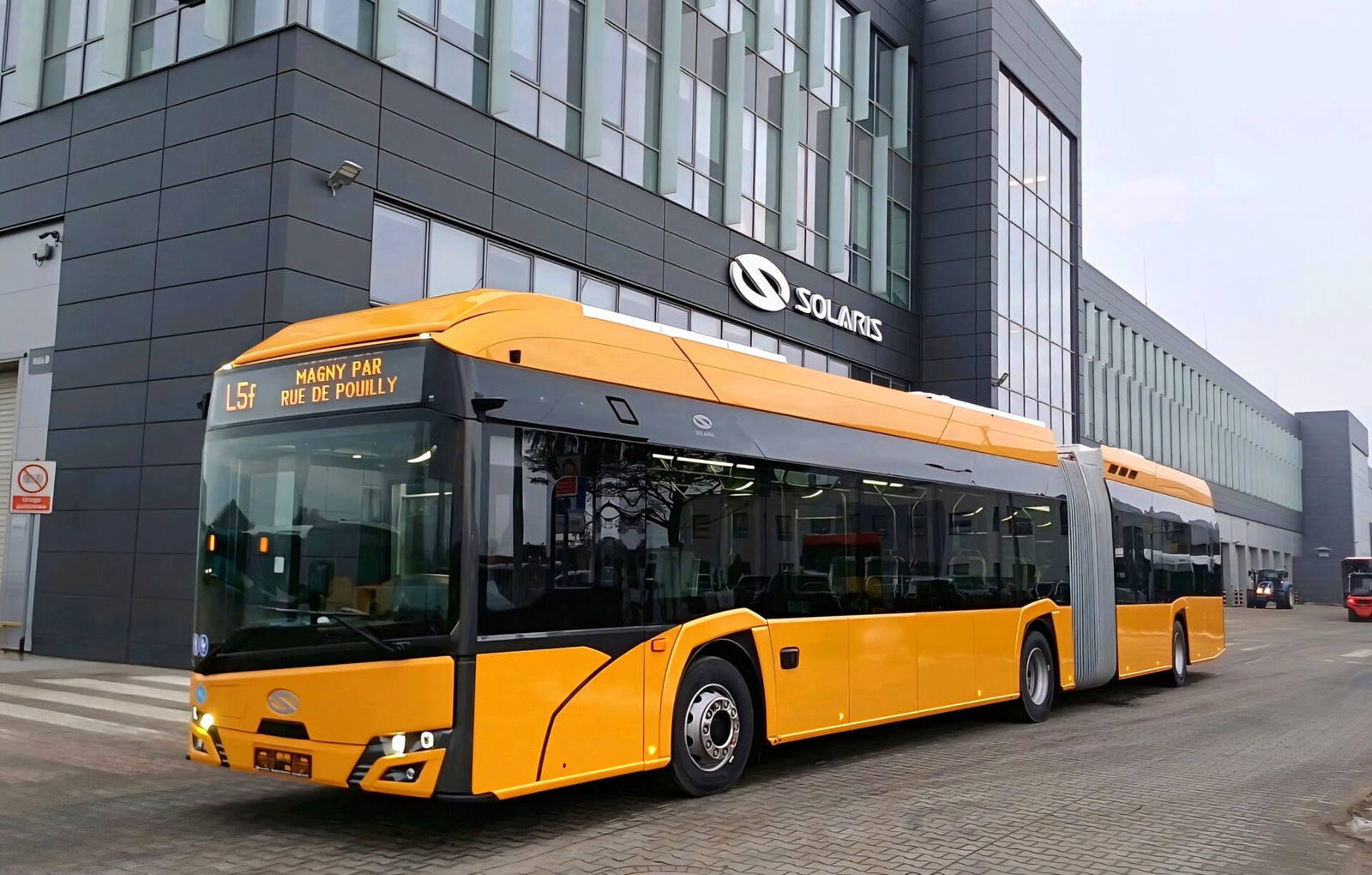
The choice ultimately fell on Solaris, which received an order to supply a total of 20 hydrogen-powered buses. The configuration, however, differs from the original concept: instead of the bi-articulated vehicles offered by Van Hool, the Polish manufacturer will deliver 14 18-metre articulated and six 12-metre solo Solaris Urbino hydrogen buses. This also means a reduction in capacity, as – at least for the time being – the line will be operated with a fleet offering lower passenger capacity than bi-articulated buses.

The first articulated Solaris Urbino hydrogen bus for the Metz fleet at the manufacturer’s plant in Poland; the vehicle was completed recently
To operate the vehicles, a new depot and refuelling infrastructure designed for hydrogen-powered buses will be built in the Frescaty area in the southern part of the city. In addition to storage and maintenance of the vehicles, the facility will also include systems for receiving and dispensing hydrogen, with the project’s longer-term objective being the use of so-called green hydrogen produced from renewable sources.
The total budget for the third Mettis line project is nearly €84.76 million, equivalent to around HUF 32 billion at today’s exchange rate. The envelope covers not only road and infrastructure improvements, but also the procurement of the hydrogen buses – valued at approximately €22 million – as well as the construction of the new bus depot, worth around €10 million. Procurement of the vehicles is being carried out by Metz Métropole, while operation will be the responsibility of Keolis, which has been providing services in the area since 1 January 2026.
Cover image: Hervé Bouley