![Magyarbusz [Info]](/mbi/header-logo.png)
European bus industry demands go before Brussels: manufacturers want new rules of the game
 Ludányi József
The future of European bus manufacturing has landed on the European Commission’s desk: the Dialogue on Bus Manufacturing in Europe was held in Brussels, organised by DG GROW, the Commission’s Directorate-General for Internal Market, Industry, Entrepreneurship and SMEs. The meeting is particularly significant because manufacturers’ concerns over the competitiveness of the European bus industry, voiced with growing urgency for months, were this time placed directly on the agenda before EU decision-makers. DG GROW’s remit includes strengthening the competitiveness and resilience of EU industry, meaning the dialogue on the state of bus manufacturing took place within the Commission department responsible for industrial-policy decision-making.
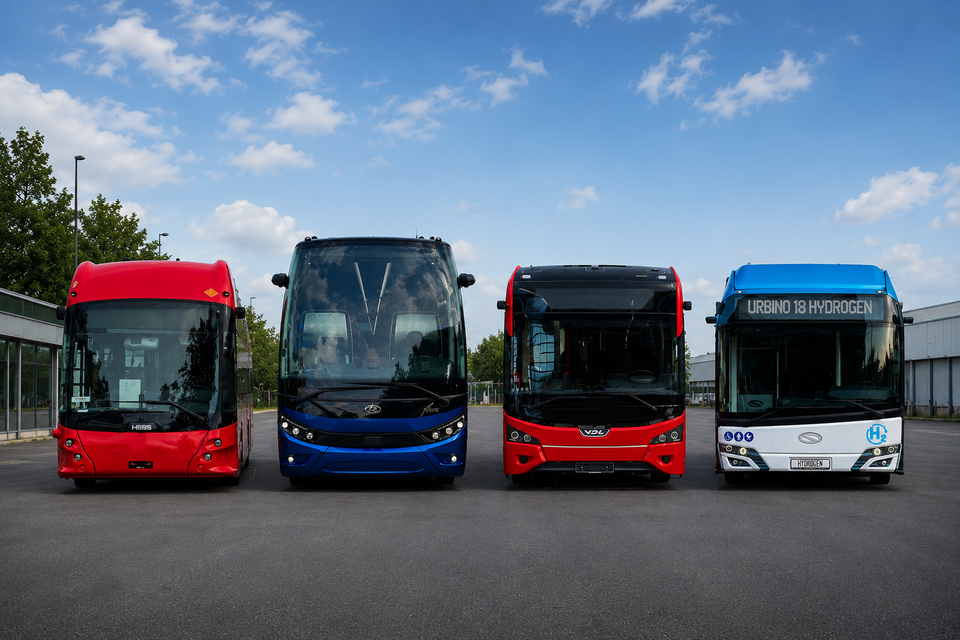
The talks were not limited to vehicle manufacturers. Participants included bus makers, transport operators, cities, and European industry associations and professional organisations. Those present included ACEA, the European Automobile Manufacturers’ Association; the IRU, the world road transport organisation; UITP, the International Association of Public Transport; EMTA, the association of European metropolitan transport authorities; as well as Eurocities, POLIS and Transport & Environment (T&E). On the manufacturing side, representatives of Solaris Bus & Coach, Hess and VDL Bus Group, among others, took part in the dialogue. The discussion set out the factors affecting the sector’s future competitiveness, resilience and sustainable growth from the perspective of European bus manufacturers.
At the same time, the Brussels meeting was not the start of a newly emerging debate, but another stage in a European industry initiative that has been taking shape for some time. ACEA had also repeatedly urged measures to strengthen the competitiveness of Europe’s vehicle industry and to reshape public procurement rules so that, alongside price, greater weight is given to European added value, industrial resilience and other non-price criteria. From the bus manufacturers’ side, the first coordinated initiative focusing specifically on the sector came in June: four independent European manufacturers, Beulas, Hess, Solaris and VDL, addressed a joint open letter to the European Commission and the member states, calling for a more level playing field and stronger consideration of added value created in Europe.
The June document already contained several elements — including the introduction of “Made in Europe” requirements, changes to the public-procurement evaluation system, and the treatment of bus manufacturing as a strategic industry — that also emerged as central issues at the latest Brussels talks. By September, the initiative had moved to another level: Hess, Solaris Bus & Coach and VDL Bus Group submitted to EU decision-makers a jointly authored, ten-page white paper containing a detailed assessment of the situation and concrete policy proposals. The document aims to strengthen the competitiveness of European low- and zero-emission bus and coach manufacturing, and to ensure that a larger share of the substantial public investment flowing into European mobility creates added value within the EU and EFTA economies.
European industry loses ground during a successful electric transition
The white paper presents a fundamental contradiction: while the European Union and EFTA countries have become global leaders over the past decade in the electrification of public transport, European manufacturers are capturing an ever smaller share of the market created in the process. The transition has been driven by EU climate targets, the Clean Vehicles Directive and various public funding programmes, with the result that by the end of 2025 almost 60 percent of newly registered city buses in the EU and EFTA countries were already zero-emission vehicles.
In parallel, however, the presence of players from outside Europe has grown rapidly. According to the document, non-European manufacturers already account for more than 35 percent of the zero-emission city bus market, with the rise of Chinese companies singled out in particular. The problem for the authors of the white paper is not foreign competition in itself, but that vehicles developed and manufactured largely outside the EU and EFTA compete with European products in public tenders partly financed from EU funds, while a significant share of the economic value generated by their production is not created in Europe.
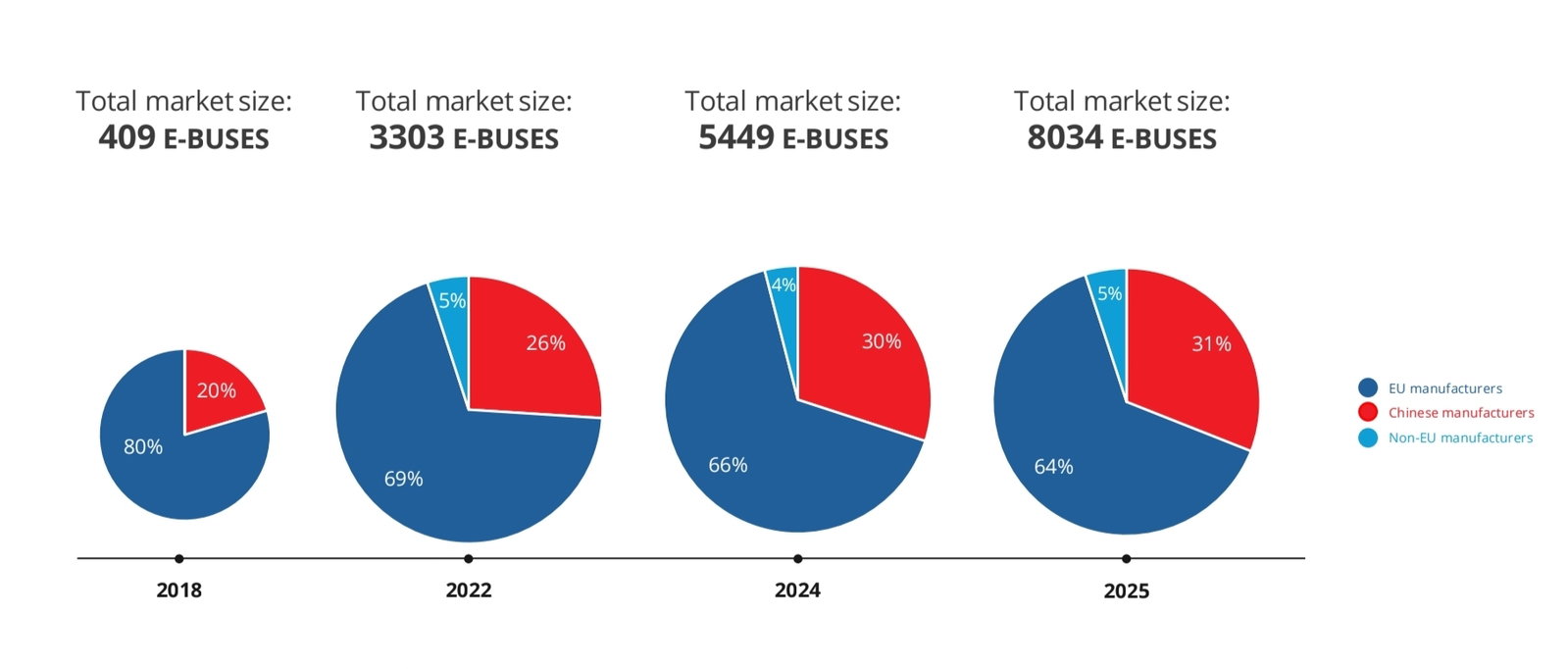
Market data published in the annex to the white paper clearly show the pace of change. The electric bus market has roughly quadrupled since 2020, and in 2025 more than 8,000 battery-electric, hydrogen-powered or trolleybuses were registered in Europe. Meanwhile, the market share of EU manufacturers fell from 80 percent in 2018 to 69 percent in 2022, 66 percent in 2024 and 64 percent in 2025, while the share of Chinese manufacturers rose from 20 percent to 31 percent.
Hess, Solaris and VDL warn that the same process could soon appear in the interurban, long-distance and coach markets as well. In these categories, the zero-emission transition is still at a much earlier stage, but new emissions requirements could open up a significant market for electric and other zero-emission drivetrains in the coming years. The manufacturers therefore argue that the European framework should be amended before the market trend seen in city buses is repeated in these segments too.
Hundreds of thousands of European jobs linked to the bus industry
The document measures the industry’s importance not only by the number of vehicles sold. According to estimates by Hess, Solaris and VDL, European bus manufacturers directly employ around 165,000 people, while the wider supplier and service ecosystem may account for as many as another half a million jobs. The white paper says that over the past five years, the closure of several major manufacturing plants or the relocation of production in the European automotive industry has already led to the loss of tens of thousands of direct and indirect jobs.
For this reason, the three manufacturers argue that the issue cannot be reduced to which company offers the cheapest bus in a given tender. Behind a European vehicle there may be an entire chain of research and development, engineering, supplier networks, manufacturing and subsequent services, and they want the economic value of this to be reflected in public-procurement decisions.
Current scrutiny of foreign subsidies seen as insufficient
One of the white paper’s most important objections is that the EU’s current tools are, in the manufacturers’ view, not properly aligned with the size of the bus market. They specifically highlight the Foreign Subsidies Regulation, the EU framework for addressing foreign subsidies. One of the relevant notification thresholds linked to public procurement currently stands at an estimated contract value of €250 million, while bus procurements of this size occur only rarely. The manufacturers therefore believe the mechanism fails to capture a large share of precisely those tenders in which, in their view, state subsidies from third countries may distort competition.
Their proposal is correspondingly radical: for bus tenders, they would consider a threshold of €30 million appropriate. In addition, all bidders would be required to disclose direct and indirect subsidies and incentives received from their home-country governments or state-owned banks.
The document also names China specifically. The manufacturers argue that the scale of industrial subsidies there significantly exceeds that of support schemes used in the EU and other OECD countries, which they say may enable more aggressive pricing. It is important to note, however, that this is the argument put forward by the manufacturers behind the white paper: on this basis, they are calling for stricter EU scrutiny and greater transparency in public procurement.
A European assembly plant alone would not be enough
On another important point, the document also defines what it would regard as a genuine European industrial presence. According to the manufacturers, it is not enough in itself for a company from outside Europe to establish final assembly capacity within the EU. They warn that if the overwhelming majority of a vehicle’s value continues to be generated outside Europe, significant public money can still flow out of the EU economy even if final assembly is localised.
Hess, Solaris and VDL would therefore take the entire value chain into account. Engineering and development work, procurement, component manufacturing and production itself would all count when determining how much European added value a vehicle represents. This is important because the “Made in Europe” system proposed later would not be a simple origin label either. A bus would not be deemed European on the basis of where it is finally screwed together, but on how much of its total production value is actually generated in Europe.
Short delivery deadlines also seen as a competition-distorting factor
An unusual but practically important element of the white paper for bus procurement is the issue of delivery deadlines. The manufacturers say geopolitical conflicts and supply disruptions in recent years have lengthened procurement times for many components, while producing an electric bus can in any case be a longer process than building a conventionally powered vehicle.
According to the document, some East Asian OEMs, by contrast, have larger production capacities and shorter local supply chains. If a tender for a transport service leaves very little time between contract award and the start of operations, the operator is forced to specify extremely short vehicle delivery deadlines. According to the three manufacturers, this may indirectly favour companies with large stocks of finished vehicles or substantial production capacity. The white paper therefore also calls for tenders to set delivery deadlines that can realistically be met.
Price would determine at most half of the decision
The three manufacturers regard the transformation of the public-procurement system as one of the most important tools. The change would apply not only to tenders in which a transport company directly purchases buses, but also to service and concession tenders after which the operator must procure new vehicles.
Under the proposal, price could account for no more than 50 percent of the evaluation. The remaining at least 50 percent would have to reflect criteria such as technical performance, service quality, sustainability, supply resilience and long-term, broader economic value.
The white paper would also bring the World Trade Organization’s Government Procurement Agreement (GPA) into the system. Until the forthcoming Industrial Accelerator Act introduces stricter requirements, the manufacturers want suppliers participating in public-transport bus procurements to originate from countries that are party to the GPA. This would also be extended to indirect vehicle purchases, meaning those linked to service contracts.
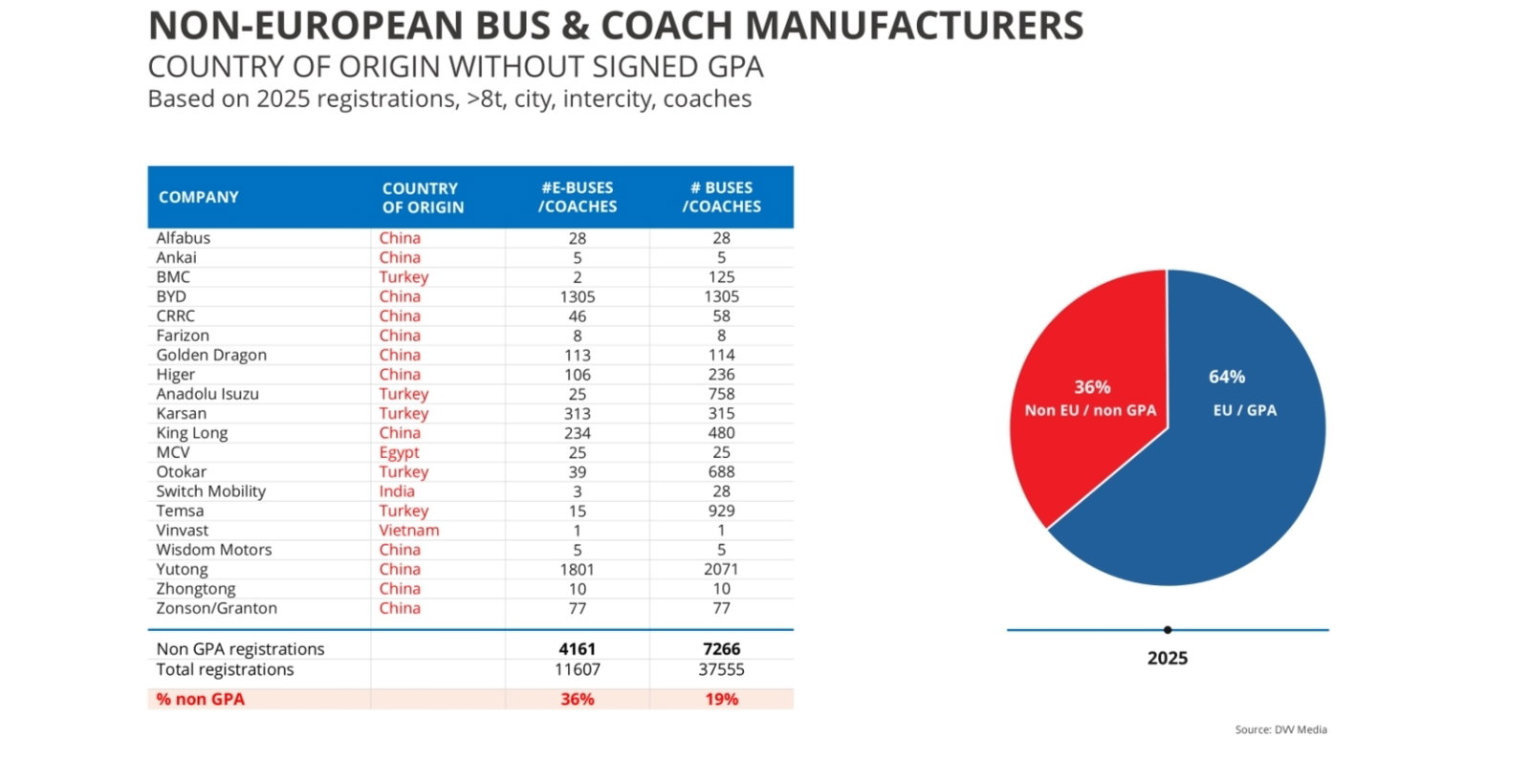
According to data published in the annex to the document, in 2025, 36 percent of city, interurban and coach vehicles over eight tonnes registered in Europe were linked to manufacturers from non-EU countries whose country of origin had not signed the GPA.
At least 50 percent European content
The white paper’s most concrete industrial-policy proposal is the introduction of a European local content requirement, or LCR. The basic concept is compared to the US Buy America rules, but would be tailored specifically to the characteristics of the European market.
Under the proposal, at least 50 percent of the value of a bus offered in public procurement would have to be generated in the EU or EFTA. The ratio would not be determined simply by the number of components or the location of final assembly, but would be based on the total production cost of the vehicle. It would include the bill of materials, manufacturing activity, engineering work carried out in Europe and the cost of research and development.
The 50 percent figure would also be only the entry-level minimum. During tender evaluation, higher verified European added value would earn additional points, meaning the larger the share of the vehicle made in Europe, the more favourable the bid’s position would be. The system would cover the entire value chain, from research and development and engineering through component sourcing and manufacturing to final assembly, including software developed in Europe.
Moreover, the three companies do not treat this as a long-term idea: they would introduce the local content requirement by 2028 at the latest, so that it can help preserve European jobs and industrial capabilities before they erode further. At the same time, they explicitly warn against an over-bureaucratic certification system.
For batteries, it would not only be the origin of the cells that matters
The question of European content is particularly interesting in the case of batteries. The white paper supports the development of a competitive European battery industry that could reduce the EU’s dependence on third countries, but the manufacturers argue that when defining European added value, it would not be advisable to look solely at the origin of the cells.
They would place greater emphasis on where the complete battery pack is made and integrated. Their argument is that significant added value is created beyond the cells themselves, in pack assembly, the cooling system, the battery management system and the related software. Under the proposed logic, a battery system developed and assembled in Europe using cells manufactured in Asia could therefore represent significant European value.
CO₂ tightening would be slowed for long-distance buses
One of the white paper’s most significant proposals, however, concerns not public procurement but EU climate regulation itself. According to Hess, Solaris and VDL, city buses and interurban and coach vehicles cannot be treated according to the same market logic.
In the urban segment, the electric transition accelerated well before CO₂ requirements took effect, and significant demand has emerged for zero-emission models. In the long-distance segment, however, demand for diesel vehicles remains substantial in some countries, while elsewhere demand for zero-emission buses is already growing quickly. European manufacturers therefore have to maintain and develop conventional and new drivetrains in parallel, while the development costs of electric intercity buses and coaches can initially be spread over only small production volumes. According to the white paper, this increases vehicle prices and further weakens the position of European manufacturers in price competition.
The three manufacturers are therefore calling for a review of the current 2030 requirement. They put forward two concrete options: postponing the 2030 target to 2033, or reducing the mandated 43 percent CO₂ reduction compared with the 2025 baseline to below 20 percent. They also identify reducing penalties linked to exceeding the target value as a possible tool.
At the same time, the document stresses that manufacturing zero-emission buses alone is not enough to decarbonise long-distance road passenger transport. Public charging and alternative-fuel infrastructure suitable for heavy-duty vehicles, depot charging facilities for coaches and appropriate electricity grid connections are also needed. According to the manufacturers, EU funding instruments are also required to build these out.
Vehicles from outside Europe are now also being treated as a security issue
The white paper also goes beyond classic industrial-policy arguments. It raises as a separate issue control over the data collected by modern buses. According to the document, concerns have been raised by cities, transport operators and government bodies regarding the data management of vehicles manufactured outside the EU and EFTA, especially when they originate from countries with which European states have no security-policy cooperation. Hess, Solaris and VDL therefore also link the issue to the resilience, security and strategic autonomy of European public transport.
Asian dominance has already emerged at the start of the coach market
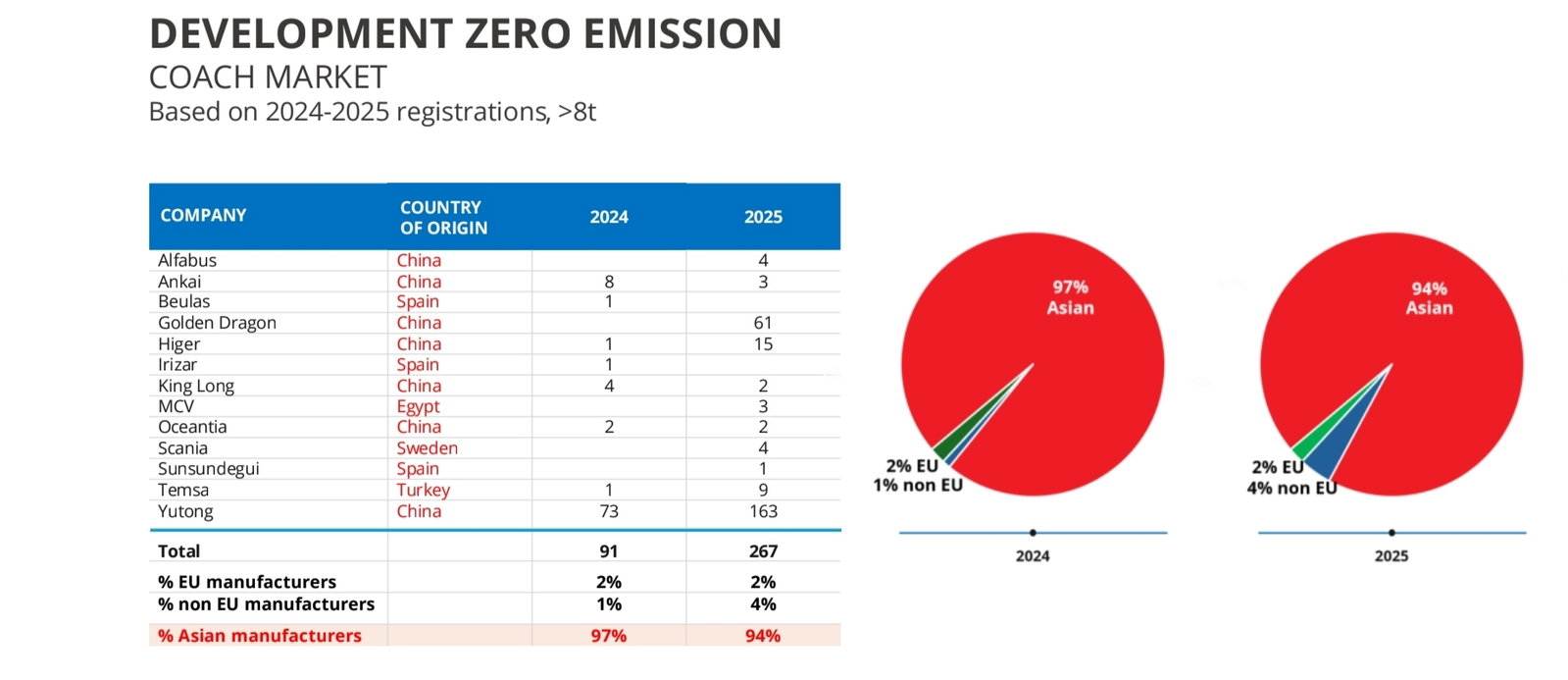
The document provides particularly noteworthy data on zero-emission coaches. This market is still small: according to the figures in the white paper, only 91 zero-emission coaches over eight tonnes were registered in the European market under review in 2024, and 267 in 2025. The manufacturer mix, however, is already heavily one-sided: Asian brands had a 97 percent share in 2024 and 94 percent in 2025.
Based on the 2025 data listed in the document, Yutong accounted for 163 vehicles, Golden Dragon for 61, Higer for 15, Ankai for 3 and King Long for 2, while among European manufacturers only Scania is credited with four vehicles. Hess, Solaris and VDL use this to illustrate that the zero-emission long-distance market is only just taking shape, but Asian players have already secured a dominant position in its initial phase.
Buses would also be included in the Industrial Accelerator Act
Finally, the white paper sets out a concrete expectation for the EU’s forthcoming Industrial Accelerator Act. The three manufacturers want the new industrial-policy framework not merely to encourage European production in general, but also to create specific advantages for bus and coach manufacturers, as well as for customers purchasing European products. Public-procurement preferences, tax incentives and various environmental and financial support measures could serve this purpose.
The package of proposals is therefore held together by a single idea: according to the three manufacturers, supporting Europe’s green transition is no longer sufficient in itself if an ever larger share of the related industrial value creation takes place outside Europe. Hess, Solaris and VDL want to ensure that public money spent on decarbonising EU transport also strengthens European research and development, manufacturing, supplier networks and jobs.
The white paper’s final conclusion is that this requires, at the same time, a more level playing field, public-procurement incentives for “Made in Europe” content, a competitive European battery industry, a review of CO₂ regulation for interurban buses and coaches, and industrial-policy tools that keep engineering know-how, development and manufacturing in Europe over the longer term. According to the three signatories, what is at stake is not merely the market share of European bus manufacturers, but the future of an industrial ecosystem representing 165,000 direct jobs and as many as another half a million related jobs.