![Magyarbusz [Info]](/mbi/header-logo.png)
Solaris accelerates growth with €1 billion in financial backing
 Ludányi József
Solaris Bus & Coach has significantly strengthened its financial base: the total bank financing available to the Polish bus manufacturer, wholly owned by Spain’s CAF, now reaches €1 billion. The facility, provided by an international banking consortium made up of seven financial institutions, consists of credit and guarantee lines and is intended to cover the company’s financing and guarantee needs for its strategic cycle through to 2030. The significance of the agreement is heightened by the fact that Solaris is currently carrying out a major capacity expansion, preparing its new zero-emission bus family designed specifically for interurban operations, while its expansion in North America is also gathering pace.
The new financing structure was introduced in June 2026. Alongside Poland’s state development bank, Bank Gospodarstwa Krajowego, the facility involves Erste Group Bank AG, HSBC Continental Europe, mBank, Bank Pekao, PKO Bank Polski and the Polish branch of Société Générale. mBank acts as ESG coordinator, Bank Pekao as security agent, and PKO Bank Polski as facility agent.
The financing does not represent a one-off €1 billion loan drawdown or capital injection. The framework consists of various credit and guarantee instruments from which Solaris can finance its operations and growth over the coming years according to its actual needs, as well as secure the bank guarantees required for the fulfilment of high-value vehicle procurement contracts. The current facility is an expansion of the previously established financing structure and, according to the company, provides the financial backing needed to implement its strategic objectives through to 2030.
Among other things, the facility will support further growth, the fulfilment of contracts already won and the development of the product portfolio. This is particularly important at a time when Solaris’ order book and revenues are both growing significantly. In 2025, the manufacturer delivered 1,631 vehicles, 7% more than in the previous year, while its revenues rose by 28% to €1.183 billion. Low- or zero-emission vehicles accounted for 86% of deliveries and generated more than 93% of annual sales revenue. Meanwhile, the value of new orders won in 2025, including related service contracts, reached €2.1 billion, while the number of vehicles contracted during the year hit a record 2,780. Solaris’ total order book still to be fulfilled stood at 2,748 vehicles at the end of 2025, with a value of €2.353 billion including related services.
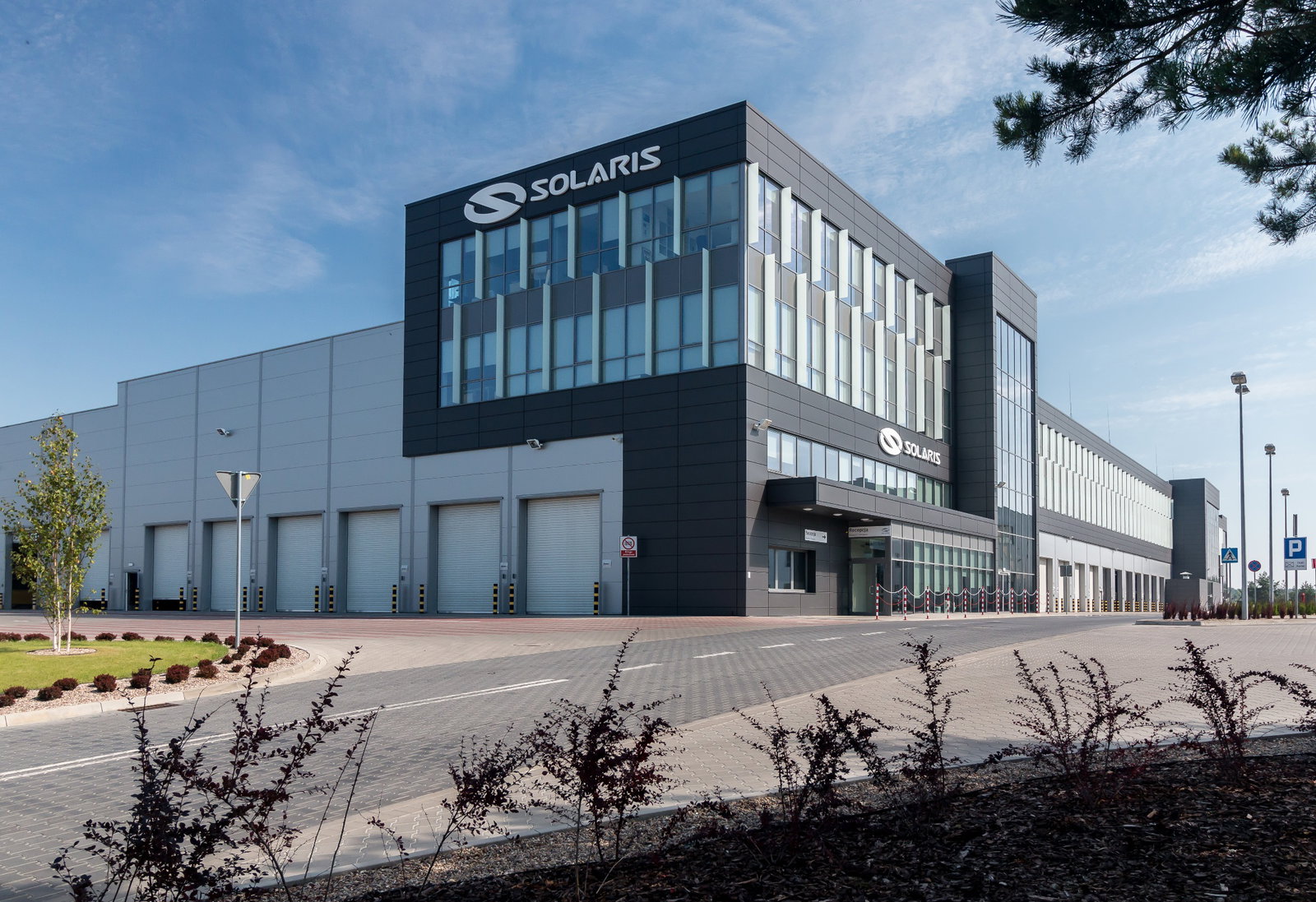
To support this growth, Solaris is already expanding its physical production capacity. In June, the company opened a new production hall of more than 7,000 square metres in the Środa Wielkopolska area, where final assembly of city buses has also begun. This stage of work had previously been carried out exclusively at the Bolechowo plant. The new facility increases the company’s production capacity by around 500 vehicles per year and represents an important step towards achieving Solaris’ target of producing and selling 2,000 buses annually.
One of the key development directions for the coming years is the interurban market. Although Solaris is already present in this segment with the Urbino 15 LE electric, the manufacturer intends to go much further. It is currently working on a new-generation zero-emission bus family designed from the outset for interurban duties. According to previously presented plans, the new product range will include 10.8-, 12- and 13-metre versions, in both low-entry and standard-floor intercity configurations. The platform is not being prepared exclusively for battery-electric drive: both fully electric and hydrogen fuel-cell versions are included in the development programme. With this, Solaris aims to extend the position it has built up in urban zero-emission technologies to regional and interurban transport as well.
The other major strategic direction leads beyond Europe. In recent years Solaris has begun its entry into the North American market, which in 2026 entered a new phase with actual vehicle deliveries and preparations for local production. The company intends to offer battery-electric buses, trolleybuses and hydrogen fuel-cell vehicles for the United States and Canada.
In the United States, the first customer was King County Metro, operating in the Seattle area, which ordered two 40-foot rigid and two 60-foot articulated electric buses. The agreement originally allowed for a further 12 vehicles to be called off, but part of the option was ultimately used by the San Francisco Municipal Transportation Agency (SFMTA): the Californian transit operator ordered three rigid and three articulated Solaris electric buses. As a result, the manufacturer’s first US reference project quickly expanded to two major West Coast transit agencies, while the number of Solaris electric buses contracted for the United States has risen to ten. The vehicles are not simply modified versions of the European Urbino, but are based on a new electric platform developed specifically to meet North American regulations and market requirements. The first 40-foot version will make its public debut in October 2026 at the APTA Expo trade fair in Chicago.
The company’s North American plans have meanwhile expanded to include local production. A key role in this could be played by the CAF Group’s plant in Elmira, New York State, which currently focuses primarily on assembling rail vehicles. Drawing on the existing infrastructure and industrial base, Solaris could establish its US assembly capacity there, which in the longer term is a fundamental condition for the manufacturer to participate meaningfully in US bus procurements financed from federal funds. In such projects, Buy America requirements demand significant US added value. The first vehicles for Seattle and San Francisco will still be built in Poland, as these contracts are not subject to the domestic content requirements that apply to federally funded projects. The development of capacity in Elmira is therefore no longer merely about fulfilling current orders, but about laying the foundations for Solaris’ long-term presence in the US market.
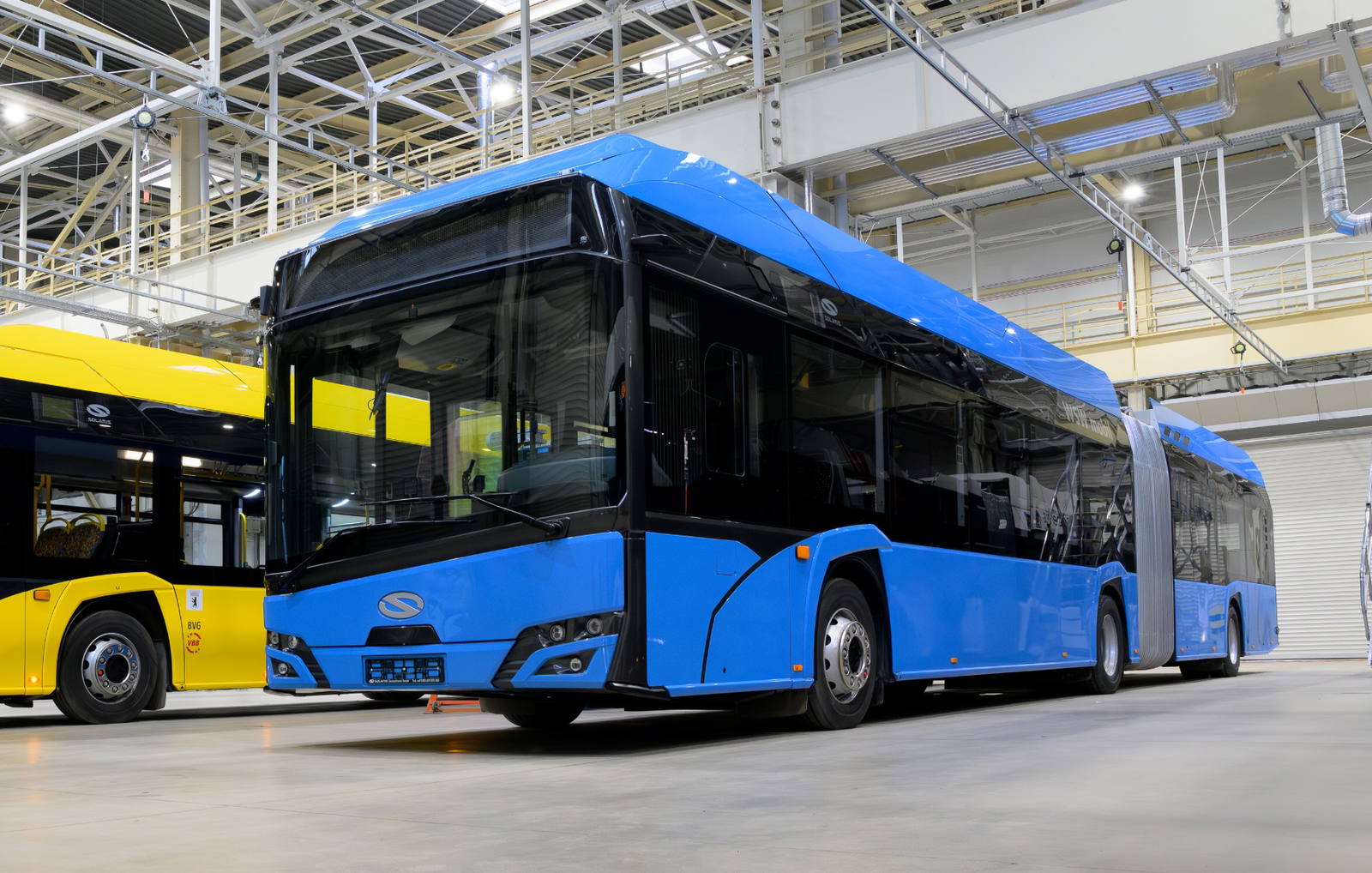
In Canada, Solaris has secured a much larger-volume contract. The framework agreement with Vancouver’s TransLink allows for the procurement of up to 512 trolleybuses in total, of which 275 vehicles have now been contracted: 183 12-metre rigid Trollinos and 92 articulated units. The first pre-series rigid vehicle is already in Vancouver and is undergoing road and operational testing on the local network; according to plans, it could enter service as early as September 2026. It will be followed by an articulated pre-series vehicle, while deliveries of series-production trolleybuses will begin in 2027. The new fleet, arriving by the end of the decade, is intended to fully replace the current 262-strong New Flyer trolleybus fleet. Unlike the new bus platform developed for the US market, the Canadian vehicles are based on the European Solaris Trollino and will be built entirely in Poland.
On this basis, the €1 billion bank facility is far more than a simple financial backing agreement. Solaris is simultaneously increasing its European production capacity, entering new vehicle categories, developing new zero-emission platforms and building up its North American presence. All this comes on top of fulfilling an order book that stands at a historic high. The credit and guarantee lines available until 2030 provide a predictable financial foundation for this growth trajectory, while the company’s objective remains unchanged: to further strengthen its position in the European zero-emission bus market and become an increasingly significant player beyond Europe as well.