![Magyarbusz [Info]](/mbi/header-logo.png)
Where next for the eCitaro? – Daimler’s electric bus on the verge of a generational change
 Ludányi József
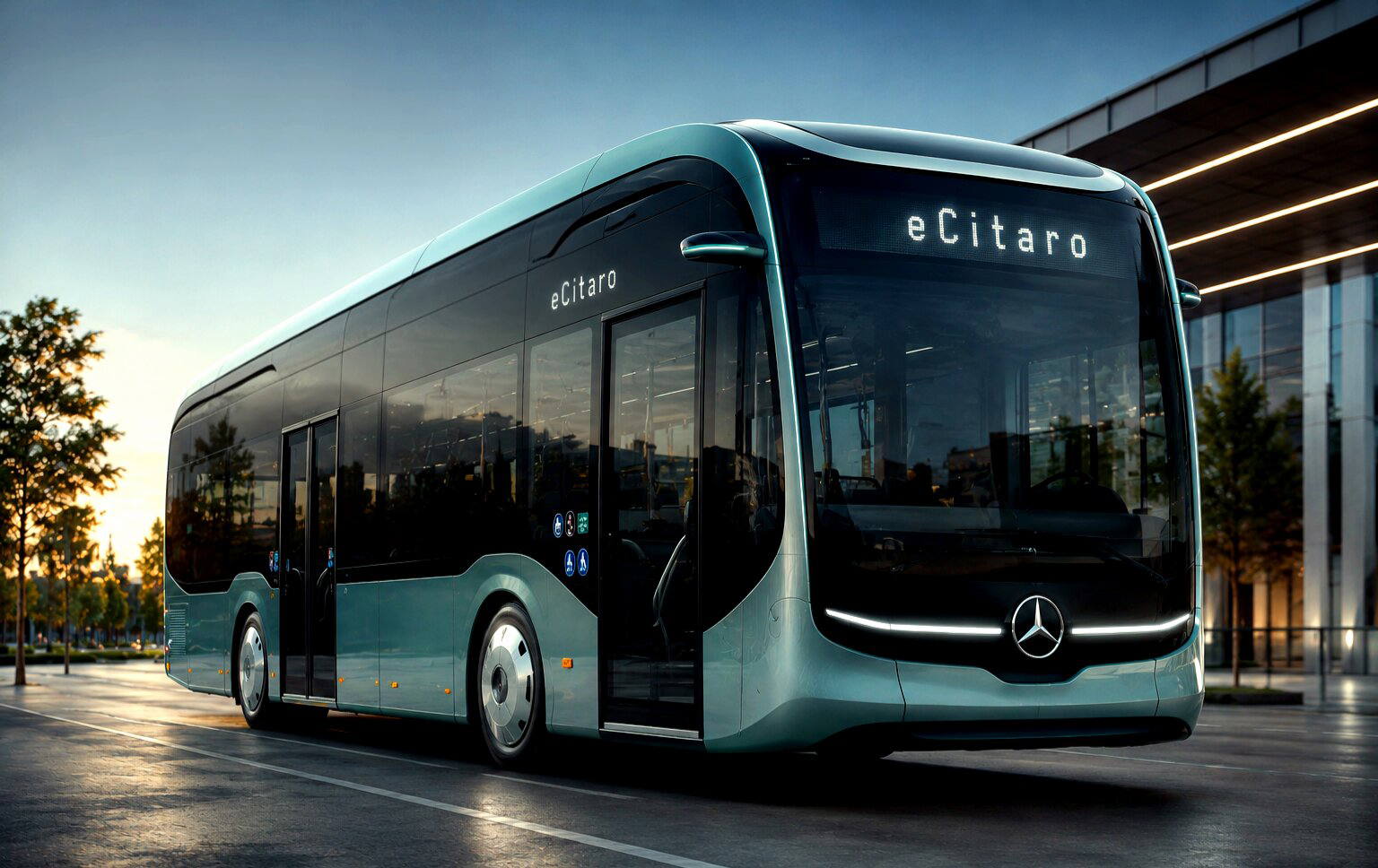
Eight years after the first eCitaro was unveiled, the question increasingly suggests itself: how much longer can a design that essentially traces its roots back to the Citaro C2 remain fundamentally unchanged, and when might the next generation of Mercedes-Benz’s electric city bus make its debut? The subject was recently also raised by omnibus.news: according to the German trade portal, industry circles are already hearing talk of a new eCitaro in development, which could appear sometime around 2027–2028. There has been no official announcement so far, and Daimler Buses is still actively developing the type as we know it today, so at most one can speculate about the exact form and technical content of its successor. For this reason, it is important to stress that the lead image of our article is not a leaked factory rendering or prototype, but solely our own illustration. This time, however, we are not trying to guess what may be hidden behind the closed doors of Daimler’s development centre. Instead, we are approaching the issue from another angle: looking at how the European electric bus market has changed around it, what technical solutions have become defining in recent years, and, on that basis, in which direction the eCitaro would be well advised to move during a genuine generational change.
Although the eCitaro itself is only eight years old this year, the underlying design actually looks back on a history of more than a decade and a half. This, of course, by no means suggests that Daimler Buses has not been continuously developing the type in recent years, but the more significant changes have primarily affected the electric driveline, energy storage and the auxiliary systems associated with them. From the outset, the eCitaro was based on the conventional Citaro, specifically starting from the version with a reinforced roof structure originally developed to accommodate compressed natural gas tanks. Daimler did not hide this at the time: it was a deliberate decision that, besides significantly reducing the costs and risks of developing an entirely new electric bus, also made it possible for diesel- and electric-powered Citaros to be integrated into the same production structure. What counted as a clearly rational solution in 2018, however, may be seen in a different light eight years later, since in the meantime not only battery technology and electric drives have advanced considerably, but the design philosophy of electric buses itself has also changed significantly.
In recent years, more and more European manufacturers have sought to free themselves from the design constraints resulting from the fact that their first electric buses were still developed from models originally engineered for an internal-combustion powertrain. A good example is Solaris, whose Urbino electric model likewise grew out of the conventional Urbino design, but in the newer generation the former engine tower – which remains in the eCitaro to this day – has been abandoned, while the batteries are placed on the roof wherever possible. MAN went even further: the Lion’s City E was developed from the outset with electric drive in mind, so the interior layout did not have to accommodate the space requirements of a diesel powertrain. Other manufacturers have chosen a different route, using battery packs partly integrated into the floor in an effort to improve weight distribution and lower the vehicle’s centre of gravity.
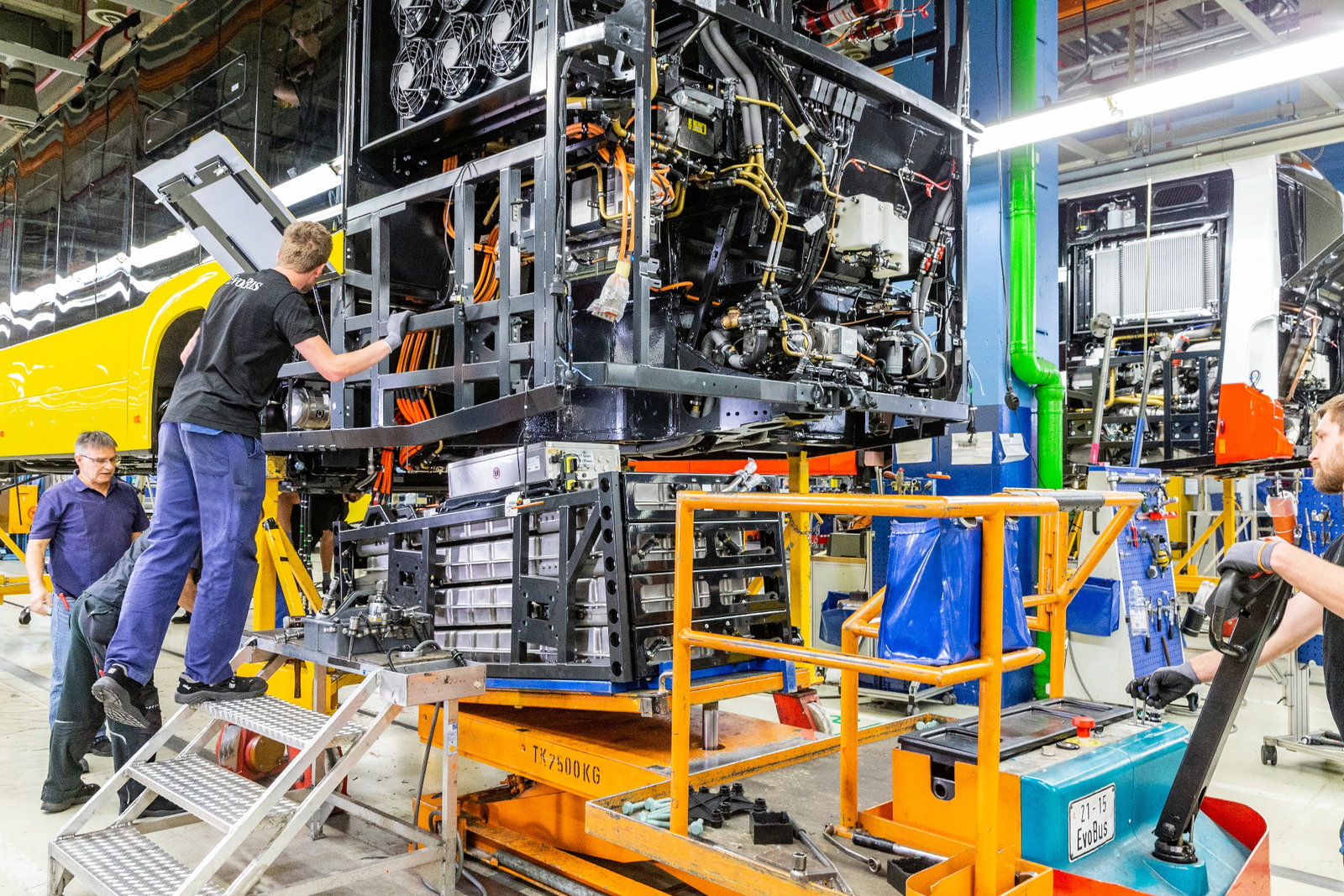
The rear section of the eCitaro clearly shows the design inherited from the conventional Citaro: above is the technical compartment created in the place of the former engine tower, while below it is the battery pack destined for that location, still before installation
At the same time, in designs optimised for electric drive, weight reduction has become a more important consideration than ever before. A battery pack weighing several tonnes represents a substantial additional load, while the permissible gross weight of a city bus is fixed: whatever the vehicle itself and its energy storage “use up” can ultimately come at the expense of the number of passengers that can be carried. Manufacturers are therefore now trying to save weight not only in the layout of the driveline, but also in the body structure itself. One way of doing this is the increasingly widespread use of lightweight composite materials. The roof superstructure of the MAN Lion’s City E, for example, is made of lightweight sandwich-structure composite elements, while VDL’s new-generation Citea already uses a composite design for the sidewalls as well. Such solutions could also become more valuable on a future eCitaro, since greater battery capacity in itself is less and less of an advance if its mass limits the vehicle’s usable payload.
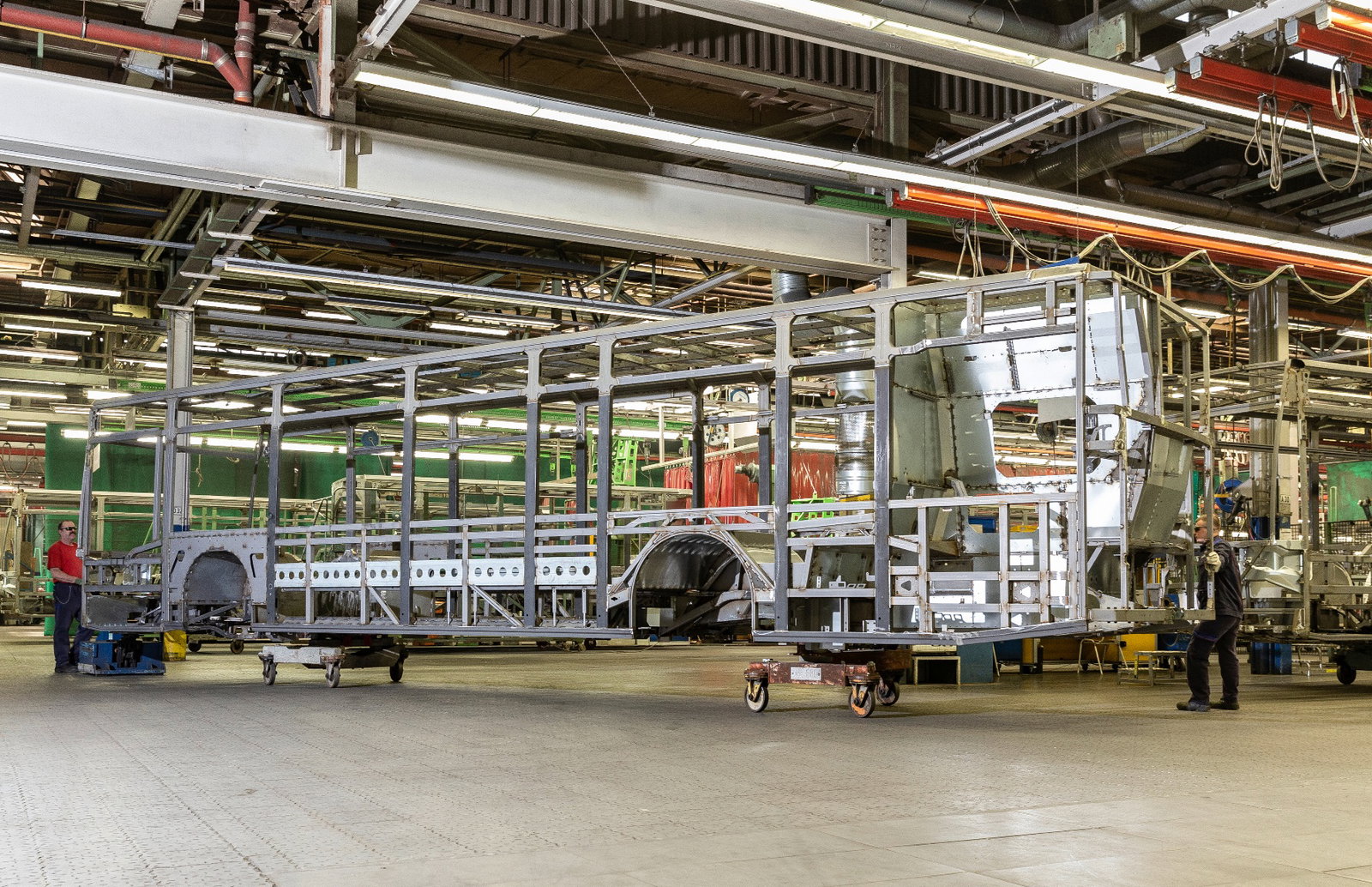
The eCitaro’s steel frame during production: the current design still essentially carries over the body structure of the conventional Citaro, without substantial structural weight reduction based on the use of lightweight materials
If Daimler can indeed start with a clean sheet in developing the next generation of the eCitaro, one of the most important questions may be how it distributes the batteries within the vehicle. In this respect, the current type still clearly shows the limitations of its origins: a significant proportion of the energy storage units are mounted on the roof, while the space of the rear engine tower is also occupied by battery modules. In a design conceived from the outset for electric drive, this would not necessarily be required, allowing the rear of the vehicle to be freed up, improving the usability of the passenger compartment, while battery placement could be determined much more by favourable weight distribution. This does not necessarily mean that Daimler would have to move the batteries under the floor. Roof-mounted energy storage units are more easily accessible, which can also be advantageous in terms of maintenance and possible module replacement, while batteries built into the floor impose quite different structural and crash-protection requirements on the body. A new platform, however, would make it possible for the location of the batteries no longer to be dictated by the remaining free spaces of a pre-existing design.
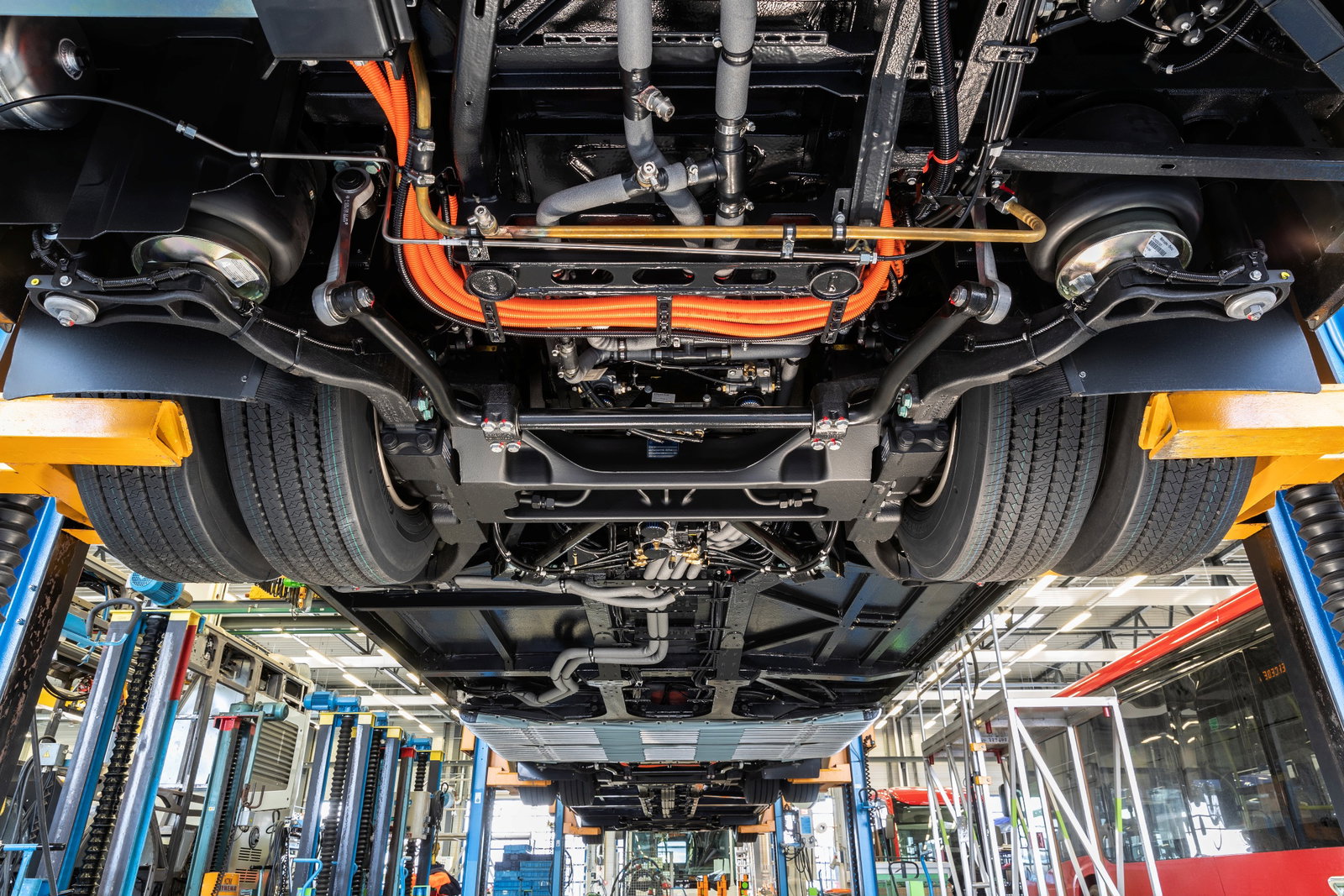
The eCitaro’s driven axle viewed from below: one characteristic of the design using electric motors positioned close to the wheel hubs is its higher unsprung mass; reducing this is important because with lower unsprung mass the wheels can follow road irregularities more easily, which has a positive effect on roadholding, ride comfort and the load on the running gear as well
The drive system itself will be a similarly important question. The current eCitaro uses ZF’s AVE 130 electric portal axle, meaning the drive is based on electric motors located close to the wheel hubs. For a new generation, however, Daimler could choose from a much wider range of options. In recent years, central-motor electric drives have spread rapidly; these can offer not only lower weight and better efficiency, but also a simpler layout and potentially easier maintenance. Central electric motors are less exposed to environmental effects from the road, and compared with wheel-hub motor solutions they also make it possible to reduce unsprung mass. It is also far from insignificant that some operators specifically prefer these more conventional drive layouts, so market requirements may also steer Daimler in this direction when developing a new eCitaro.
Alongside design considerations, the transformation of the production background may also create greater room for manoeuvre for a new eCitaro. Daimler still builds Citaros with different drivelines within a shared production system – in addition to Mannheim, eCitaros have also been assembled at Ligny-en-Barrois in France since 2024 – but the weight of electric drive within production has increased noticeably. Mannheim remains the central competence centre for Mercedes-Benz city buses, but the plant was already reconfigured by 2024 so that, if necessary, it would be capable of producing electric city buses only. As a result, the design constraint that was still a major advantage when the first eCitaro was created is gradually losing its importance: that the diesel and electric versions should be built with as many common structural elements as possible, in the same production system. For a next generation, this could therefore open up much greater freedom to build the vehicle structure from the outset around the requirements of electric drive.
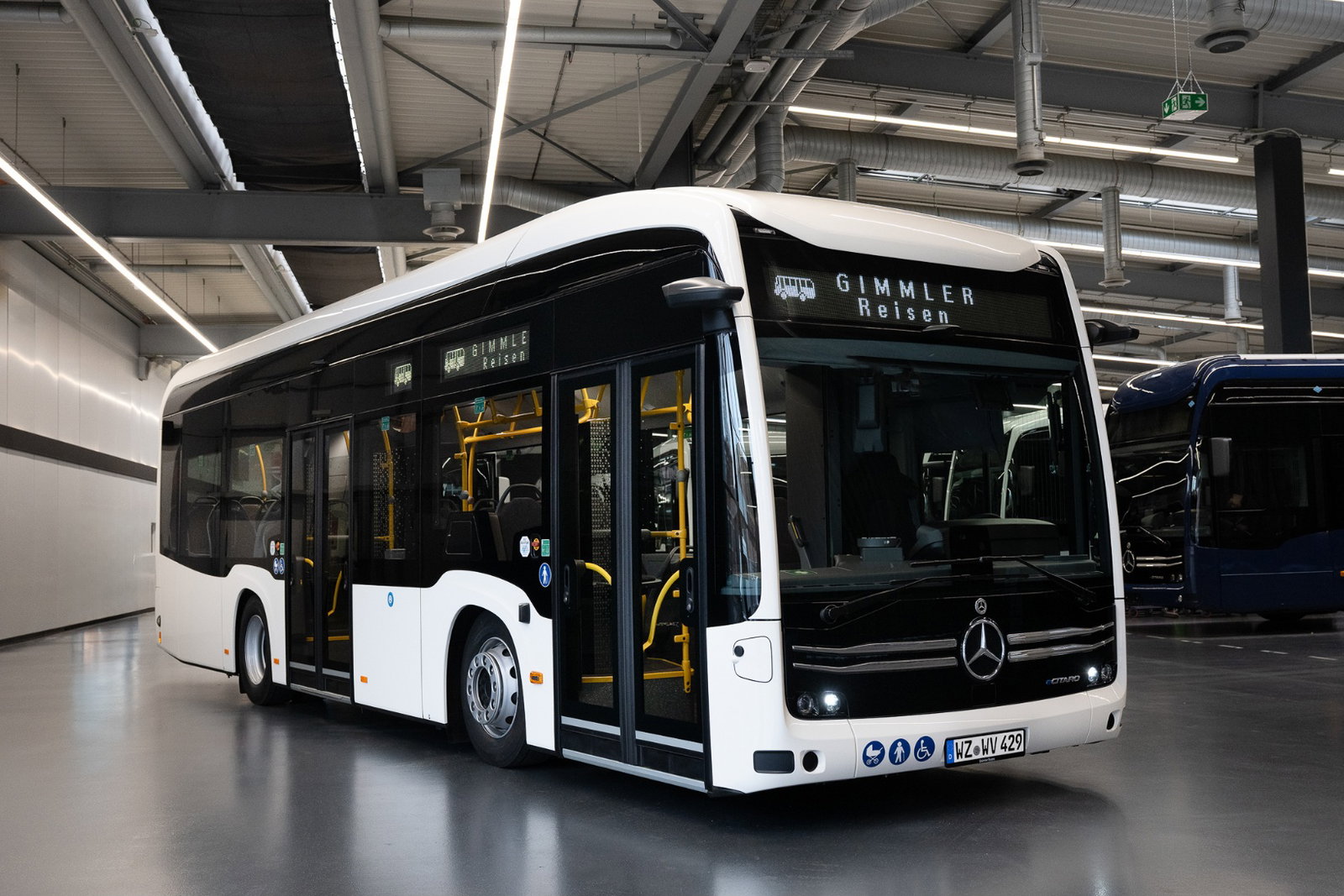
For the time being, then, little is known about the next generation of the eCitaro: Daimler Buses has not yet officially announced a successor, and beyond the fact that industry circles are already hearing of a new model in development, there is no firm information about its technical content either. By bus-industry standards, however, the current eCitaro is slowly approaching the end of its life cycle, while the technical and production changes detailed above make it less and less justifiable to retain the foundations laid down a decade and a half ago. Daimler’s engineers therefore most likely have the task before them: to replace the Citaro based on a design from the early 2010s, which has since been continuously adapted to the requirements of the electric era, with a new generation conceived from the outset for the needs of electric urban transport in the next decade.
The lead image is an illustration.