![Magyarbusz [Info]](/mbi/header-logo.png)
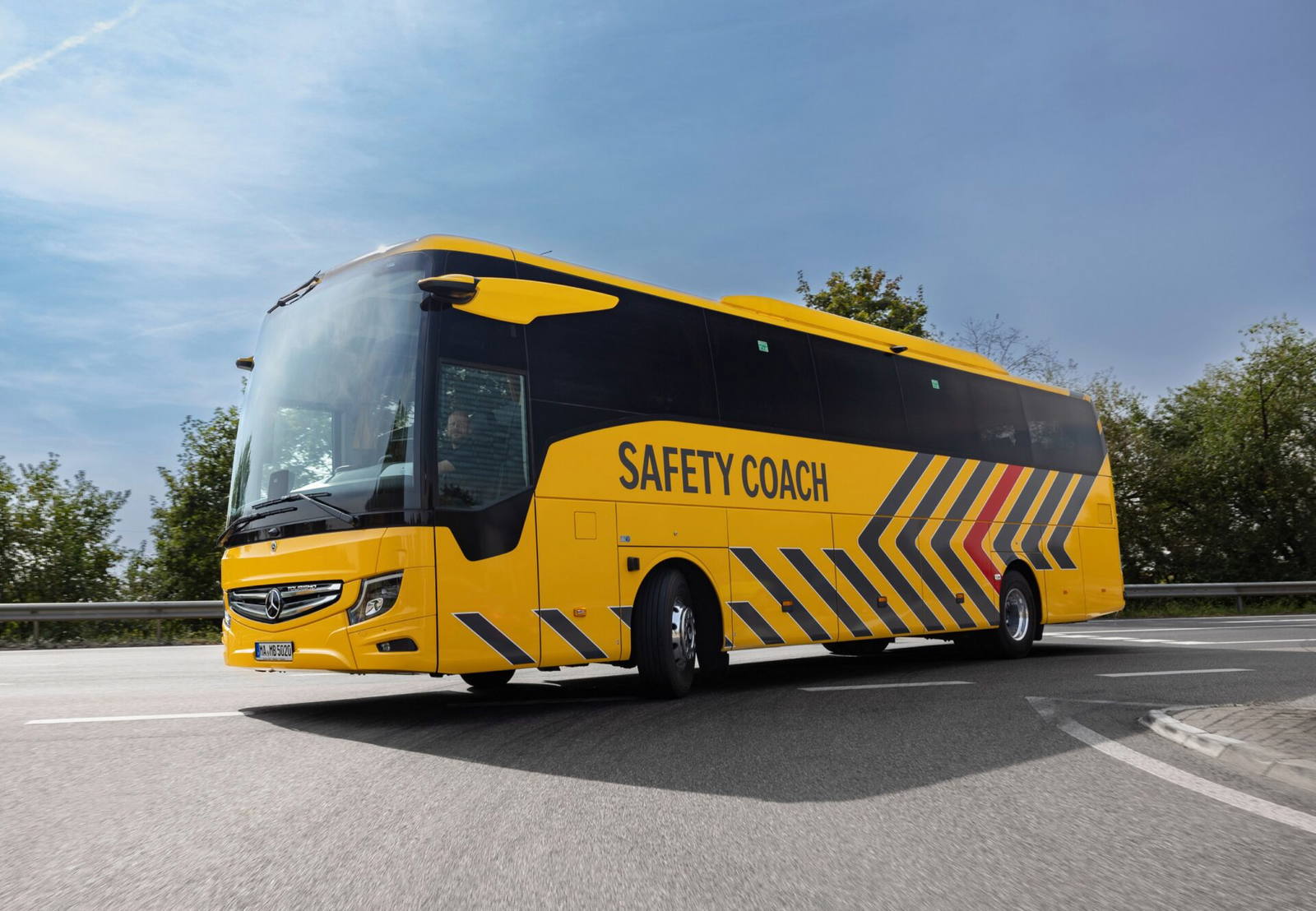
Technology can intervene, but it cannot rewrite physics – how a modern coach protects its passengers
 Ludányi József
Sunday’s serious bus accident on the M3 motorway has once again brutally focused attention on a question that usually only comes to the fore after a tragedy: how much can the vehicle itself do to prevent human error from turning into a mass-casualty disaster?
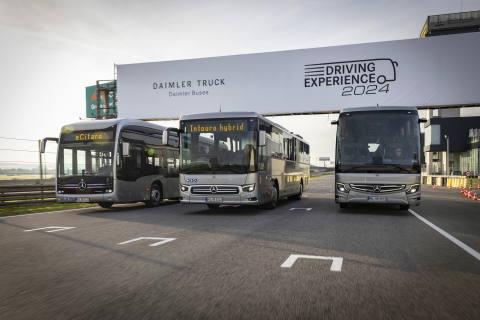
The question is especially timely at a period when bus safety systems are developing at an almost unimaginable pace. In today’s Mercedes-Benz and Setra coaches, it is no longer a single electronic guardian angel working alongside the driver, but an entire array of active and passive safety systems built on one another. Their task is first to detect a hazardous situation, then, where possible, to avoid the accident, and finally – if the collision is already unavoidable – to mitigate its consequences.
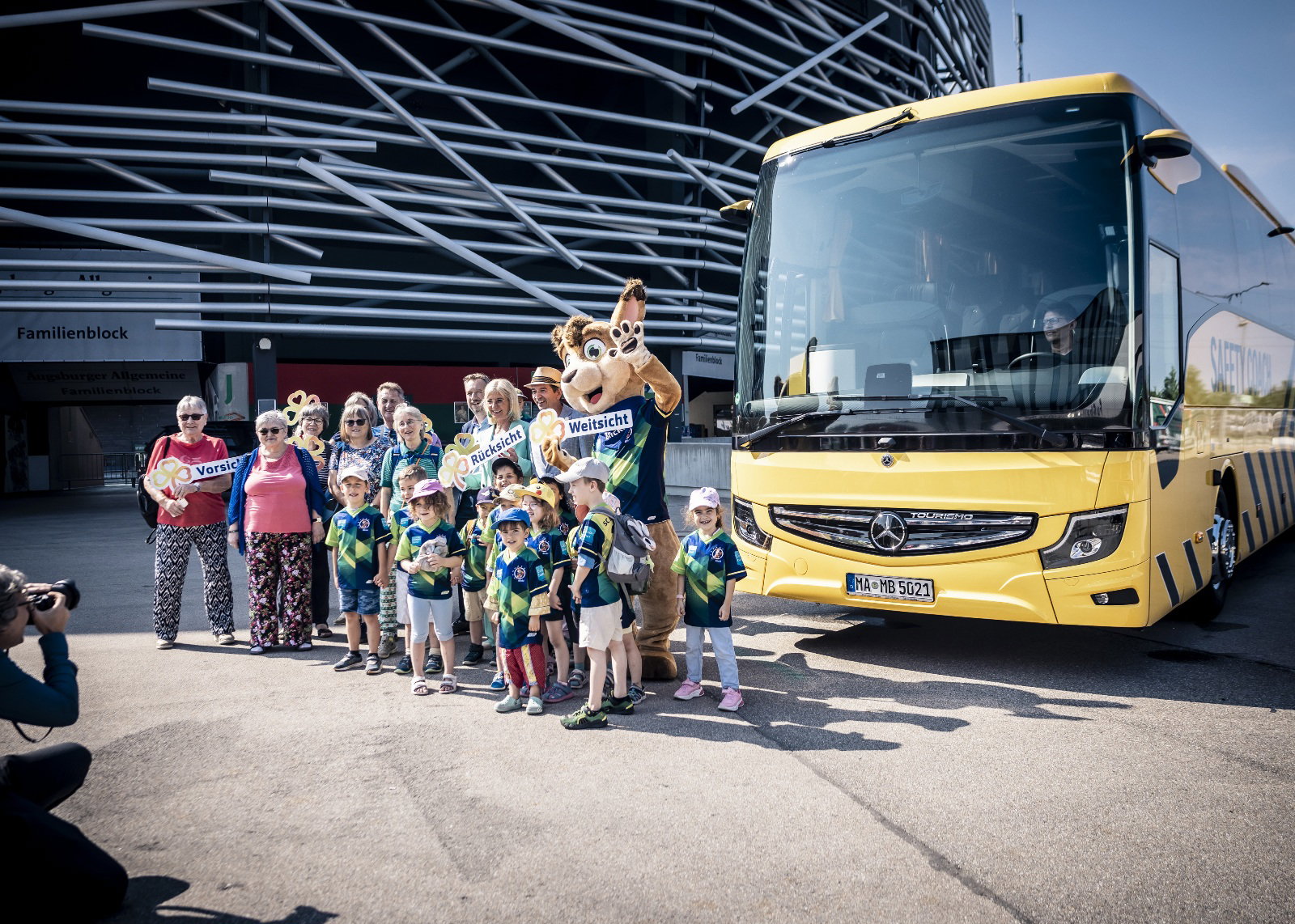
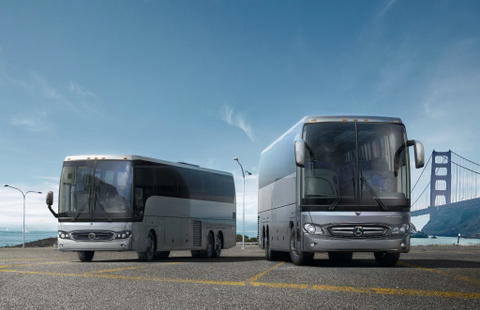
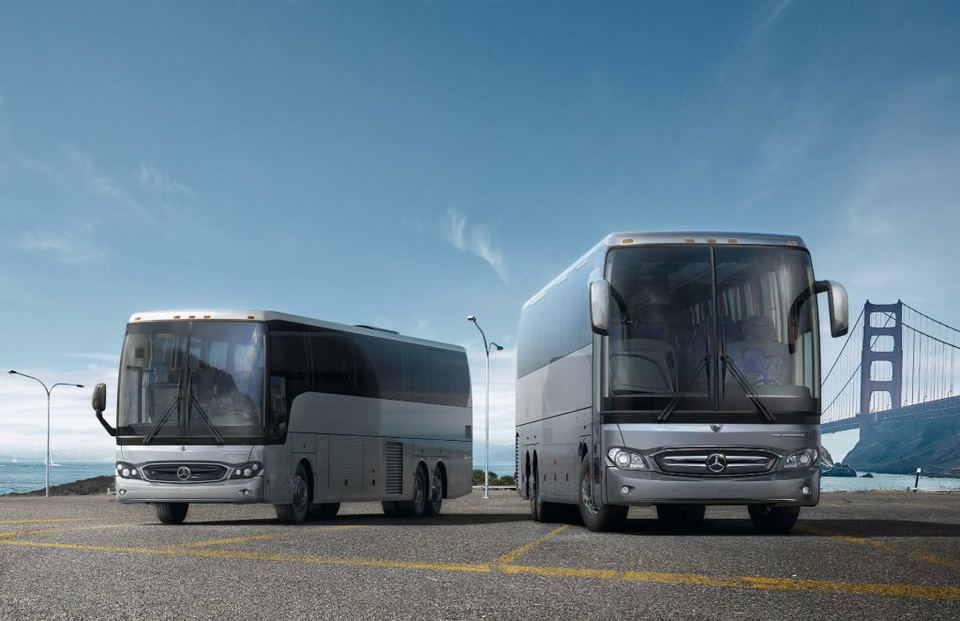
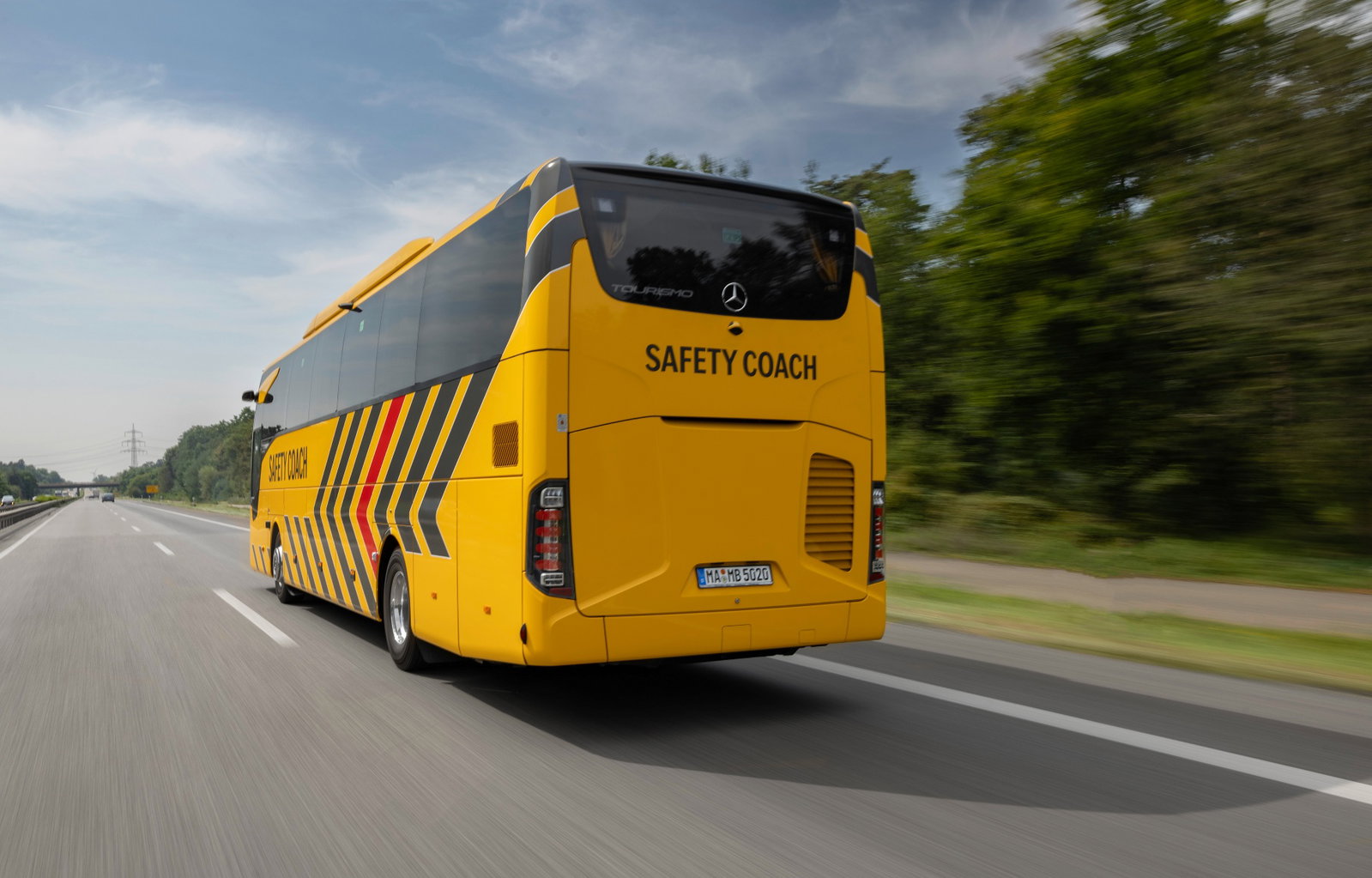
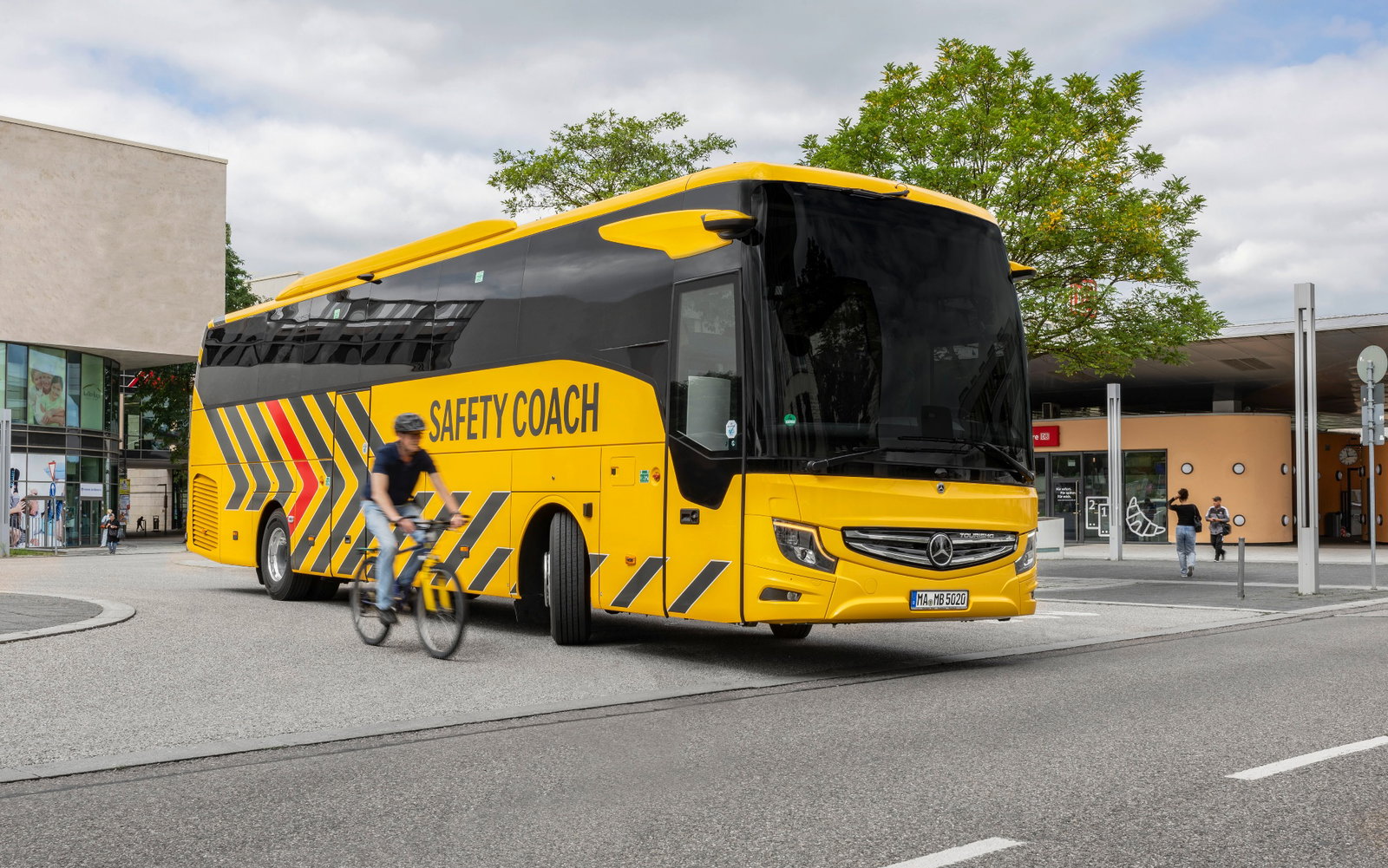
This is precisely the approach demonstrated by Daimler Buses’ Safety Coach demonstrator vehicle, based on the Mercedes-Benz Tourismo. The manufacturer put the model back in the spotlight in August, this time as part of the German “Deutschland blickt’s” initiative aimed at improving children’s road safety. But the eye-catching demonstration coach is far more than a simple awareness-raising tool: in essence, it shows how far the bus industry has come in preventing accidents and reducing their consequences.
The first objective: prevent the accident from happening at all
The most important change in modern safety philosophy is that, wherever possible, the vehicle should intervene before a driver error results in an accident. One of the key elements of this is Mercedes-Benz Active Brake Assist 6, and its further developed ABA 6 Plus version. Using radar and a camera, the system continuously monitors the area in front of the vehicle, detects obstacles and, under certain circumstances, can initiate automatic emergency braking. Under suitable conditions, ABA 6 may be able to prevent a collision with a stationary vehicle or a vehicle ahead at speeds of up to 90 km/h, while at higher speeds it can reduce the severity of the impact. But this is only one line of defence.
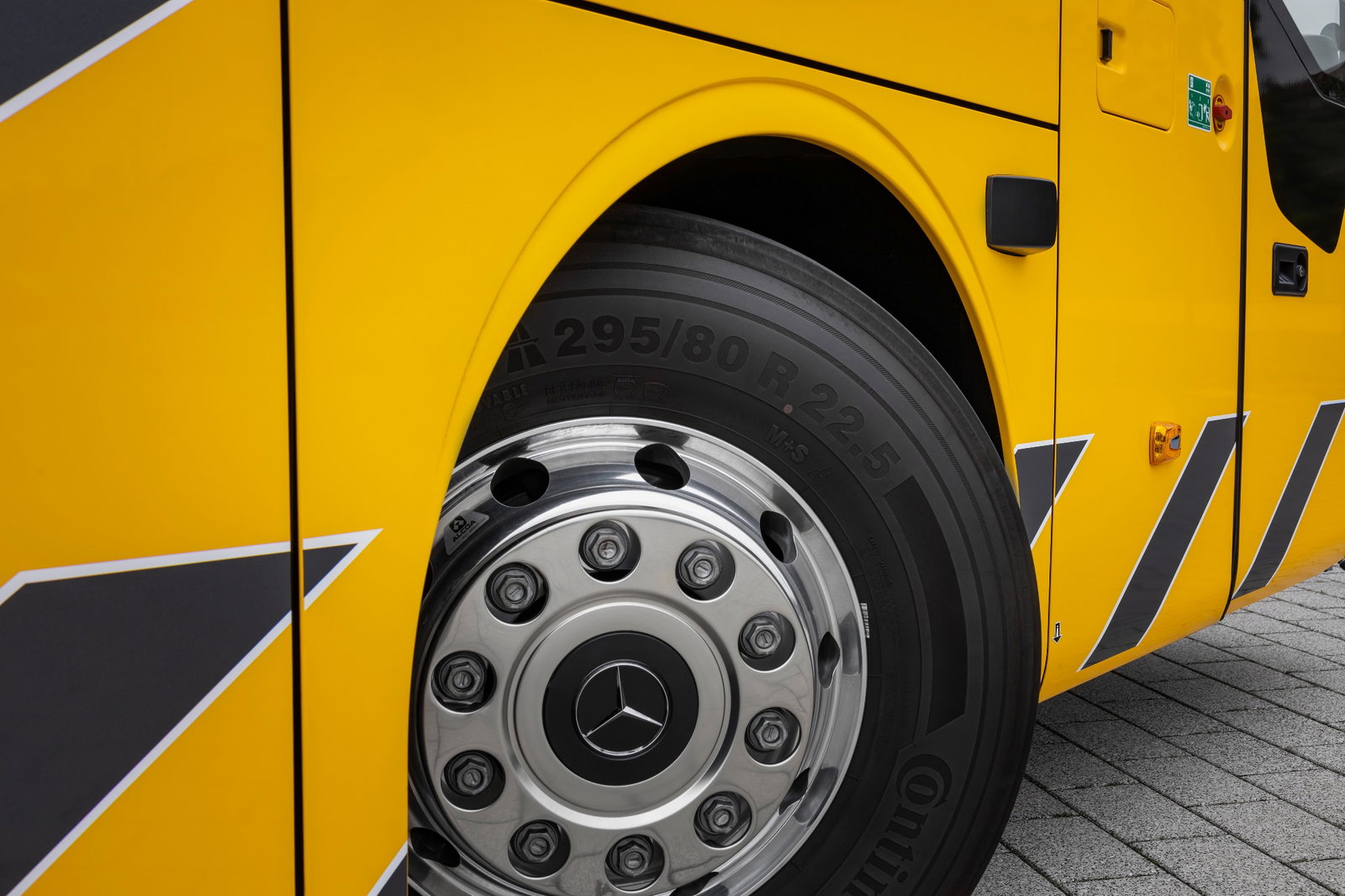
Sideguard Assist 2 monitors hazardous situations developing along the side of the bus, Frontguard Assist primarily looks out for pedestrians and cyclists directly in front of the vehicle when setting off, Traffic Sign Assist monitors speed limits, and MirrorCam uses cameras instead of conventional exterior rear-view mirrors to give the driver a better overview.
But what happens if the driver becomes the risk?
One particularly sensitive safety issue for coaches is fatigue and distraction. On a journey of several hundred kilometres, often extending into the night, the driver is exposed to a very different level of strain than on a short urban service. Driver alertness monitoring systems provide a technical response to this risk, attempting to recognise when the driver’s attention is waning, when they are becoming tired, or when their driving behaviour deviates from the norm. Daimler Buses’ system is Attention Assist, which in its earlier versions sought to identify patterns indicating fatigue or loss of attention from steering inputs, braking events and other driving parameters, among other things. For 2026, the manufacturer has further developed this into the camera-based Attention Assist 2, which is now also designed to directly detect the driver’s attentiveness. Alertness and attention monitoring is no longer merely an added safety feature offered by manufacturers: since 7 July 2024, the use of such systems has been mandatory in the European Union for all newly registered buses under the requirements of the General Safety Regulation, or GSR. The same regulatory package also includes, among other things, the mandatory use of systems warning of vulnerable road users in blind spots and a lane departure warning function.
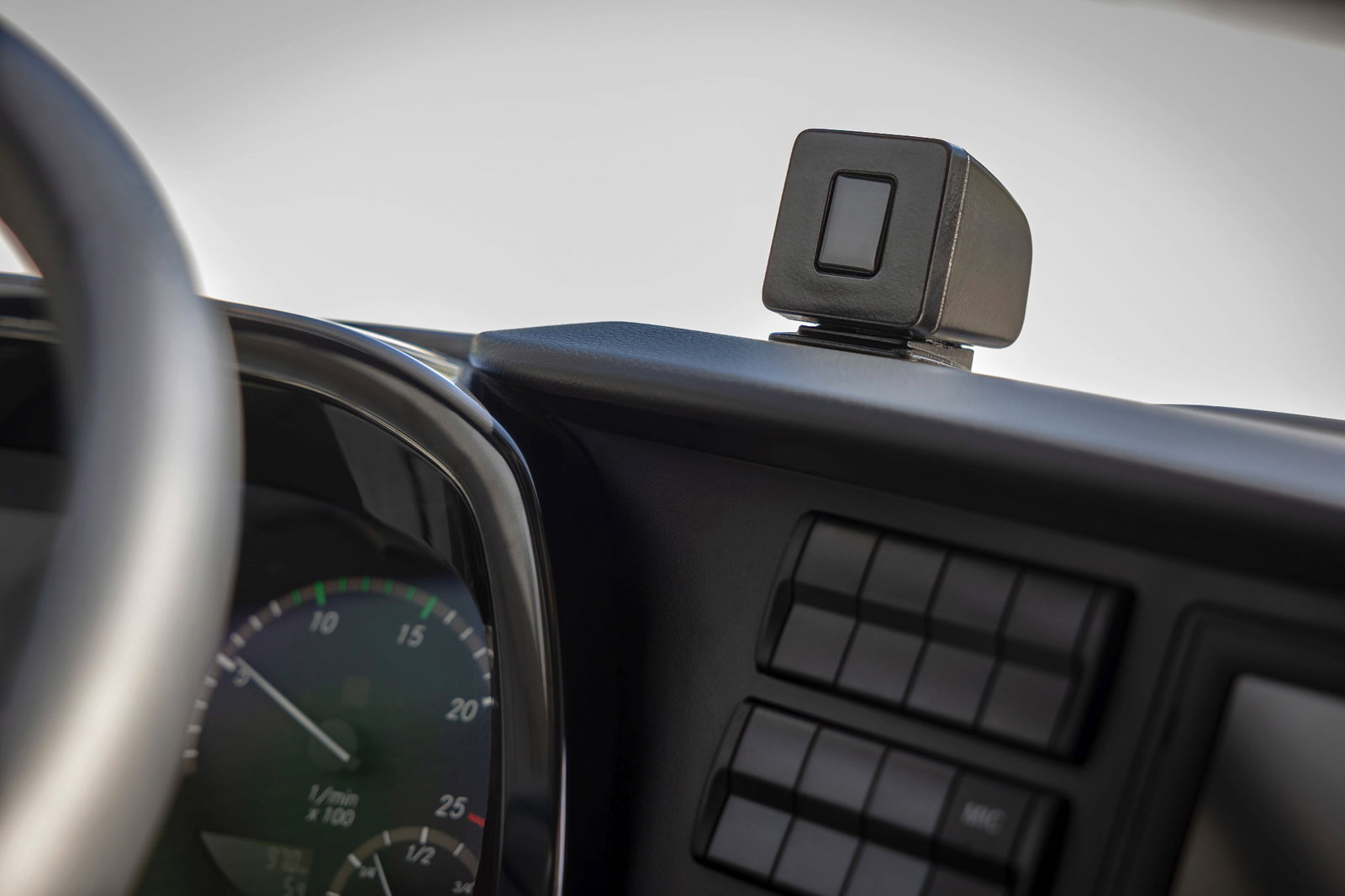
Continuous monitoring of the driver’s attentiveness therefore goes far beyond a simple comfort function. In the case of a coach weighing several dozen tonnes and carrying more than fifty people, the vehicle can cover an enormous distance in just a few seconds of lost attention. At 100 km/h, it travels almost 28 metres in a single second, and nearly 140 metres in five seconds.
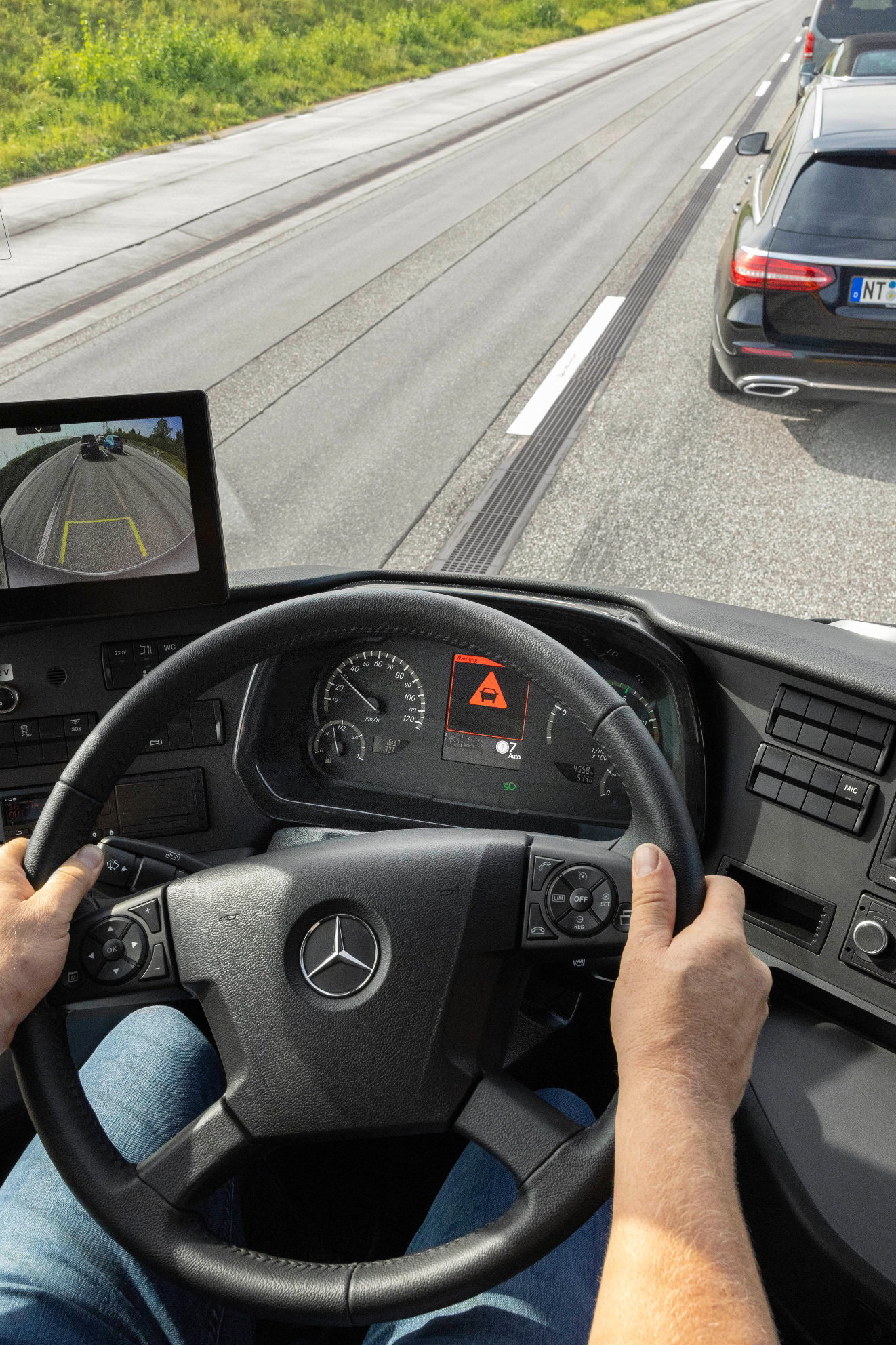
The aim of the technology is therefore increasingly not merely to warn the driver of something they may not have noticed. A modern safety system must also recognise if the driver themselves is unable to respond appropriately. Active Drive Assist 2 (ADA 2), available for Mercedes-Benz and Setra coaches, brings together several driver assistance functions, including adaptive cruise control, lane keeping assistance and alertness monitoring. Using the radar and camera sensor systems of ABA 6 as well, it can intervene in both the longitudinal and lateral control of the vehicle: it accelerates, brakes, maintains following distance and keeps the bus in its lane through active steering.
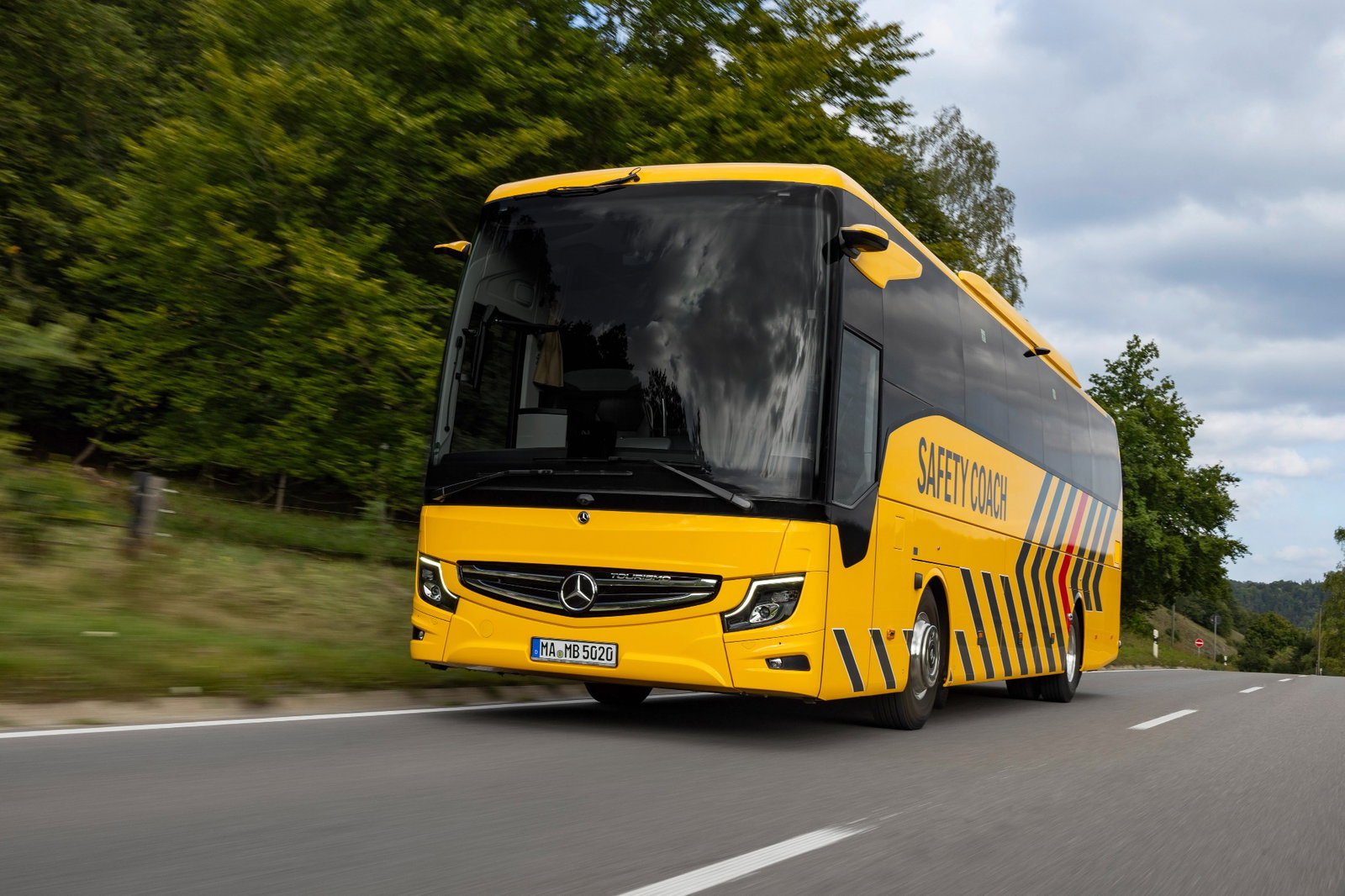
If the alertness monitoring system detects sustained driver inactivity, it first warns the driver in several stages. If there is still no appropriate response, ADA 2 takes over control of the vehicle and begins an emergency stop: keeping the bus in its lane, it brakes it to a standstill in a controlled manner, warns surrounding traffic in the process, and then activates the electronic parking brake once the vehicle has stopped.
At the same time, all this also clearly shows the limits of the technology. The system must first detect the driver’s sustained inactivity, attempt to elicit a response through warnings, and only then can automatic stopping begin. At motorway speeds, every second means several dozen metres. Electronics can therefore be an extremely important line of defence, but they cannot perform miracles either: recognising the danger and intervening takes time, and stopping the vehicle takes distance.
If even the electronics cannot avoid the collision
The second major area of safety is passive protection. One of the most interesting solutions on the Mercedes-Benz Safety Coach is the Front Collision Guard, or FCG. Its first element is a transverse structure which, in the event of a frontal collision, is intended, among other things, to prevent a passenger car from underrunning the coach. This is also a noteworthy solution because UN ECE Regulation No. 93, which governs front underrun protection, applies to N2 and N3 category goods vehicles, not to M2 and M3 category buses. In other words, in Mercedes’ case this is not simply a matter of meeting a mandatory underrun-protection requirement prescribed for buses. Behind the transverse element of the FCG are energy-absorbing structures that dissipate part of the collision energy through controlled deformation.
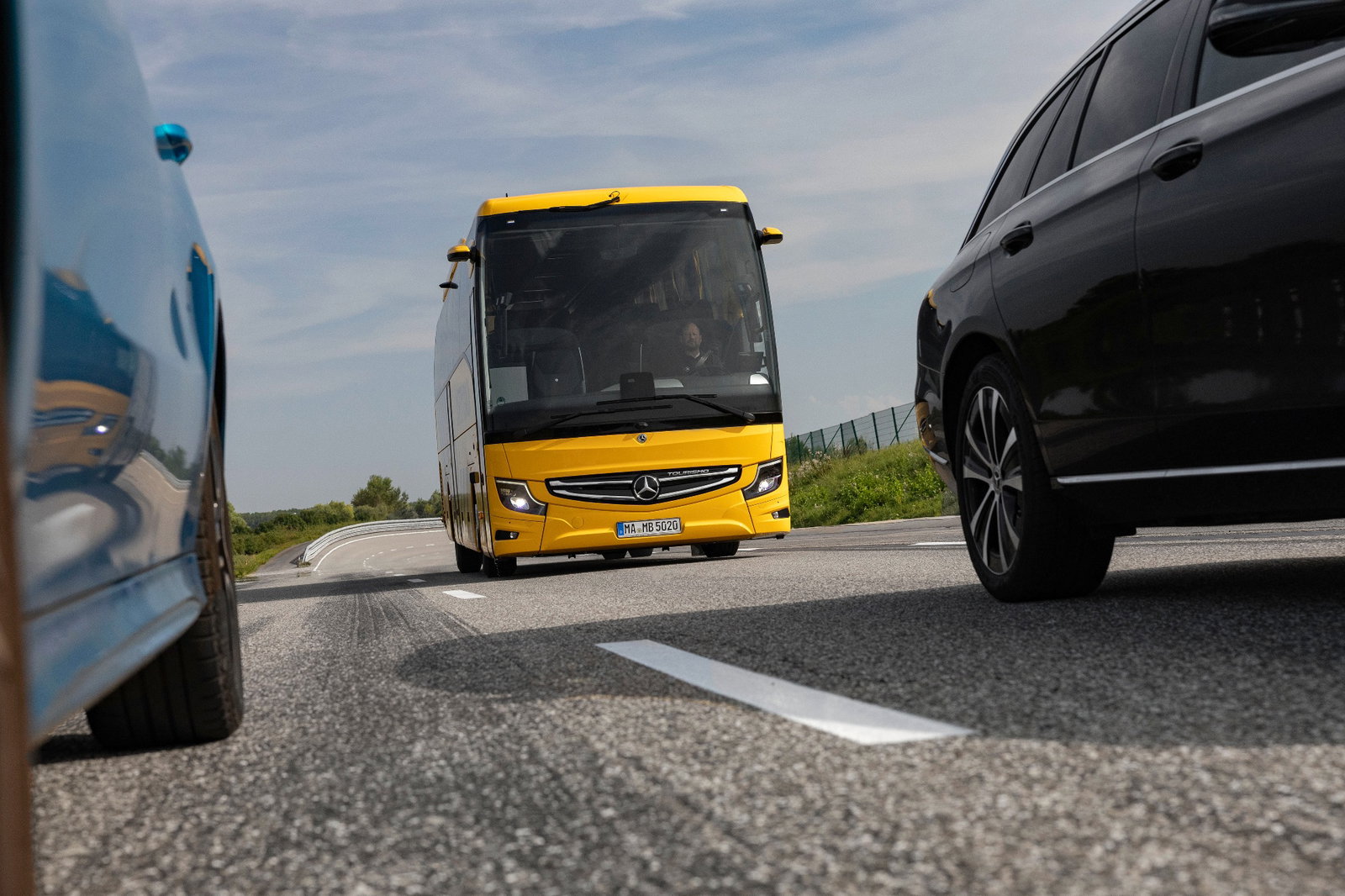
But the system goes further than this. The driver’s workplace – together with the steering wheel, pedals and seat – is built on a robust structural unit that can move rearwards in a severe frontal collision. This can increase the survival space available to the driver by valuable centimetres. In other words, the same basic principle appears here that we already take for granted in passenger cars: if a collision cannot be avoided, then the way the vehicle deforms must be controlled.
In a rollover, however, an entirely different world begins
One of the most serious accident scenarios for coaches is a rollover. Because of their height, high mass and the size of the passenger compartment, extremely large forces can arise in such situations. One of the fundamental tasks of body structure rollover safety is therefore not to ensure that the body does not deform at all – that would be an unrealistic expectation in a serious accident – but to ensure that, despite deformation, the defined survival space for passengers is maintained.
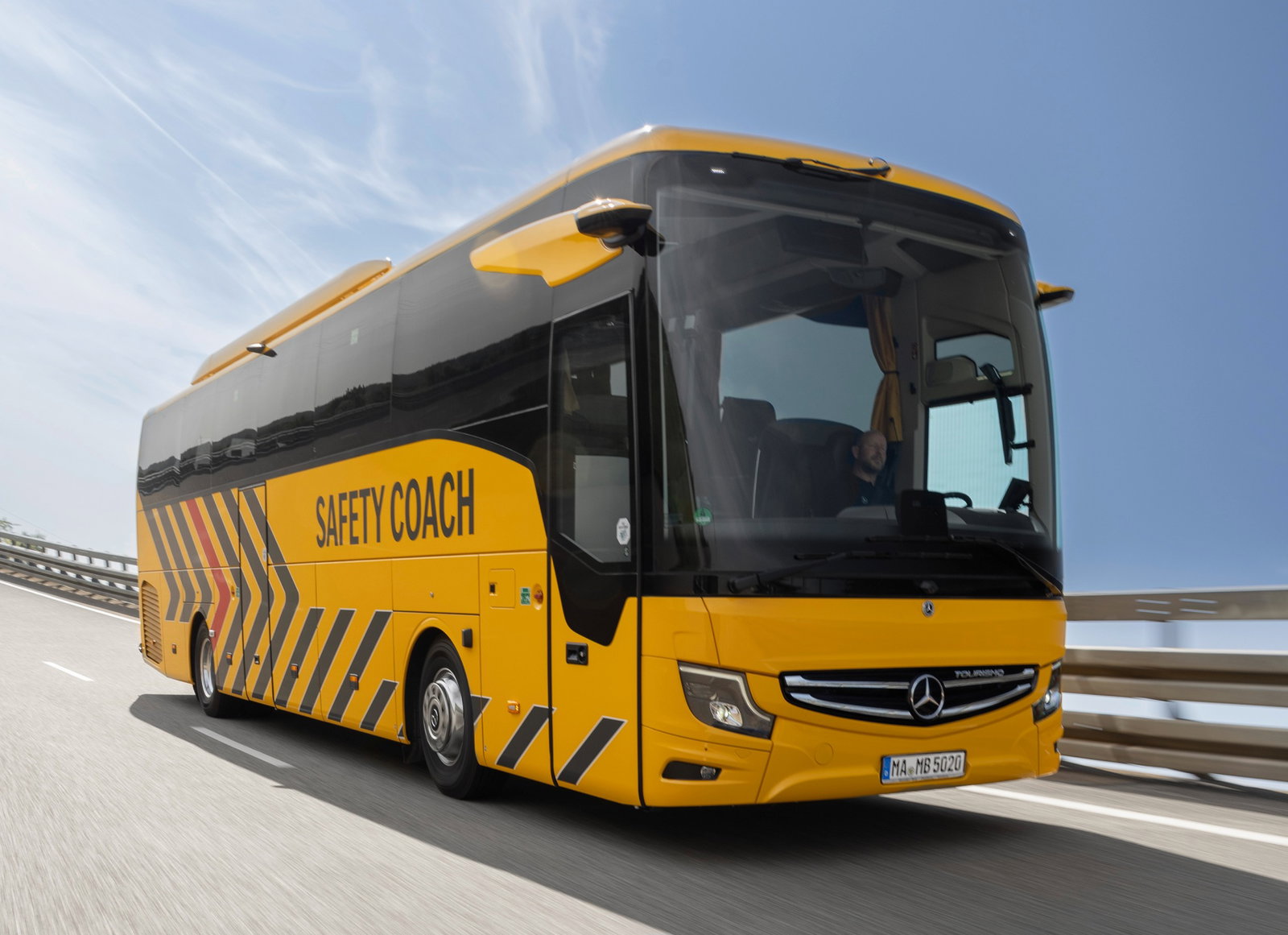
This is also regulated by UN ECE Regulation No. 66, which sets out requirements for the strength of the superstructure of M2 and M3 category buses, above all for the so-called survival or residual space that must be preserved during a rollover. The essence of the test is therefore not that the vehicle should remain undamaged after a rollover, but to demonstrate that no part of the deforming superstructure intrudes into the survival space geometrically defined in the regulation, and that this space itself does not extend beyond the outline of the deformed body.
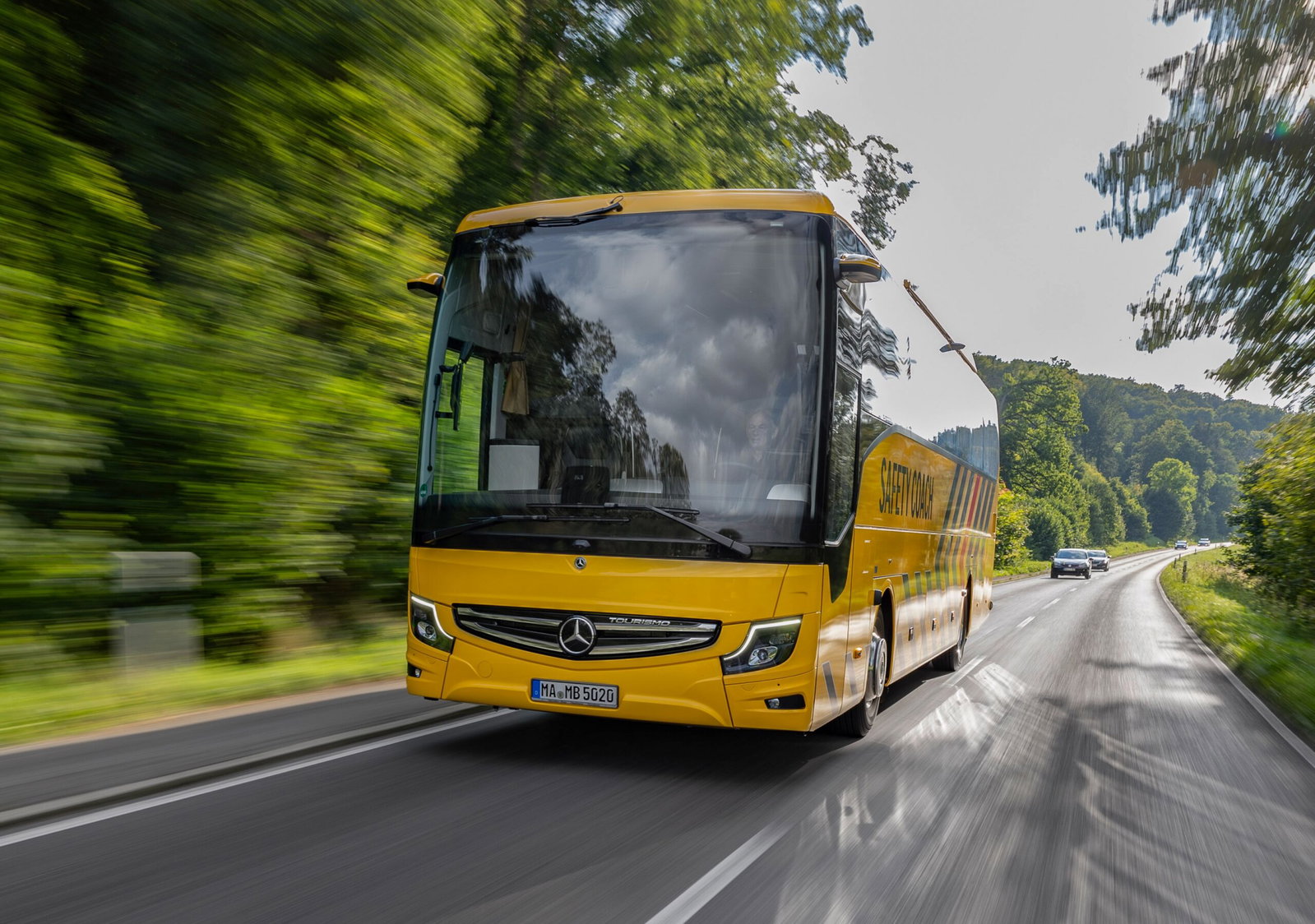
The current Tourismo generation is designed to comply with the stricter UN ECE R66.02 version of the regulation. One important change is that passenger mass must now also be taken into account during the rollover test: for seats fitted with seat belts, a defined portion of the passengers’ mass must be added to the vehicle’s test mass. This increases the energy acting on the superstructure during a rollover, meaning the body must ensure that the prescribed survival space is maintained under greater loads. To meet this requirement, the Tourismo uses a high-strength ring-frame structure.
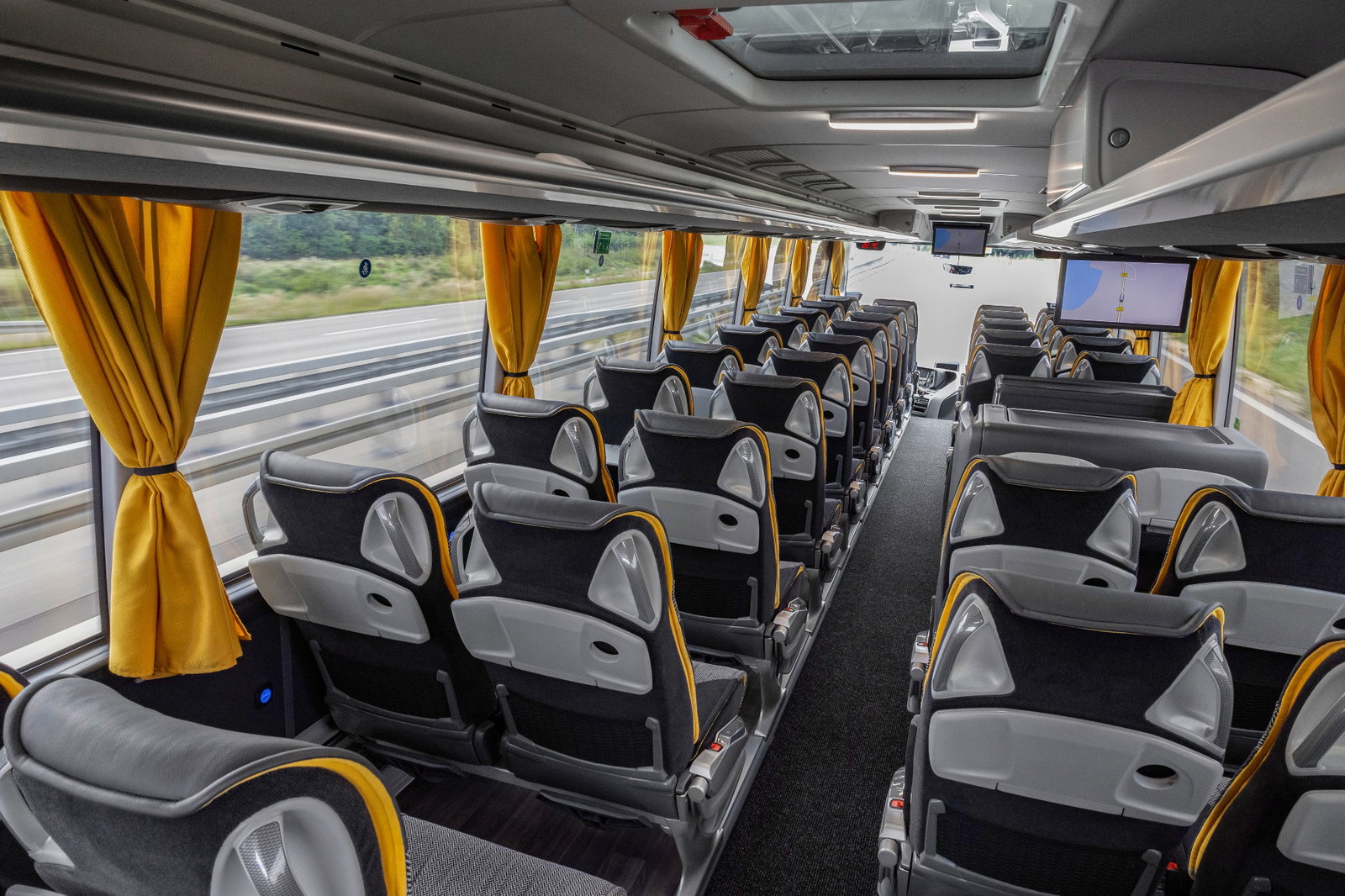
Protection, however, does not end with the body structure itself. Mercedes-Benz has also incorporated certain elements of the passenger compartment into the passive safety concept: partition walls, grab rails and specially designed seats also perform an energy-absorbing role in the event of a collision or rollover, thereby reducing the loads acting on passengers. In other words, in a modern coach we are not talking about a single rigid “safety cage”, but about a system in which the strength of the superstructure, its controlled deformation, the design of the passenger compartment, the seats and the occupant restraint systems all work together to reduce the risk of injury.
All this, however, does not in itself mean that every passenger is protected. The survival space only provides real protection for those who remain within it during the accident.
And this brings us to the seat belt. No matter how well the body protects the passenger compartment, it cannot help if the passenger is ejected from it. In a rollover, the body of an unbelted passenger effectively continues moving as an independent mass. It may strike seats, the roof, the side wall or other passengers, and in extreme cases may be partially or completely thrown out of the vehicle through a side window.
It is therefore misleading to judge a bus’s safety solely by how spectacularly its body has deformed after an accident. A severely damaged vehicle may still have met the structural requirements applicable to it, just as serious injuries may occur in a passenger compartment that has remained relatively intact if passengers are not properly restrained. The seat belt is therefore not an add-on to body structure safety, but one of its fundamental prerequisites.
There is no electronics that can abolish physics
A modern coach, then, already monitors road users in front of and alongside it, detects obstacles, brakes when necessary, checks the driver’s attention, warns of hazards, and if all this proves insufficient, attempts to protect those on board with energy-absorbing structures, a reinforced driver’s area and an appropriately designed superstructure.
This is an enormous development compared with what a coach was capable of even twenty years ago. But there is a point where the possibilities of technology come to an end. No assistance system can guard against every road condition, every driver error and every accident scenario. No body structure can absorb unlimited energy. And no survival space can protect a passenger who is no longer in their seat during a rollover.
Road safety, then, is not a matter of a single system or technology. Proper technical condition, a rested and responsible driver, active driver assistance systems, a suitably designed vehicle structure and passengers wearing seat belts form successive lines of defence. If one cannot prevent a hazardous situation from developing, the next may still mitigate its consequences. The more of these lines of defence remain functional in a critical situation, the greater the chance that a single mistake will not lead to a serious tragedy. Technology is capable of more and more in this field, but even the most advanced Safety Coach cannot step beyond the limits of physics.