![Magyarbusz [Info]](/mbi/header-logo.png)
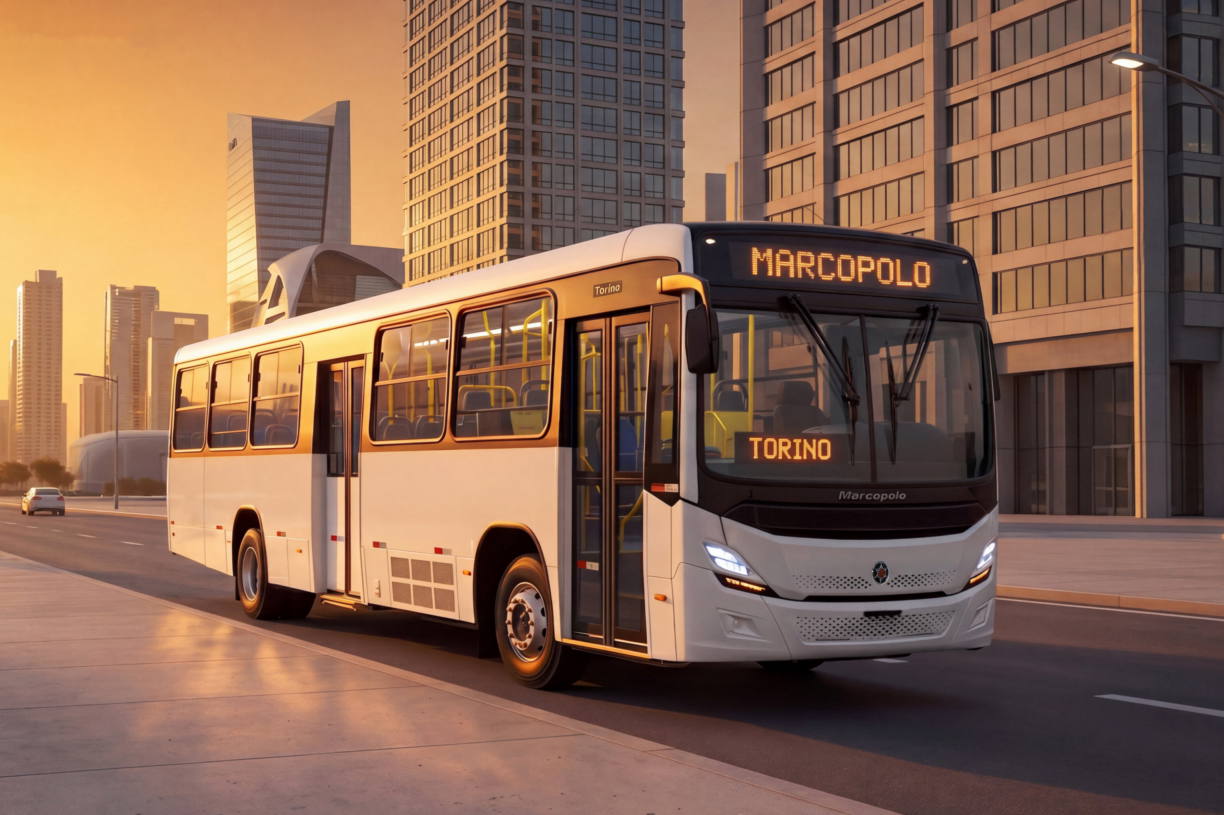
Marcopolo launches renewed entry-level city model
 Patthy Gellért
The Lat.Bus 2026 exhibition, held in São Paulo between August 11 and 13, brought a host of new developments, and once again the Marcopolo stand was well worth close attention. From the Brazilian manufacturer returning to the European market, we had previously expected more of a major reveal in the coach segment, and although there was indeed a new product in this area too, in the form of the Paradiso G8 TEC focused on technological, efficiency and comfort improvements, the real attraction ultimately came in the urban category with the presentation of the renewed Torino. In its home market and on certain African export markets, alongside the long-distance Paradiso range, this is unquestionably one of Marcopolo’s most important product families.
With a history spanning more than four decades, the model family is a true success story in Marcopolo’s history: its first generation was launched back in 1983, and since then more than 120,000 units have been sold. The latest edition, presented simply as the Torino 2027 in reference to the new model year, like its predecessors places the main emphasis on robustness, durability and operational efficiency, embodying continuous development while, according to the manufacturer, responding to the current needs of urban transport. Nevertheless, Marcopolo’s website still lists members of the previous generation among the available models, so for the time being there is some overlap in the range. At the São Paulo exhibition, the front-engined, standard-floor solo version fitted with a wheelchair lift at the second door was presented, but later the standard-floor and low-entry rear-engined product lines, as well as the articulated version, will almost certainly also receive the new design elements. In line with Marcopolo’s philosophy, the body can be adapted to a wide range of rolling chassis; at the world premiere, the model family was represented by examples on Volksbus and Mercedes-Benz chassis. In terms of overall dimensions, however, there is a slight anomaly: while the official website gives the vehicle’s length as 12,500 mm, its width as 2,540 mm and its height as 3,410 mm, the factory brochure lists figures of 12,565 mm, 2,550 mm and 3,260 mm respectively.
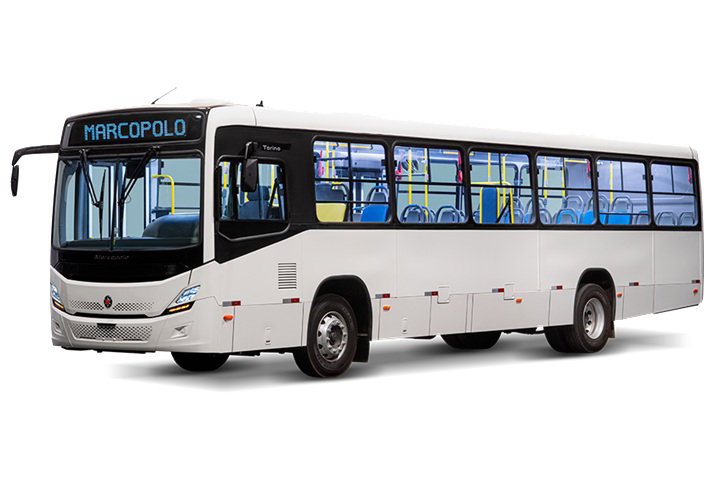
The basic shape remains clearly recognisable, yet the overall appearance has become much more modern
During the preliminary market research, operators were also involved in the development process in order to assess their experiences and any issues that had previously arisen, with particular regard to daily maintenance and servicing tasks. As a result, the updated Torino has received a redesigned, more modern front end with a slightly more angular appearance, featuring new lamp housings that allow faster replacement and easier repair, with halogen or LED light units available as required and integrated daytime running lights. LED fog lamps are also available as an option. The designers have managed to combine style and practicality effectively: the two smaller lower grilles at the front appear almost airy thanks to the three-dimensional pattern fashionable today, while the larger upper grille has been integrated seamlessl into the black area below the windscreen, even as the front service hatch provides an opening 40% larger than before. The three-piece bumper makes repair and maintenance cheaper and simpler. The rear end also uses LED light sources — in principle these are also easier to access — while the familiar brand identity has remained clearly identifiable. As standard, the side glazing continues to use rubber-mounted windows, which the display buses tried to disguise with black surrounds, although in practice most operators dispense with this styling trick. The simple, flat passenger doors characteristic of the Torino series are made from a stronger material than before and are 30% lighter than their predecessors. This change reduces the load and wear on the operating mechanism, minimises adjustment issues and air leakage, and, according to the manufacturer, even improves corrosion resistance.
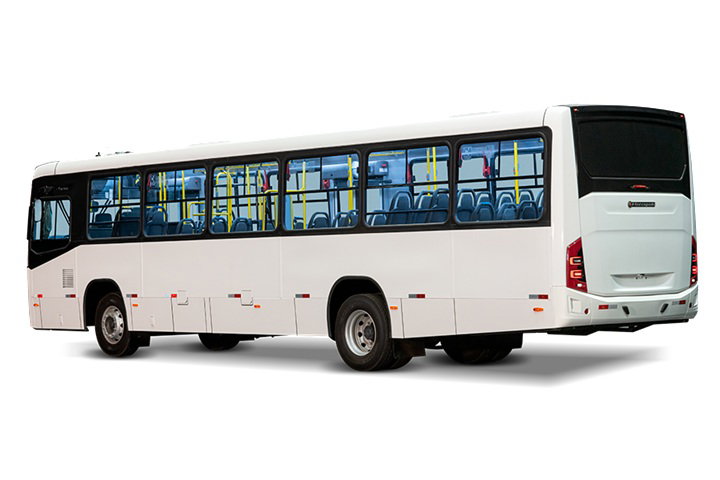
The relatively high build and large rear departure angle are characteristic of the Torino model family
Passenger comfort is served not only by improved thermal and acoustic insulation but also by new seats, which can optionally be supplemented with USB-A and USB-C charging sockets; according to the manufacturer, the choice of materials and the quality of the upholstery have also been improved. The air-conditioning system is new as well: thanks to air ducts developed with the aid of virtual airflow simulation, Marcopolo says it distributes air more evenly than before, with an average discharge velocity up to 40% higher, for better thermal comfort. The driver’s workplace is made more comfortable by more space, a more ergonomic arrangement of the controls, better ventilation and more storage compartments than before, while the new windscreen provides improved visibility and reduces blind spots, as do the new rear-view mirrors.
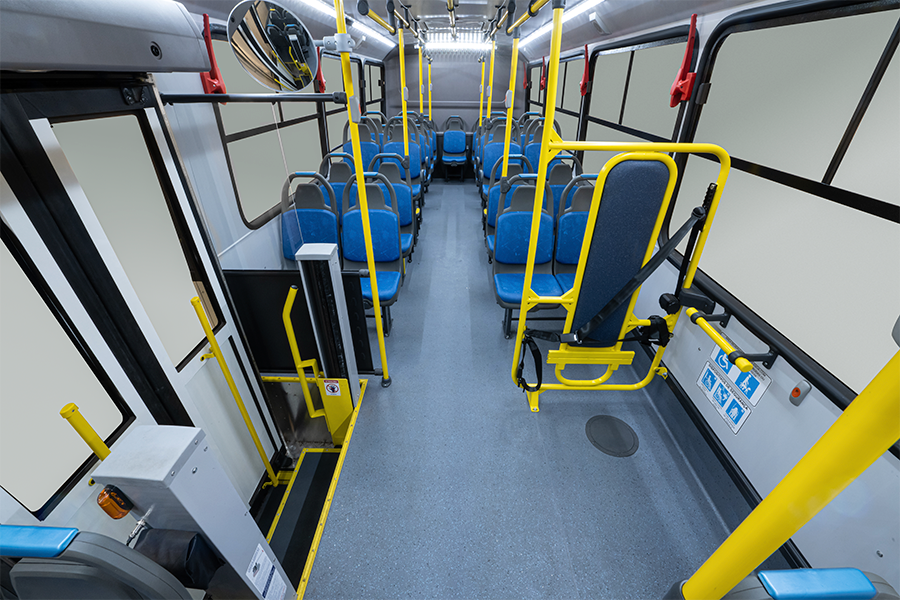
A simple, functional interior with newly developed passenger seats and a wheelchair lift at the centre door
An important innovation is the redesigned architecture of the onboard electrical system. Also for maintenance reasons, more space has been provided for the electrical switch panels above the driver’s seat, and access to them has also been improved thanks to a service opening that is 15% larger. The new Torino also sees the debut of the EVIA (Equipment for Vehicle Interface Architecture) central diagnostics system, which enables faster and more accurate fault detection, primarily in the field of electronic problems.
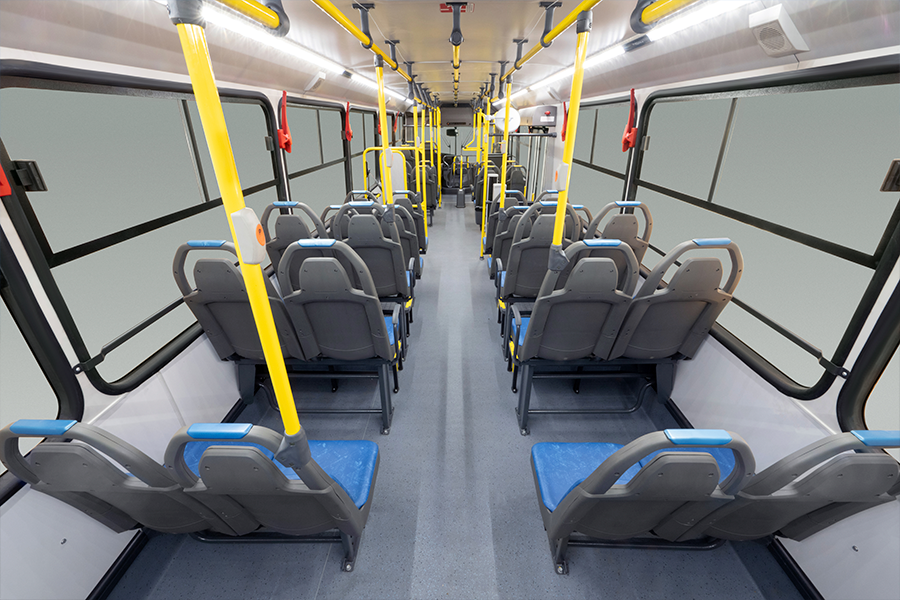
View from the rearmost row of seats in the new Torino 2027
Series production of the new Torino will begin this September at Marcopolo’s Brazilian plants in Caxias do Sul and São Mateus, and this will be followed almost immediately by the delivery of the first customer vehicles. According to the manufacturer, the purchase price of the facelifted edition will be 5–8% higher than that of the outgoing generation, depending on configuration, but as Ricardo Portolan, Marcopolo’s commercial and marketing director, pointed out, this must be analysed in light of the lower operating costs over the bus’s entire service life (greater availability, faster diagnostics and maintenance, shorter downtimes, more durable and standardised components, etc.).
Photos: Marcopolo S.A.