![Magyarbusz [Info]](/mbi/header-logo.png)

A Kecskemét bus driver was publicly pilloried; the investigation ultimately refuted every allegation
 Ludányi József
A single social media post was enough for a Kecskemét bus driver to be publicly condemned. According to the post, the driver had simply thrown away a found wallet, prompting many people to criticise his work and demand that he be held to account. The reality, however, was quite different, as Kecskemét Television also reported.
The story began last Monday on route 110 of the Kecskemét Transport Centre. At the railway station, a woman handed the driver a small bag that appeared to be a wallet, saying she had found it somewhere nearby. The bus driver took the found item and continued his service. Around ten to fifteen minutes later, however, an increasingly unpleasant smell began to spread through the cab. Since he did not know where the stench was coming from, he opened the wallet.
It then became clear that it contained no money, documents, bank card or any other valuables. Instead, its interior was filled with faeces. The driver then closed it again and threw it into a waste bin at the next stop. This was also seen by the woman who had earlier handed him the found item, although she did not know what was inside the wallet.

Photo: KeKo
Not long afterwards, she published an outraged post in a Facebook group, claiming that the bus driver had simply thrown away a found wallet. The post quickly began to spread, and condemnatory comments poured in within a short time.
The management of the Kecskemét Transport Centre, however, did not let the matter rest. It immediately launched an internal investigation, during which onboard camera footage was reviewed, and the wallet recovered from the waste bin was also examined. The investigation clearly confirmed that the bus driver had not thrown away a wallet, documents or valuables, but a wallet filled with faeces.
The company’s management subsequently stood publicly by its employee. It stated that it firmly rejects all such unfounded assumptions, and also drew attention to the fact that incomplete or false information posted on social media can have serious consequences.
It also asked the public to make sure of the facts before publicly condemning anyone. As they put it, a post of this kind does not only pass judgement on the bus driver concerned, but also places all bus drivers, the employees of the Kecskemét Transport Centre and the staff working in the background in an undeservedly difficult position. They also stressed that reputational or even financial damage arising from false claims may have legal consequences for the author of the post and for commenters alike.
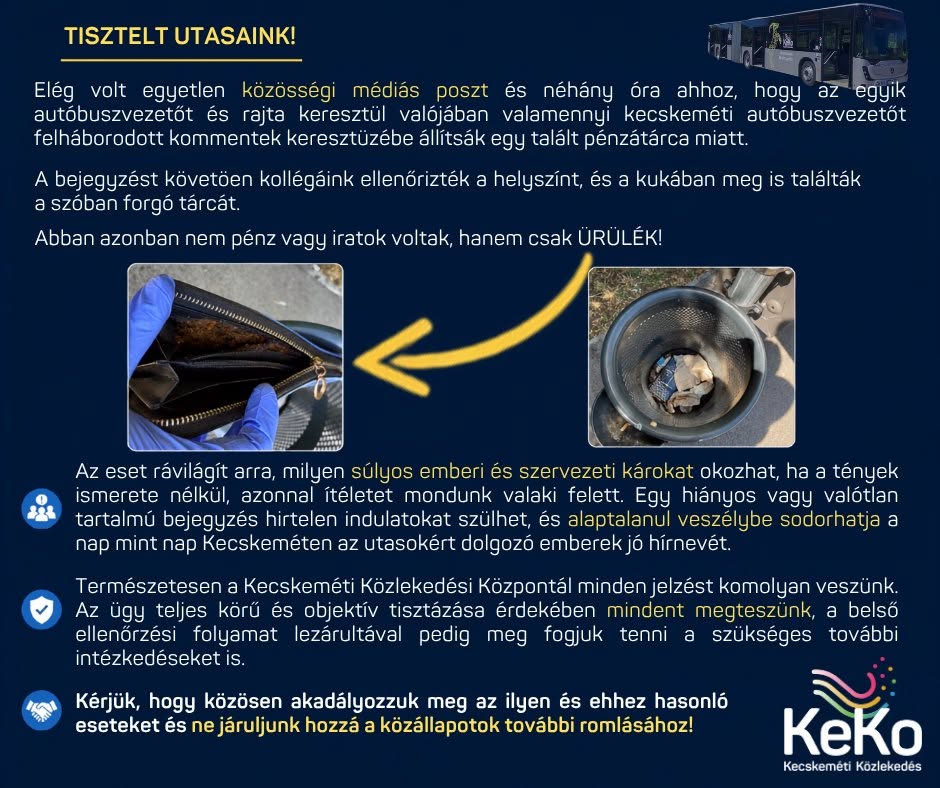
At the same time, the management of the Kecskemét Transport Centre deserves praise for not taking the easiest route. It did not yield to the pressure of social media, but investigated the case. Perhaps even more importantly, when the truth emerged, it did not remain silent, but publicly stood by its employee. Unfortunately, this attitude today is more the exception than the rule, even though this is exactly what a responsible employer should do.
We are increasingly often seeing cases — primarily on Facebook, but now on TikTok as well — where an anonymous passenger complaint, an excerpt from a video taken out of context, or a one-sided post is enough for someone to be publicly stigmatised. Commenters pass judgement in moments, often demanding disciplinary action or dismissal, even though the other side of the story has not yet been heard and the facts are not even known.

Photo: KeKo
The problem, however, is not only with social media. Many employers also adapt far too readily to this pressure. Instead of objectively investigating every case, they respond quickly to the outrage because they fear greater reputational damage. The people who often pay the price for this are precisely those employees who, in reality, acted in accordance with the rules and with the requirements of their job.
Yet experience shows that in a significant proportion of such stories it later turns out that important details were missing, the story was taken out of context, or the accusation was simply untrue. But by the time the truth comes to light, social media has long since delivered its verdict, and the good name of the employee who has been dragged through the mud is often impossible to fully restore.

Photo: KeKo
That is precisely why every employee is entitled to the presumption of innocence and to a fair investigation. A responsible employer does not make decisions based on Facebook comments or anonymous complaints, but on facts. And if it is proven that the employee acted properly, the employer must stand by them with the same determination with which many people had previously condemned them. This is not only in the interest of the employee concerned, but also of the company: it strengthens the company’s credibility and reputation, while also sending a message to employees that they can rely on their employer.
Unfortunately, the attitude that “the passenger is always right” still prevails in too many places today. Passengers do have the right to make complaints, but they do not have the right to destroy people’s reputations with false or unfounded claims. And social media is not a court where a single post is enough to convict someone.