![Magyarbusz [Info]](/mbi/header-logo.png)
Trolley:motion questions the calculations underpinning the phase-out of Solingen’s trolleybuses
 Ludányi József
The debate over the future of Solingen’s trolleybus operation has entered a new phase. As we reported in detail in February, a feasibility study examining the long-term electrification of public transport in the German city found that the most economically favourable option would be to gradually phase out the current BOB system, which relies on both overhead wires and battery-powered off-wire operation, and switch to purely battery-electric buses. According to the calculations, this could save around €2.5 million a year, meaning that, in parallel with the natural replacement of the trolleybuses, the overhead-wire infrastructure could also gradually disappear from Solingen’s streets, probably by the mid-2040s. The significance of the decision is underlined by the fact that, in Solingen’s case, this is not about the possible closure of a transport system with a marginal role, but about the backbone of urban public transport that remains central to the city today. The findings of the study have since been analysed in detail by our professional partner trolley:motion, which has made its technical position paper available directly to our publication.
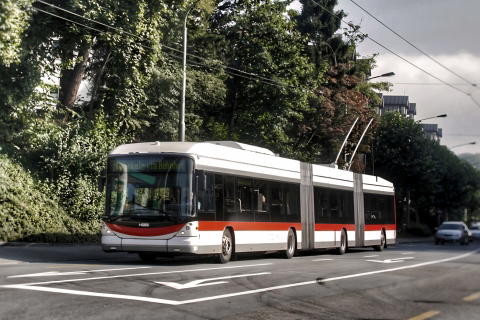
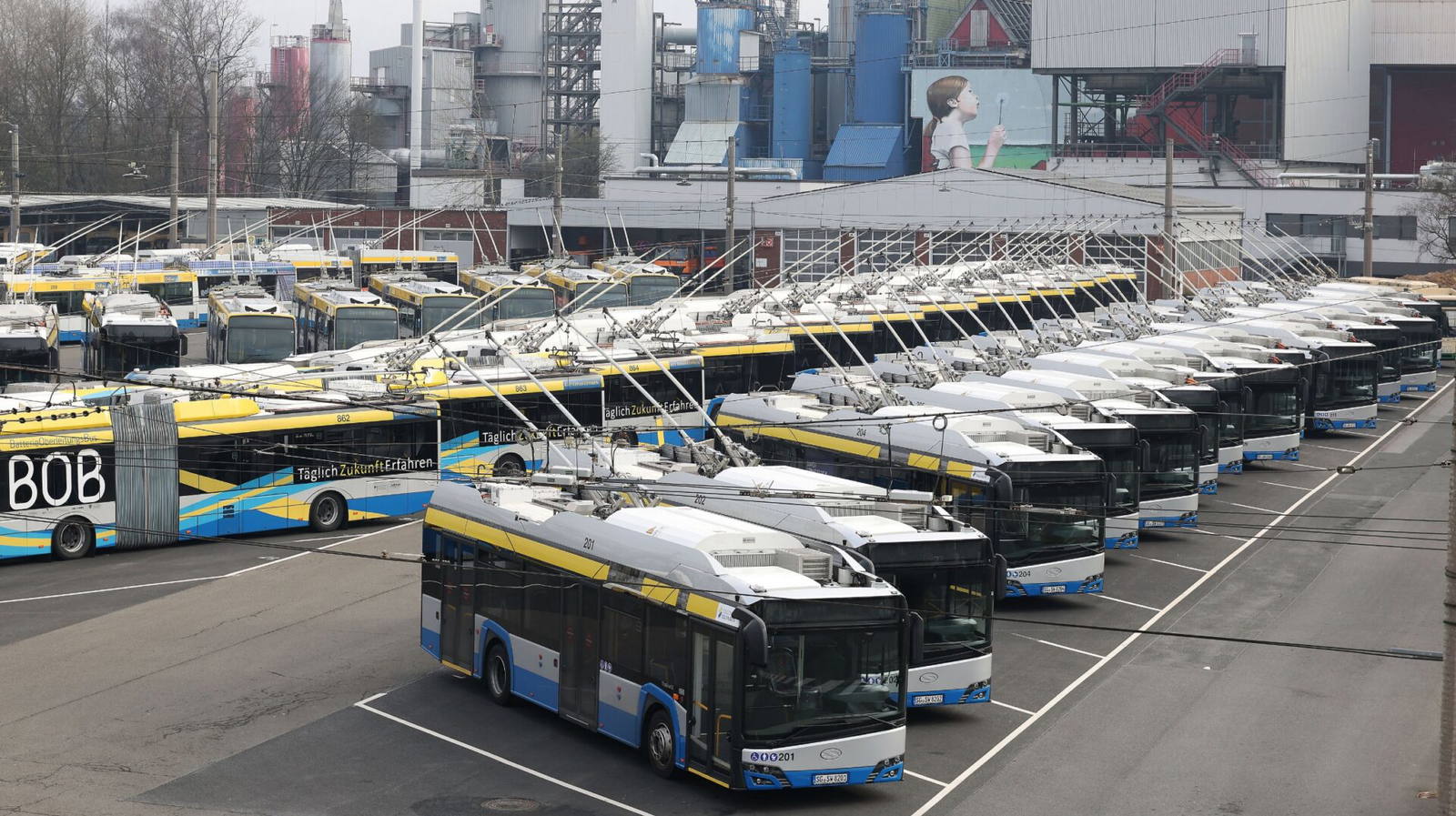
Trolleybuses currently account for more than 70% of Stadtwerke Solingen’s public-transport output, while the 64-vehicle fleet consists of 36 Solaris Trollino vehicles and 14 trolleybuses each from Hess and Van Hool. The system is also in the midst of renewal: in 2026, 24 new articulated Solaris Trollino vehicles are due to arrive, intended to replace the ageing Hess and Van Hool vehicles. At the same time, the Solingen operation is no longer based solely on a traditional, continuous connection to the overhead wires. The trolleybuses capable of battery-powered off-wire operation take energy from the wires while running underneath them and charge their batteries, enabling them to cover sections without overhead wires in fully electric mode. The existing network therefore already partly serves as dynamic charging infrastructure – and it is precisely the long-term viability of this system, built up over several decades, that the earlier study calls into question.
Solingen’s plans are also notable because, while the city is examining the long-term phase-out of its overhead-wire system, the opposite process is taking place in several parts of Europe. In recent years, a number of existing trolleybus networks have been modernised or extended, while elsewhere trolleybus operation has been restarted after a long break, or decisions have been taken to develop new routes and IMC systems. With the spread of modern battery trolleybuses, the logic of network development itself is also changing: new routes no longer necessarily require overhead wires along their entire length, but can be created by making partial use of existing infrastructure and incorporating longer wire-free sections. Solingen is therefore considering the gradual dismantling of its decades-old system at a time when other European cities are seeking to modernise the same technological basis and develop it further as part of the electric transport of the future.
The conclusions have now been challenged in a detailed technical critique by trolley:motion, a European professional network established in 2004 and specialising in electric bus systems, in particular modern trolleybus and In-Motion Charging (IMC) solutions. The organisation brings together transport operators, cities, industrial players and research institutes, and is involved in several European research and development programmes. According to trolley:motion, what is open to question is not the need to compare the technologies, but the calculation basis from which the substantial cost advantage of purely battery-electric operation is derived. In its view, the study overestimates the costs of the overhead-wire system at several points, while failing to take full account of the depot, charging and power-grid requirements of a purely battery-electric fleet, as well as the economic value of Solingen’s already existing overhead-wire infrastructure. In addition, it argues that the expected development of the two technologies is not assessed by the same yardstick.
The organisation is therefore not simply arguing for the retention of trolleybuses, but considers that the comparison on which the decision is to be based should itself be reconsidered. In its view, the question in Solingen is not merely whether the buses of the future should draw their energy from overhead wires or exclusively from batteries. The real question is what combination of the already installed power supply, the overhead wires, batteries, vehicles, depot charging and energy management will deliver the most economical, operationally reliable and resource-efficient electric transport system in the long term.
One of the central elements of the critique is precisely how the concept of the modern trolleybus is interpreted. According to trolley:motion, the modern trolleybus capable of battery-powered off-wire operation, referred to in the German-speaking world as a BOB (Batterie-Oberleitungsbus), is no longer the same as the traditional design whose operation essentially required continuous contact with overhead wires. In the case of IMC technology, the wire also functions as charging infrastructure while the vehicle is in motion: as it runs beneath the overhead line, the vehicle not only draws the energy needed for traction but also charges its battery, then continues independently over longer wire-free sections. The organisation argues that advances in battery, power-electronics and vehicle technology are enabling ever greater off-wire distances, while the required battery capacity and the proportion of the network that needs to be equipped with overhead wires can be reduced.
This is important because, according to trolley:motion, the Solingen study does not treat the expected development of the two technologies by the same standard. While it allows for increasing range and improving battery technology in the case of purely battery-electric buses, for the BOB system it essentially starts from today’s technical conditions. The organisation points out that IMC trolleybuses also benefit from the same battery development; with a greater off-wire range, the amount of overhead wire required can be reduced further, while new current-collector technologies can also increase the performance of energy transfer. The counterargument is that, in modern BOB designs, an off-wire range of more than 100 kilometres may already be achievable.
In this context, trolley:motion also disputes whether the further development of the BOB system would really require the construction of the 5.7 kilometres of new overhead wire assumed in the study. Modern battery trolleybuses do not need to run under wires along the entire route: it is sufficient for them to take in enough energy on certain sections while in motion to cover the parts without overhead wires. This also makes it possible, for example, not to install overhead wires at all at more complex intersections and junctions, with vehicles passing through them on battery power. The organisation therefore argues that the energy demand of the specific services, the battery capacity of the vehicles and the charging options offered by the existing network should first be modelled, and only then can it be determined where, and over how many kilometres in total, new wiring is actually needed.
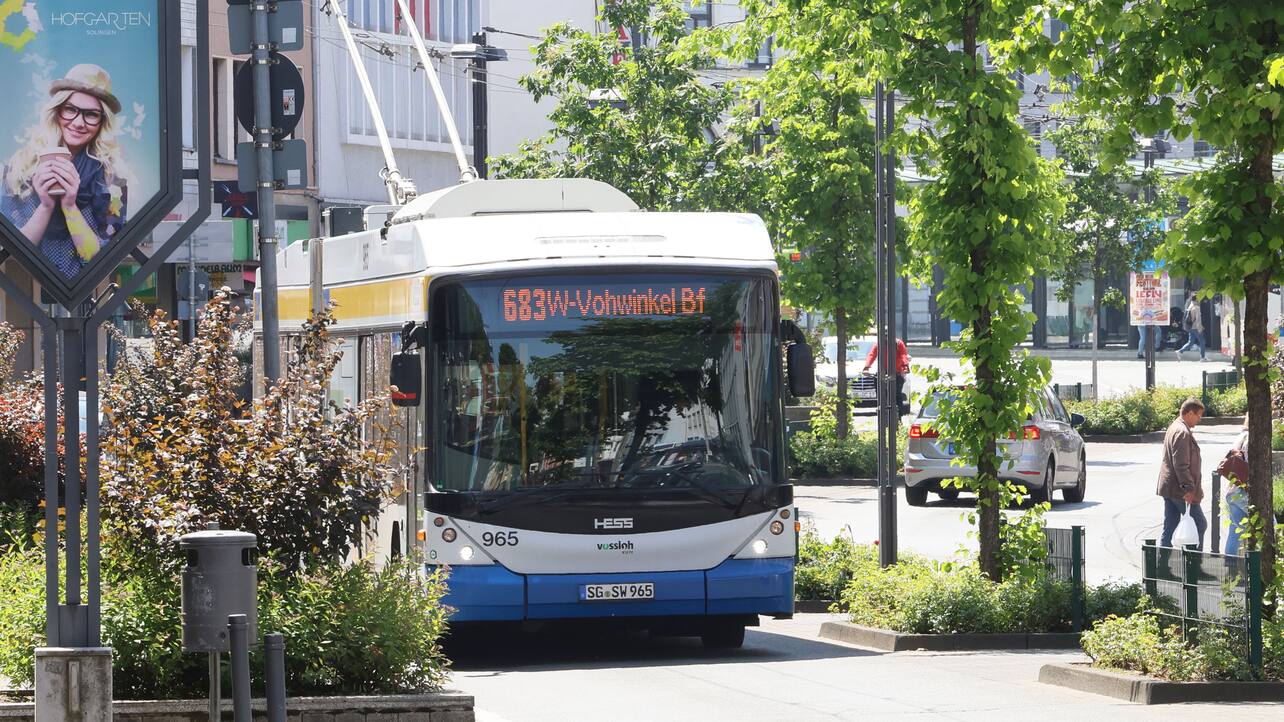
Photo: Christian Beier
The valuation of the existing infrastructure is another fundamental issue in the debate. In Solingen’s case, the choice is not between two systems that would both have to be built from scratch: over several decades, the city has created an overhead-wire network, substations, grid connections and the background needed to operate them. According to trolley:motion, their economic value should be taken into account as existing municipal assets when comparing the continued operation of the BOB system with the development of a new BEB system based on depot charging – that is, a purely battery-electric, wire-free bus system.
The question of infrastructure service life is also linked to this. The response considers the uniform 12-year service life applied to electrical equipment to be too short. By way of example, it mentions overhead wiring for which the manufacturer specifies a 70-year service life, while it assumes at least 30–40 years of usability for substations and more than 50 years for support poles. In trolley:motion’s view, projecting the costs of long-lived infrastructure over too short a period necessarily worsens the economic position of the BOB system in the comparison.
The organisation also challenges the cost assumptions on the vehicle side. It does not consider it justified, for example, that the study places the performance-based maintenance costs of BOB vehicles 10% higher than those of BEBs. According to the response, the only significant additional task for trolleybuses is the replacement of the carbon inserts in the current collectors, which, with modern solutions, can be extended to a two-week interval; the additional cost of this is put at no more than €0.01 per bus-kilometre, compared with the €0.05 used in the study.
On the other hand, trolley:motion argues that the costs of the purely battery-electric system have been underestimated in several areas. In particular, the electrification of the depot may represent a significantly more complex investment than indicated in the study. In addition to the charging equipment, transformers, adequate grid feed-in, cabling, load and charging management, and an IT background are required. When designing the depot, the space required by the charging equipment and fire-safety requirements must also be taken into account. The organisation therefore considers the €150,000 assumed in the study for a charging station to be too low.
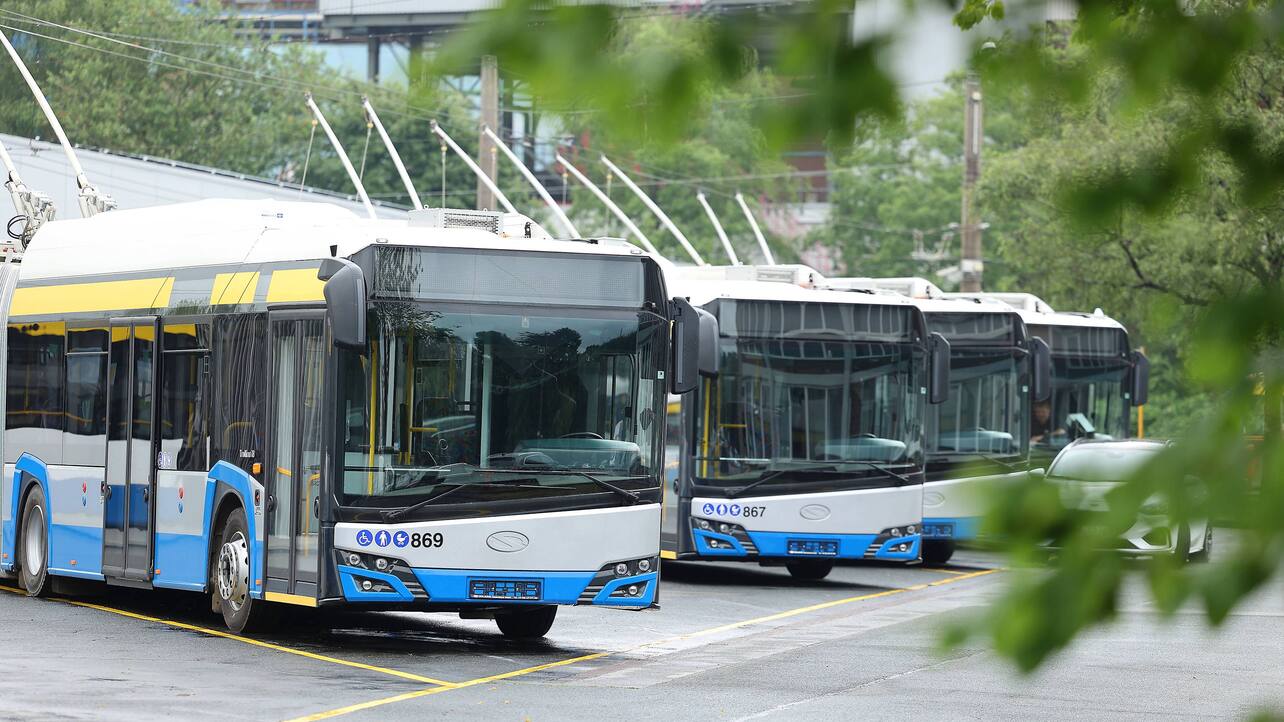
Photo: Christian Beier
The assumption regarding the required electrical capacity is particularly strongly disputed. The feasibility study assumes a depot connection capacity of 3–6 MW, but according to trolley:motion this would only be sufficient if the vehicles could be charged for more than ten hours. The organisation assumes that, for most buses, the actual available time window is 5–8 hours, and therefore considers a grid connection of at least 10 MW necessary; from a supply-security perspective, it also raises the need for a second, independent feed-in. At the same time, it itself emphasises that an exact determination would require a load curve prepared on the basis of the actual duties and charging processes.
This directly affects one of the most important assumptions on which the previously identified economic advantage of the purely battery-electric system is based. Trolley:motion does not consider it sufficiently substantiated under all operating conditions that BEBs would be able to cover all duties without intermediate charging. It sees high daily mileage, frequent headways and high utilisation in particular as areas where year-round operation based exclusively on depot charging could become problematic.
If, however, daytime vehicle swaps are needed to cover certain duties, the impact is no longer limited to the energy supply. According to the response, more vehicles may then be required, increasing procurement and maintenance costs, the space needed at the depot, and staffing expenditure as well. For this reason, trolley:motion also disputes the annual mileage and vehicle requirement calculated for BEBs and, consequently, does not accept the level of savings indicated by the study either.
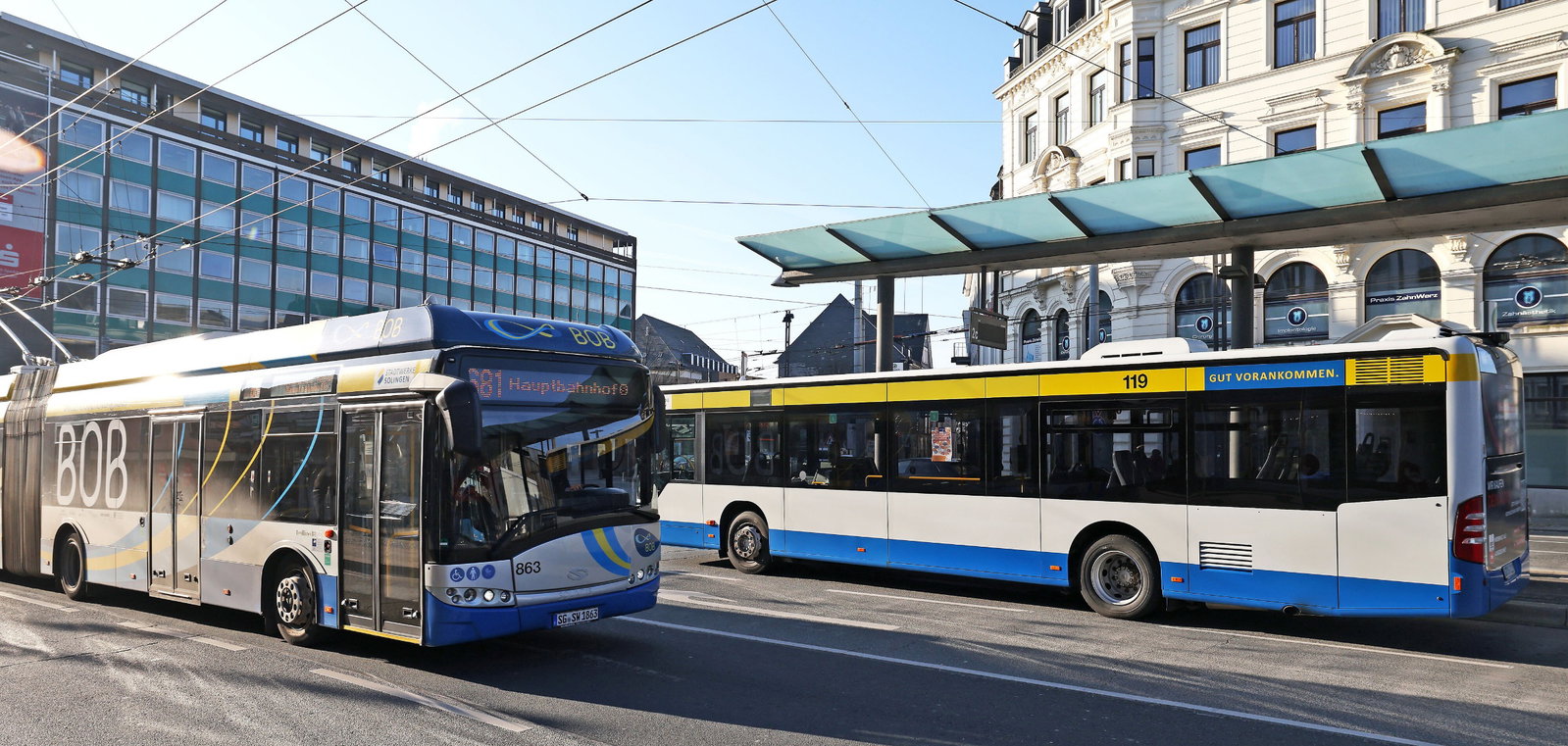
Photo: Christian Beier
Battery service life also plays a prominent role in the critique. According to trolley:motion, the difference between the two systems cannot be described solely by the purchase price of the vehicles, because in the case of BEBs with large battery capacities the cost of battery replacement must also be taken into account. The organisation contrasts a BEB battery life of 5–10 years with the service life of LTO batteries used in many BOB vehicles, which can reach 20 years or more. The paper estimates battery replacement to remain an item exceeding €150,000 over the longer term. These, however, are trolley:motion’s own calculation assumptions, and the document now published does not include a detailed life-cycle cost calculation to support them.
Larger batteries, meanwhile, mean not only higher costs but also a difference in weight. According to trolley:motion, because of the larger energy storage required, a purely battery-electric bus can be more than four tonnes heavier than a BOB vehicle of the same category. The organisation argues that, given Solingen’s annual output of around 4.5 million bus-kilometres, this could already have a noticeable impact on the use of the road network. It also makes a much stronger environmental claim: citing its calculations, it states that the ecological footprint of a BEB could be up to thirty times that of a BOB. At this point, however, the response again does not provide detailed calculations or a source trail from which this ratio could be clearly verified, so the thirty-fold difference should be treated as the organisation’s own assertion.
The organisation sees a further advantage of the BOB system in the fact that energy intake is distributed in both space and time. The vehicles charge while in motion, and the battery also acts as a buffer, allowing energy intake to be reduced during power peaks. According to trolley:motion, this makes the use of the electrical grid more flexible than with traditional trolleybuses without batteries, and the existing infrastructure could also be used to serve new routes or more frequent services.
On this basis, trolley:motion is not simply claiming that the BOB system has been proven to be cheaper than the purely battery-electric alternative. The technical response raises a more fundamental issue: in its view, the current calculations do not make it possible to determine with sufficient confidence which system is more favourable in the long term, because both solutions would first have to be modelled under identical technical and economic conditions.
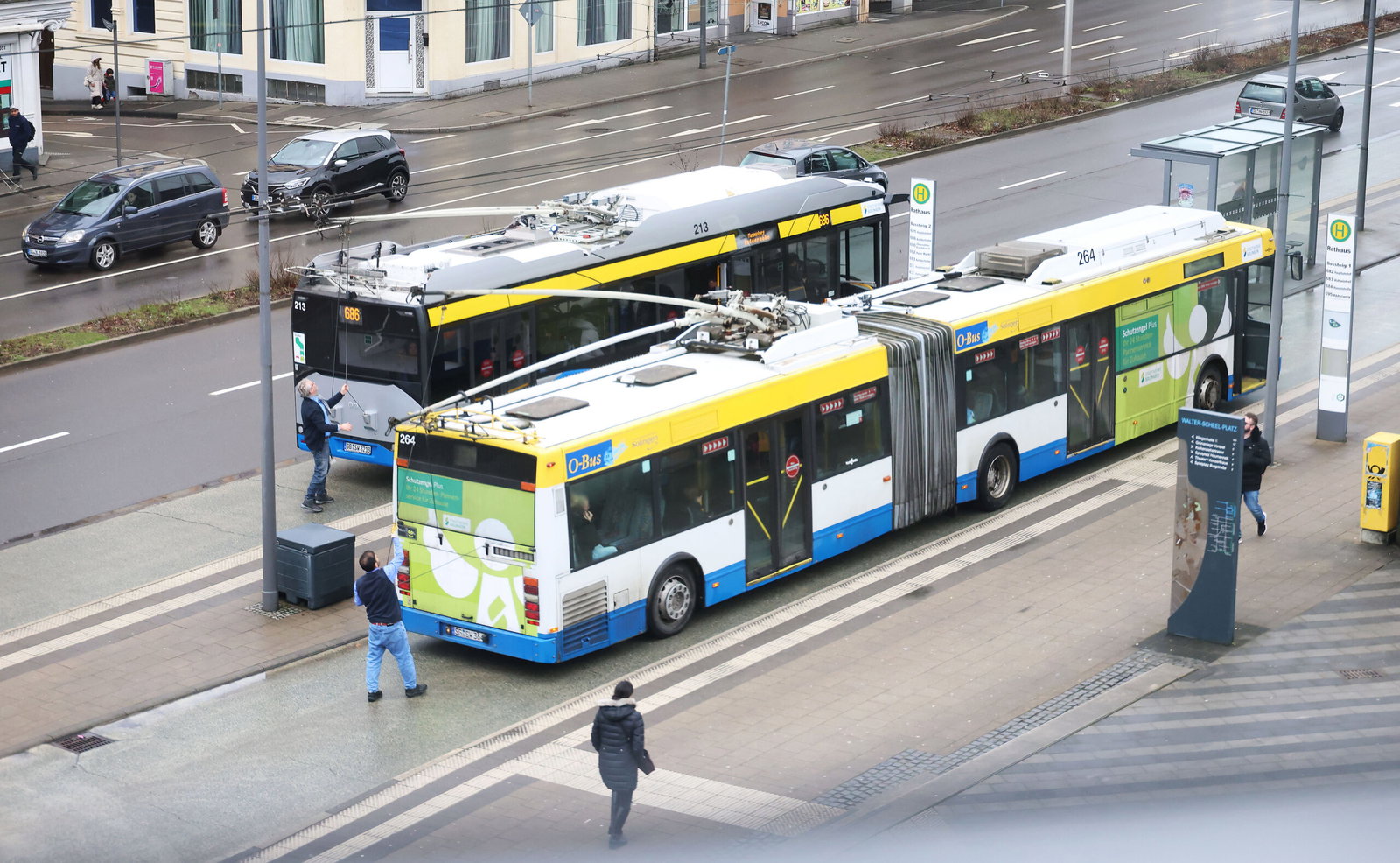
Photo: Christian Beier
The organisation therefore recommends revising the feasibility study and preparing a detailed network simulation. This should show where the amount of existing overhead wire can be reduced, whether the number and location of substations can be optimised, whether additional BOB routes can be served using the infrastructure already available, and whether more frequent services or extended operating hours can be implemented without further major infrastructure investment.
The Solingen debate therefore goes well beyond the question of whether trolleybuses or purely battery-electric buses should be regarded as the more modern technology. In reality, the city is preparing to decide whether it will continue to regard the electrical power and overhead-wire network built up over several decades as an active part of the electric transport system of the future, or gradually give it up and instead create a new infrastructure based essentially on depot charging. For such a decision, it is therefore not enough simply to compare the vehicles, or even annual operating costs: the entire system’s life cycle, energy supply, infrastructure requirements, reserves and potential for future development must be examined together. This is also the most important message of trolley:motion’s current critique.
Cover photo: Christian Beier