![Magyarbusz [Info] International](https://bunny-wp-pullzone-thjj7ocpga.b-cdn.net/wp-content/uploads/2025/06/cropped-cropped-mbi_sby_v1-scaled-1.png)

CaetanoBus, majority-owned by Toyota, has announced the development of a completely new, zero-emission urban bus family on the occasion of the 2025 UITP Global Public Transport Summit. The announcement outlined the contours of a model portfolio encompassing multiple variants, forecasting a significant expansion of the Portuguese manufacturer’s offering. The development is not being conducted solely in-house, as the Chinese CRRC is also involved in the project as a strategic technology partner, particularly in the area of the powertrain.
CaetanoBus’s soon-to-be-launched new model family promises a much wider range of sizes and types than previous offerings: the range of lengths spans from the 8.5-meter midibus to the classic 12-meter solo configuration, and even to the 18-meter articulated version, which for the first time features zero-emission propulsion in the manufacturer’s history, including a dedicated articulated BRT version.
All members of the series share a common design language. The unified appearance is defined by deep-tinted glazed surfaces, straight-line front and side walls, and striking LED light fixtures supplied by the German company Nolden. Based on the released renderings, the battery and hydrogen-powered versions will not differ externally, with even the integrated roof fairing’s lines being identical in the computer graphics.
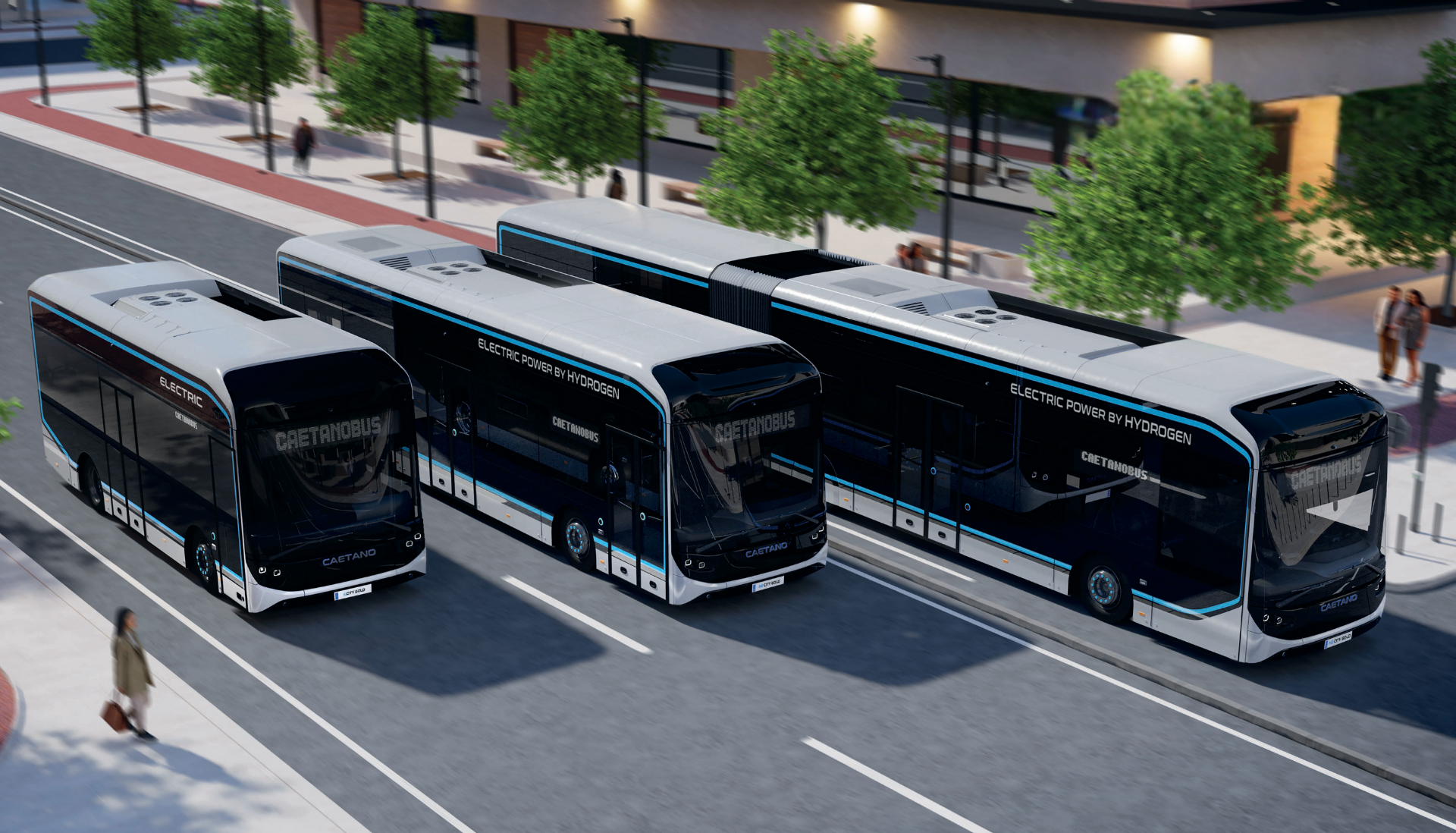
With the introduction of the new generation arriving under the familiar City Gold moniker, CaetanoBus is decisively departing from the Siemens ELFA drive systems previously used. The future vehicles’ powertrains will be entirely based on solutions from the Chinese CRRC – whether they are battery or hydrogen-powered variants (excluding, of course, the Toyota fuel cell built into the latter). The central element of the powertrain is the so-called “6-in-1” integrated inverter module, which compresses motor control, air compressor and oil pump operation, voltage conversion, and high-voltage energy distribution supervision into a single compact unit – with built-in insulation monitoring. The high degree of integration not only allows for significant weight reduction but also considerably improves the system’s efficiency and operational reliability. Energy storage for all electric versions is provided by the Chinese CATL BC5 lithium iron phosphate (LFP) traction batteries.
The interior design of the model family follows a uniform structure. The flooring for all versions is made from honeycomb polypropylene panels, and the body is constructed from high-strength carbon steel as a self-supporting structure with cataphoretic corrosion protection. Heating and cooling are provided by a modern heat pump air conditioning system in all cases. The doors are electrically operated in every version.
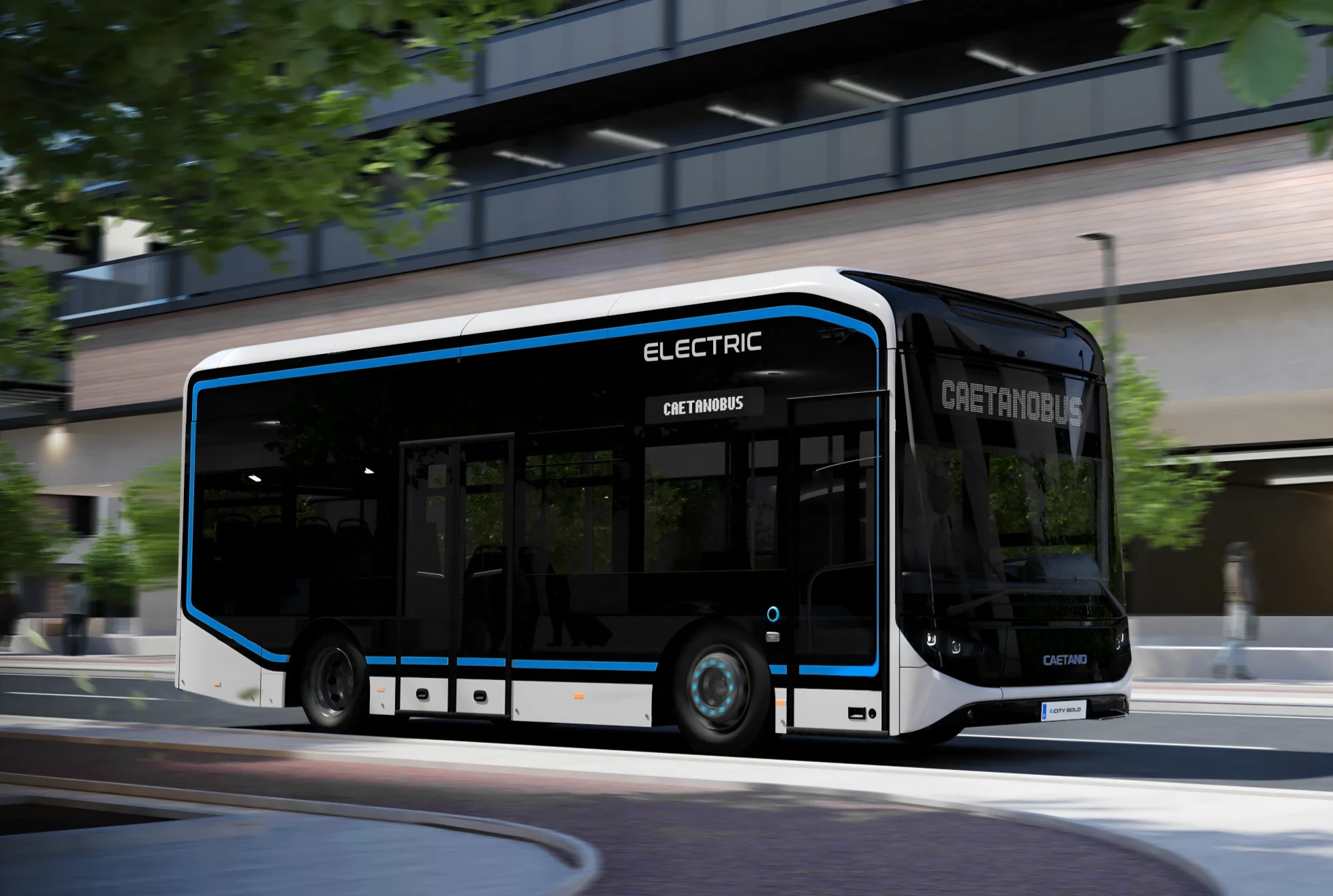
The entry model of the purely electric range is the 8600 mm long, 2420 mm wide, and 3300 mm high e.City Gold 8.5m midibus, which can be equipped with a battery pack of up to 282 kWh capacity. This allows for a range of up to 400 kilometers based on the UITP E-SORT measurement cycle. The drive is provided by a permanent magnet synchronous motor with a nominal power of 100 kW and a peak power of 200 kW, delivering a maximum torque of 2048 Nm. Both the front and rear axles are sourced from the Chinese GK Drive range. The interior, with a low floor throughout its length, can accommodate up to 60 passengers, with an interior height of 2.1 meters. Based on relevant technical data (powertrain, battery capacity, interior height, wheelbase, etc.), the smallest CaetanoBus is technically very closely related to the existing CRRC TEG6853 and Ikarus 80e midibuses.
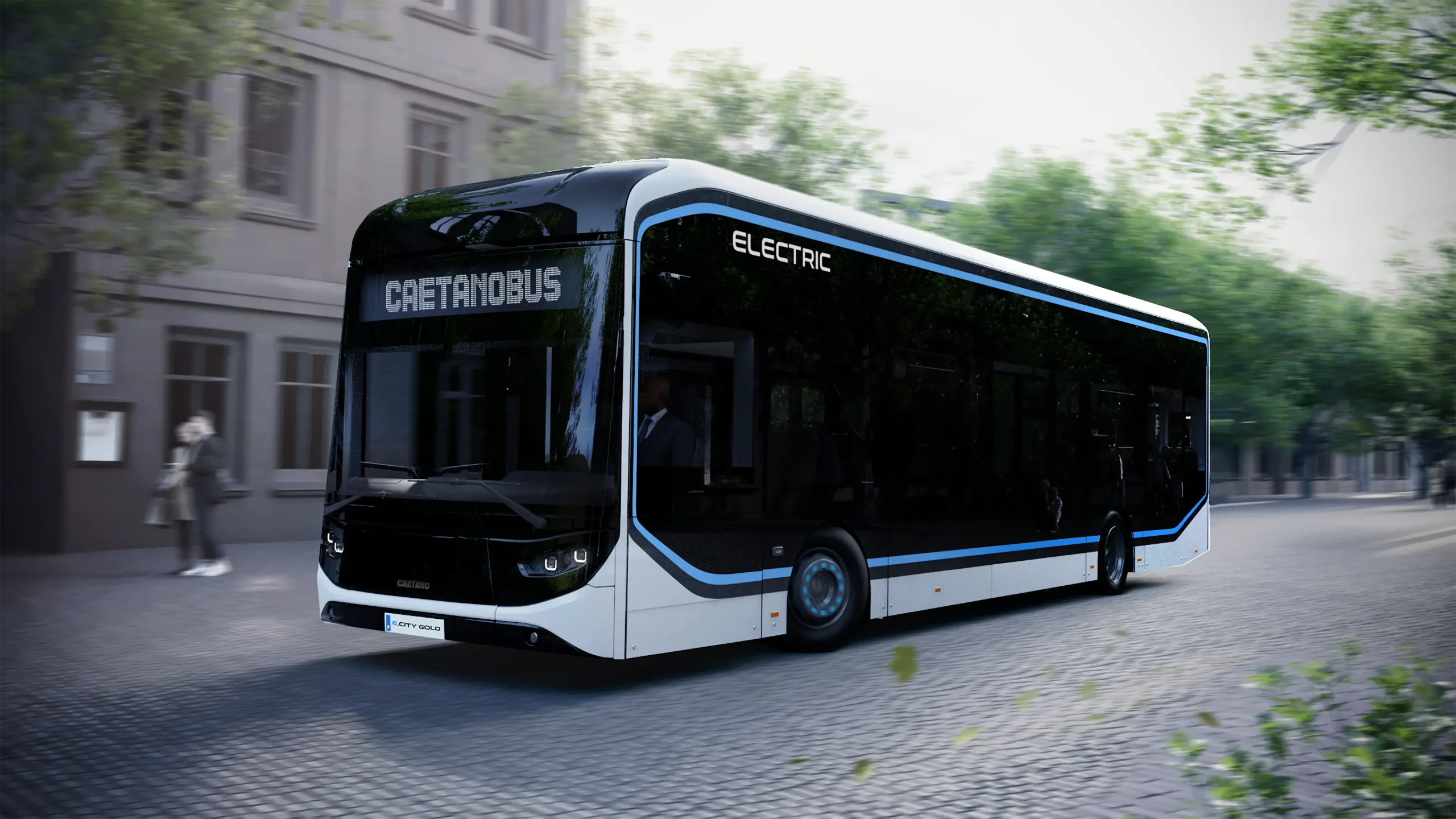
The next element in the selection is the 12.2-meter solo version of the e.City Gold, which can be equipped with a battery pack of up to 423 kWh capacity. According to the manufacturer, this allows for a range of up to 460 kilometers on a single charge. The powertrain is built around an electric motor with a nominal power of 180 kW and a peak power of 350 kW, capable of delivering a maximum torque of 3500 Nm. The 3.3-meter-high vehicle’s interior can accommodate up to 85 passengers. The axles are supplied by ZF in this case, with the independent front suspension RL 82 EC and the driven rear portal axle AV 133 type. The braking system is complemented by an advanced emergency braking system known as AEBS, which can prevent or mitigate accidents by automatic braking in the event of collision danger. The type – though not mandatory in the urban M3/I vehicle class – also meets the requirements of UN ECE Regulation 66, which pertains to body rollover protection.
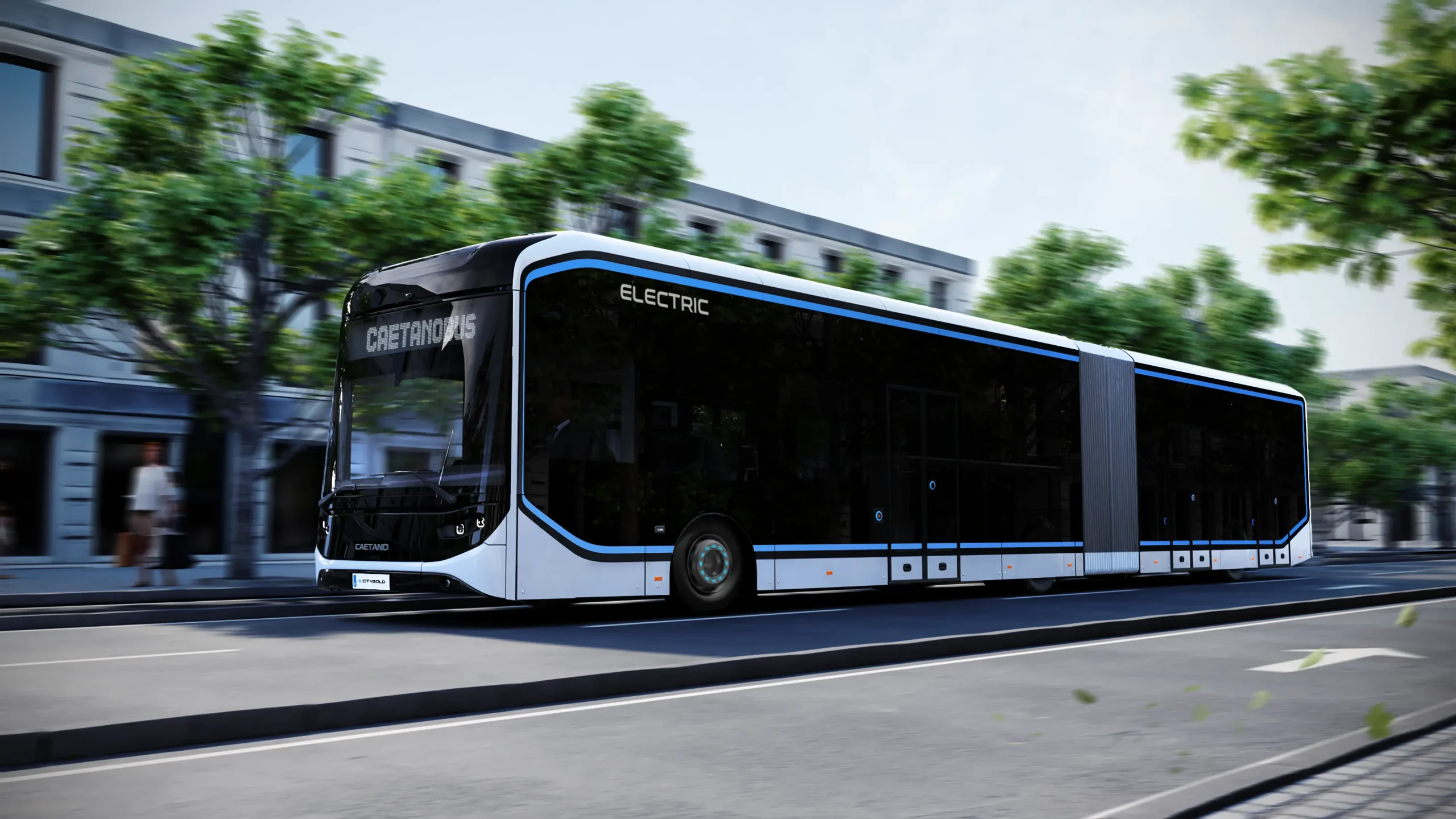
The longest model in the electric lineup is the 18.75-meter e.City Gold articulated version, equipped with two separate central electric motors. The main drive motor is located at the B-axle, with a peak power of 240 kW and a maximum torque of 3200 Nm. The auxiliary motor mounted on the rear axle provides an additional 135 kW of power with 1700 Nm of torque. The energy supply comes from a 621 kWh capacity LFP battery pack, allowing the vehicle to have a range of up to 450 kilometers, although the maximum charging power, similar to other body versions, is limited to 120 kW, which is somewhat modest by today’s standards. The 3.36-meter-high electric bus can accommodate up to 123 passengers, with two wheelchair spaces possible depending on the configuration. The door configuration (0-2-2-2) is unusual, as no passenger door is installed in front of the front axle according to the factory brochure. The axles for this type are also supplied by ZF: the aforementioned RL 82 EC at the front, while the driven AV 133 units are found in the middle and rear under the bus. The braking system also includes the full safety arsenal, including AEBS.
In recent years, the key to CaetanoBus’s international success has clearly been the hydrogen fuel cell product line, so naturally, successors to this are also found in the new generation models. The hydrogen-powered H2.City Gold types continue to use Toyota’s advanced fuel cell, now complemented by Chinese technology instead of German and French on the electric side. The second-generation Toyota Fuel Cell Stack 2.5 unit provides a nominal power of 70 kW, paired with a CATL manufactured LFP battery intermediate energy storage system – with a capacity of 100-130 kWh for solo buses and up to 176 kWh for articulated versions. The vehicles carry four hydrogen tanks operating at 350 bar on their roof, with a total hydrogen storage capacity of 40 kg, sufficient for 500-600 kilometers. The 12.25-meter-long, 3.4-meter-high solo hydrogen bus has the same electric motor as the battery version, with a nominal power of 180 kW and a peak power of 350 kW, capable of delivering 3500 Nm of torque. The interior can accommodate up to 85 passengers, although the manufacturer claims the vehicle’s range can be up to 600 kilometers.
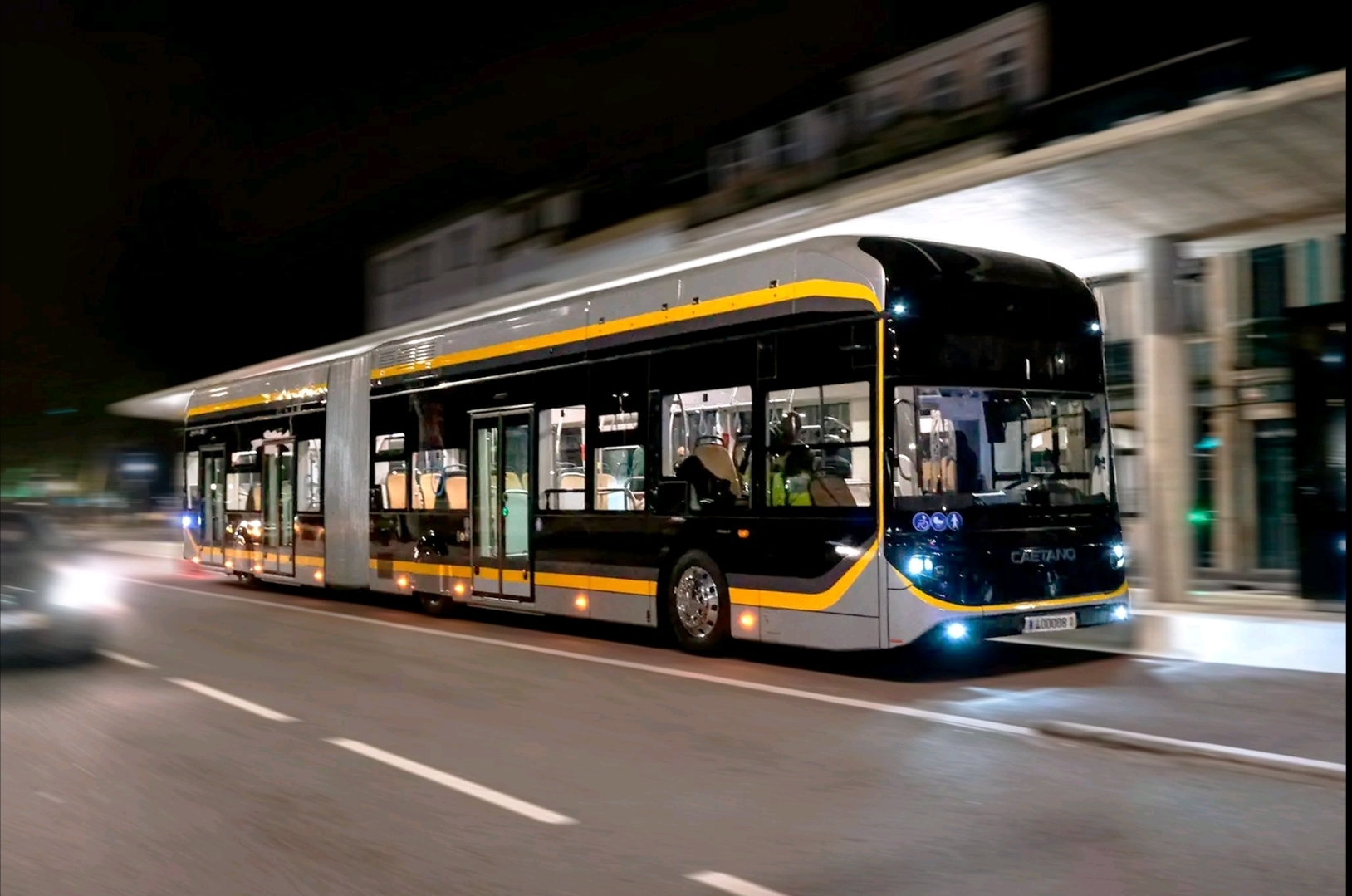
New to the lineup is the H2.City Gold articulated version, which operates with two separate electric motors similarly to the battery-only version. The electric powertrain uses the same configuration for both versions, accordingly, the middle axle is driven by a motor with a peak power of 240 kW, while the rear by a 135 kW peak power motor, though the battery pack here is only 176 kWh capacity. Interestingly, the hydrogen-powered version’s length of 18,665 mm is somewhat shorter than the battery-powered version, and it is slightly taller (3435 mm, presumably due to the hydrogen tanks), with a passenger capacity of up to 130 depending on the configuration. The lineup also includes a version intended for BRT lines, which is shorter at 18,620 mm and features a single 350 kW peak power traction motor. This variant offers increased standing space, a central platform area, and a unique, rapid passenger exchange optimized dual-sided door arrangement, specifically designed for urban rapid transit applications.
 Related Articles


