![Magyarbusz [Info] International](https://bunny-wp-pullzone-9e1je37kud.b-cdn.net/wp-content/uploads/2025/06/cropped-cropped-mbi_sby_v1-scaled-1.png)

On March 12, the Chicago Transit Authority (CTA) approved a contract with the American startup Hayden AI, under which six of the CTA’s buses will be equipped with the company’s AI-supported Automated Bus Lane Enforcement (ABLE) system, as part of the Smart Streets program launched last November. The initiative aims to automatically detect and identify vehicles parked in or obstructing bus and bike lanes, as well as bus stops, using AI-supported camera technology. Offenders caught in the act will receive a warning for the first offense, but will subsequently be fined – $90 for blocking a bus lane and $250 for a bike lane.
The two-year pilot project started on November 4 in Chicago, when eight vehicles belonging to the city’s transportation and financial authorities were equipped with the ABLE system. As a result, by the end of February, the city government had issued over 11,000 warnings and nearly 1,400 fines. The program is now being extended to CTA buses. The pilot project area covers several downtown routes, mainly those with bus or bike lanes, or bus stops where parking violations have been frequently reported in the past. Vehicles parked illegally not only hinder public transportation but often pose a threat to traffic safety, especially if the bus cannot pull into the stop.

The ABLE system in operation in Portland (Photo: Hayden AI)
Structurally, the ABLE system consists of an onboard processor unit and two cameras mounted on the windshield, which are used to identify and document parking violations and assess their impact on public transport services. Subsequently, Hayden AI manually evaluates the incoming data before forwarding it to the relevant authorities in Chicago, who are responsible for determining the violation and imposing penalties. The transit company does not directly participate in evaluating disputes or issuing fines.
Recently, other North American transit companies have also implemented the ABLE system, including the MTA in New York, SEPTA in Philadelphia, LA Metro in Los Angeles, and WMATA in Washington, while in Europe, it has been tested in Gdańsk, Poland, Braga, Portugal, Barcelona, Spain, and Tallinn, Estonia. According to reports, the New York transit company is very satisfied with the system, despite initial errors where several hundred drivers were mistakenly fined, which Hayden AI identified as a “configuration issue.” Despite the glitch, the average speed of buses increased by 5%, and the number of accidents decreased by 20% on the affected routes. In Braga, AI also proved effective, uncovering almost 8000 bus stop incidents in three months using two buses. Official communication suggests that the goal is not to issue fines (though the revenue from fines is undoubtedly beneficial for city governments), but to change driver behavior and improve traffic safety.
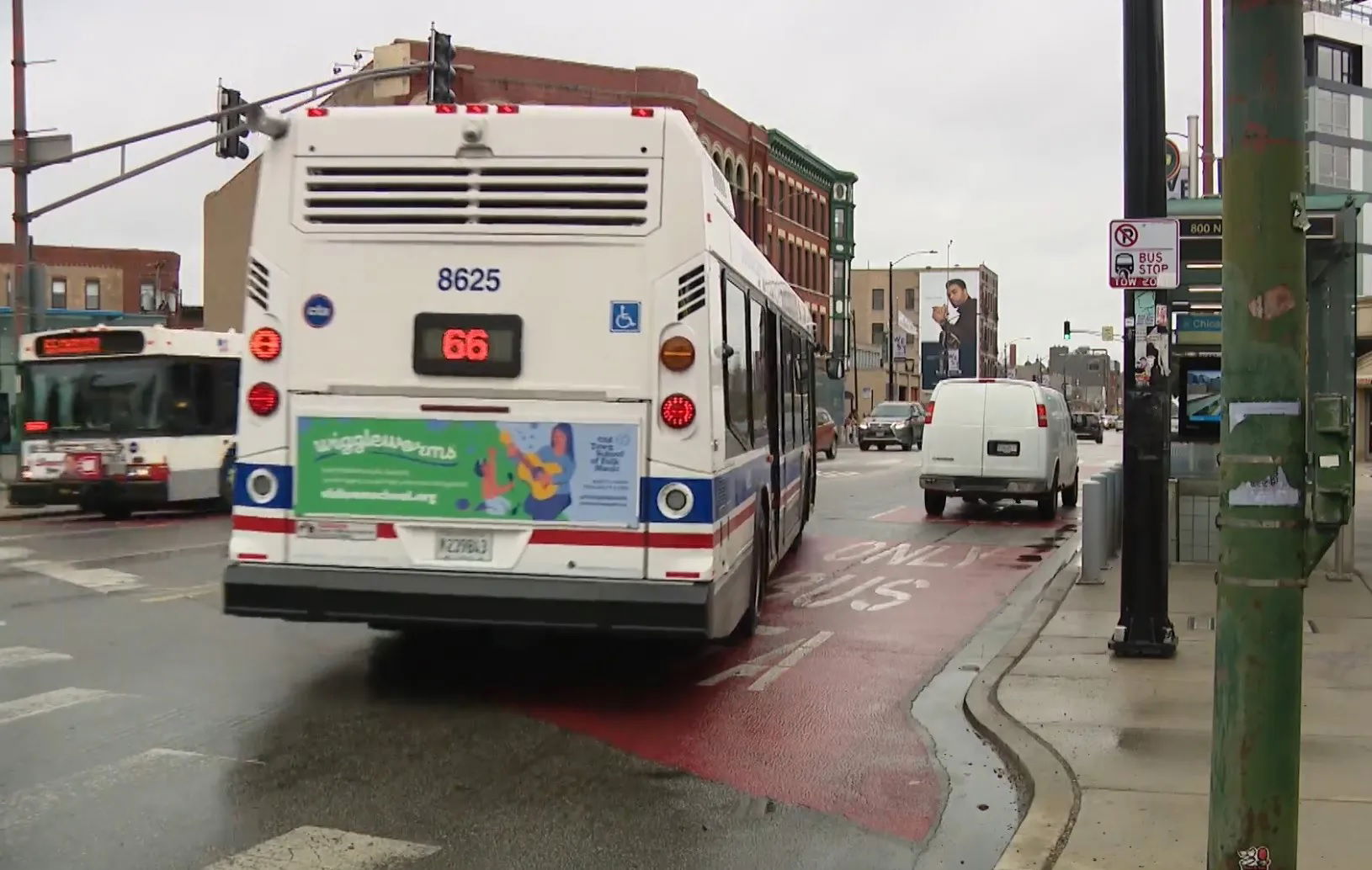
An everyday issue: a white van parked in the bus lane on Chicago Avenue on November 4, 2024 (Photo: WGN-TV)
Installing the system is not cheap; equipping the first six buses in the Chicago pilot project costs a total of $315,852 (more than 108.6 million forints), which includes the procurement of equipment and related services. The current contract also includes an option to procure an additional 94 camera systems, depending on the performance of the first six units, the progress of the Smart Streets program, and the availability of financial resources.
The cover image is an illustration, source: CTA/Nova Bus
 Related Articles


