![Magyarbusz [Info] International](https://bunny-wp-pullzone-9e1je37kud.b-cdn.net/wp-content/uploads/2025/06/cropped-cropped-mbi_sby_v1-scaled-1.png)

This morning, at a joint press conference held at Népliget, HUMDA Hungarian Mobility Development Agency Ltd. and Volánbusz Ltd. announced that Ikarus has been selected as the supplier for 15+5 purely electric, solo urban buses for the state-owned bus company. The agreement was signed today, October 29. Six Hungarian cities will share these vehicles—following our report in mid-October, Komló will receive 7 buses, Tata 6, Balatonfüred 3, Komárom 2, and Hajdúszoboszló and Keszthely 1 each. This aims to contribute to sustainable local transport under the Green Bus Program coordinated by HUMDA.
Following the Budapest metropolitan area and ten county capitals, the government’s Green Bus Program will soon extend to six smaller Hungarian cities. The Volánbusz and Mobiliti Volánbusz Ltd. consortium secured over 4.4 billion HUF in funding from HUMDA. With full support from the Ministry of Energy and HUMDA, 20 Ikarus 120e electric buses will be delivered within a year to the cities mentioned above.
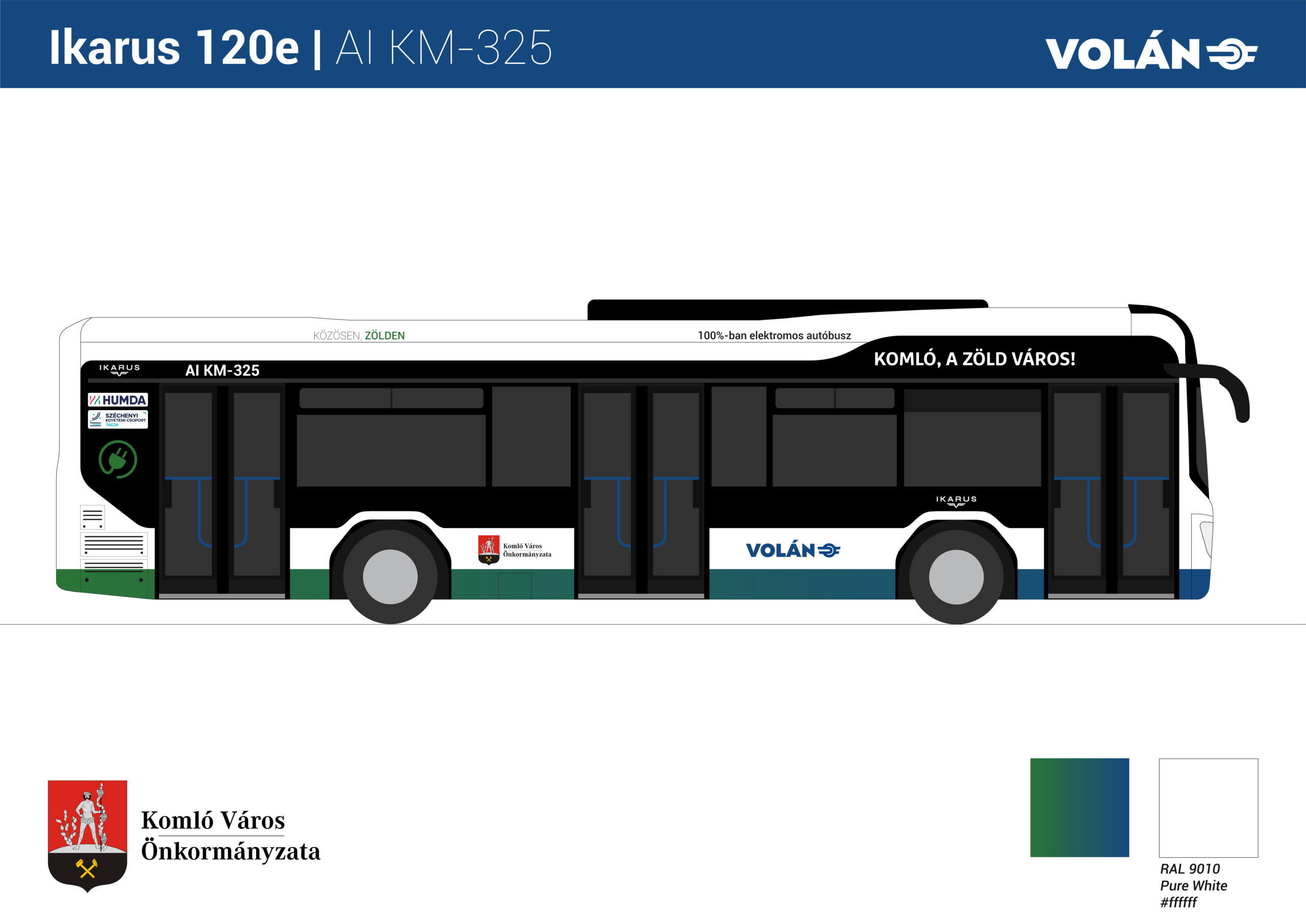
A possible vision for the Komló bus design (Unofficial illustration, graphic: Gergő Garamvölgyi)
Although the latest version of the Ikarus 120e, showcased at the InnoTrans 2024 exhibition in Berlin, was featured at the Népliget event, the buses for Volánbusz will come from the previously known and tested V3 series. These will be assembled in Székesfehérvár. The buses’ main features—a 165 kW continuous and 240 kW peak power central t-DRIVE-MD2021 permanent magnet synchronous electric motor, a CATL 314 kWh lithium iron phosphate (LFP) battery pack, and ZF axles—will match those of previously delivered models.
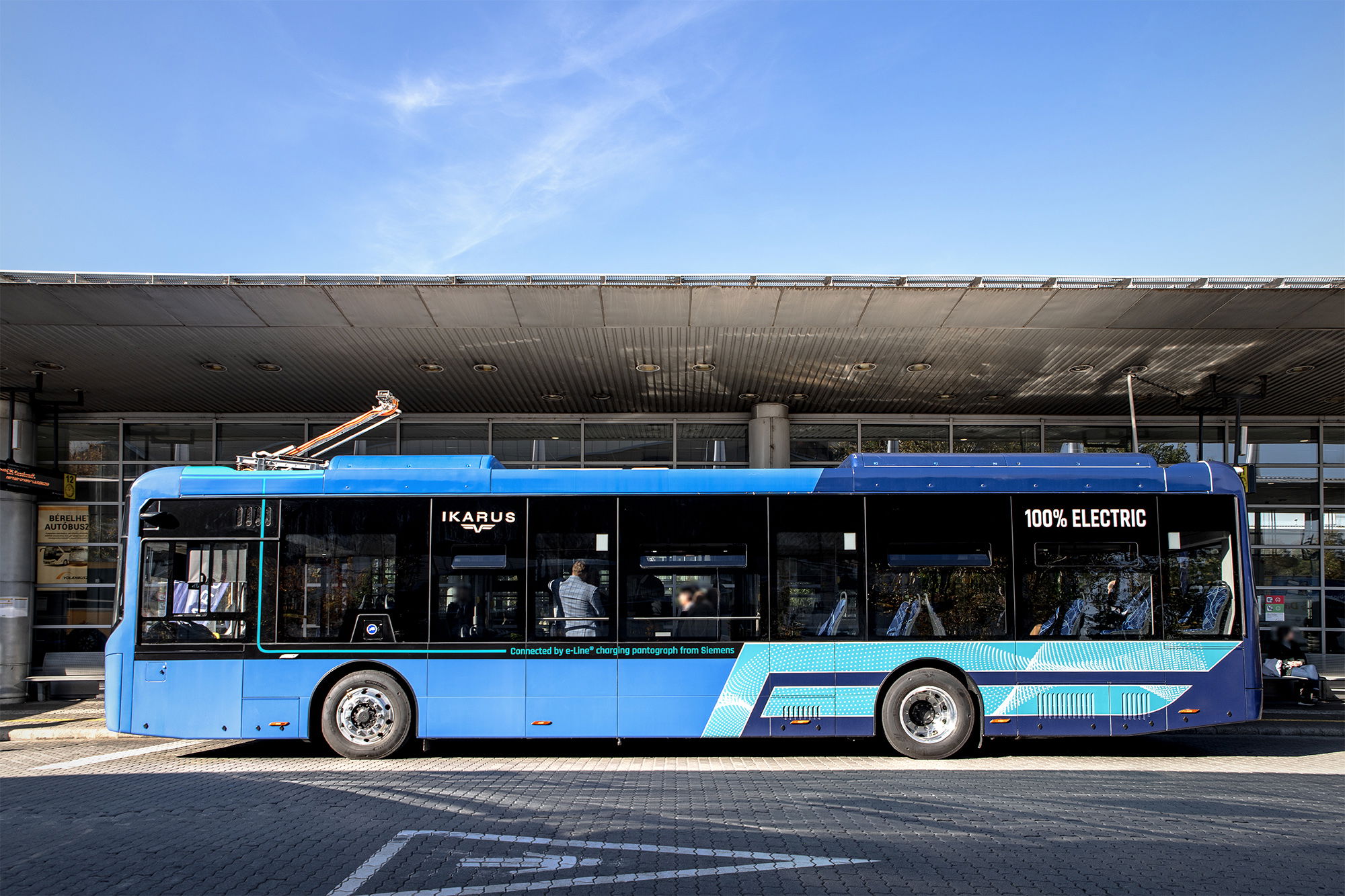
The V4 demonstration bus served only for display purposes; Volánbusz will receive the V3 series
These low-floor buses can transport 30 seated and 55 standing passengers. They offer a range of up to 300 kilometers on a single charge. Equipped with air conditioning, supplementary diesel heaters, space for wheelchairs and strollers, boarding ramps, electronic passenger information systems, onboard cameras, and USB charging points, they ensure a high-quality and safe travel experience. The buses will be powered by high-performance charging equipment installed by Mobiliti Volánbusz Ltd. at Volánbusz depots or bus stations in the cities deploying the electric buses. Mobiliti Volánbusz Ltd. received 80% funding for building the charging infrastructure.
The event featured Balázs Weingartner, President of HUMDA, Dr. László Mosóczi, CEO of Volánbusz Ltd., and Roland Fehér, CEO of the Ikarus Group. Weingartner highlighted that the 20 electric Ikarus buses to be delivered are equivalent to the air quality benefit of nearly 15,000 trees in the six cities. Dr. Mosóczi emphasized Volánbusz’s commitment to reducing environmental impact and promoting sustainability as a member of the MÁV Group, which includes rejuvenating the bus fleet with modern, eco-friendly vehicles. He noted that Ikarus electric buses in Székesfehérvár have already proven their worth, having clocked approximately 1.35 million kilometers since summer 2022. The green fleet expansion will continue with the arrival of Volánbusz’s first hydrogen fuel cell bus in 2026, with plans to further expand their fleet with zero-emission buses through additional funding while increasing the ratio of “clean,” emission-free buses in intercity transport.
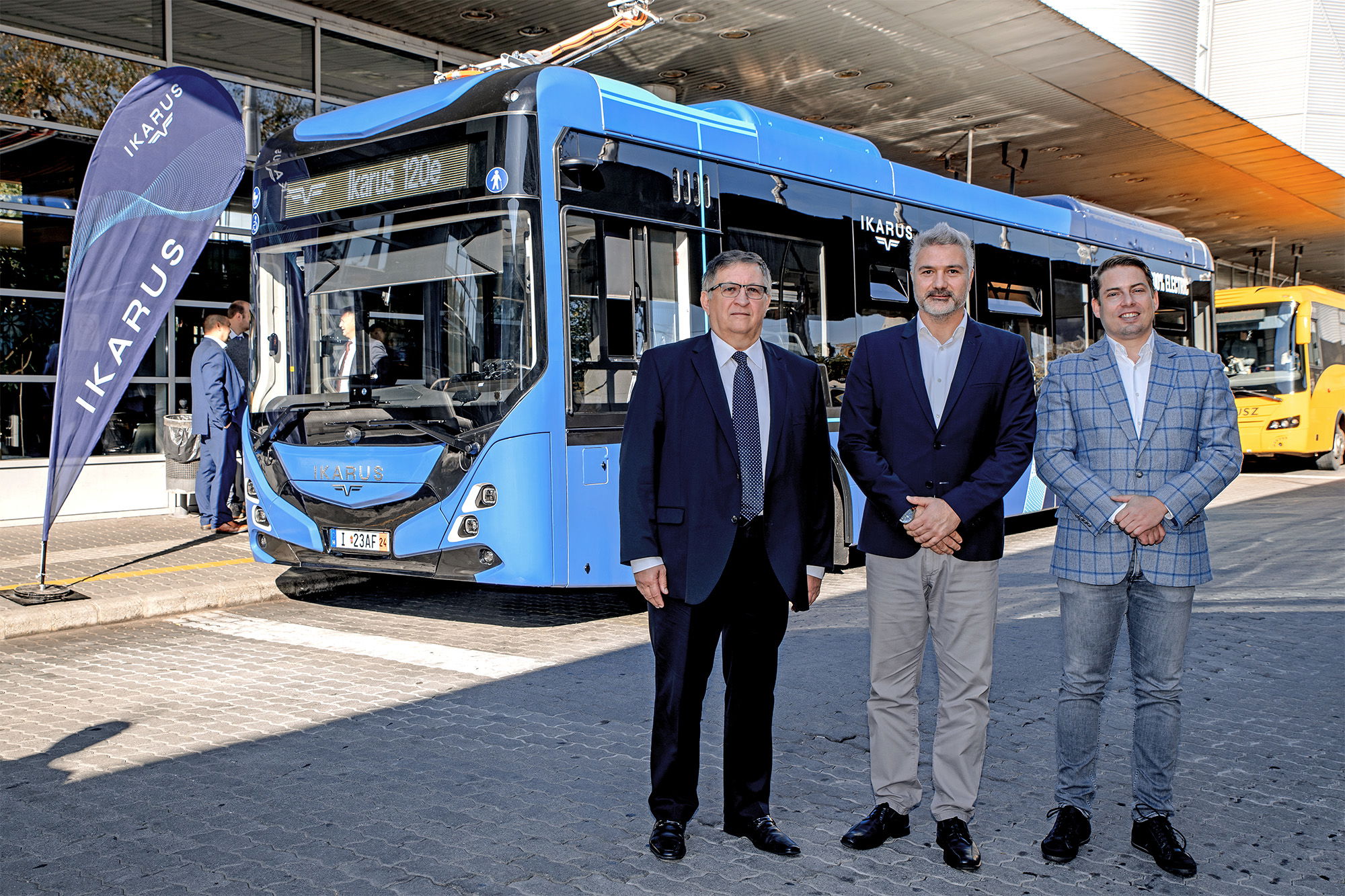
From left to right: Dr. László Mosóczi, Roland Fehér, and Balázs Weingartner
Roland Fehér stated: “We are immensely proud to once again contribute to greening domestic transport under the Green Bus Program, as new environmentally friendly Ikarus electric buses will soon be on the roads in six more Hungarian cities. These buses are prime examples of Ikarus’s 130-year history of innovation-driven development, enabling us to successfully represent the forefront of Hungarian bus manufacturing both domestically and internationally.”
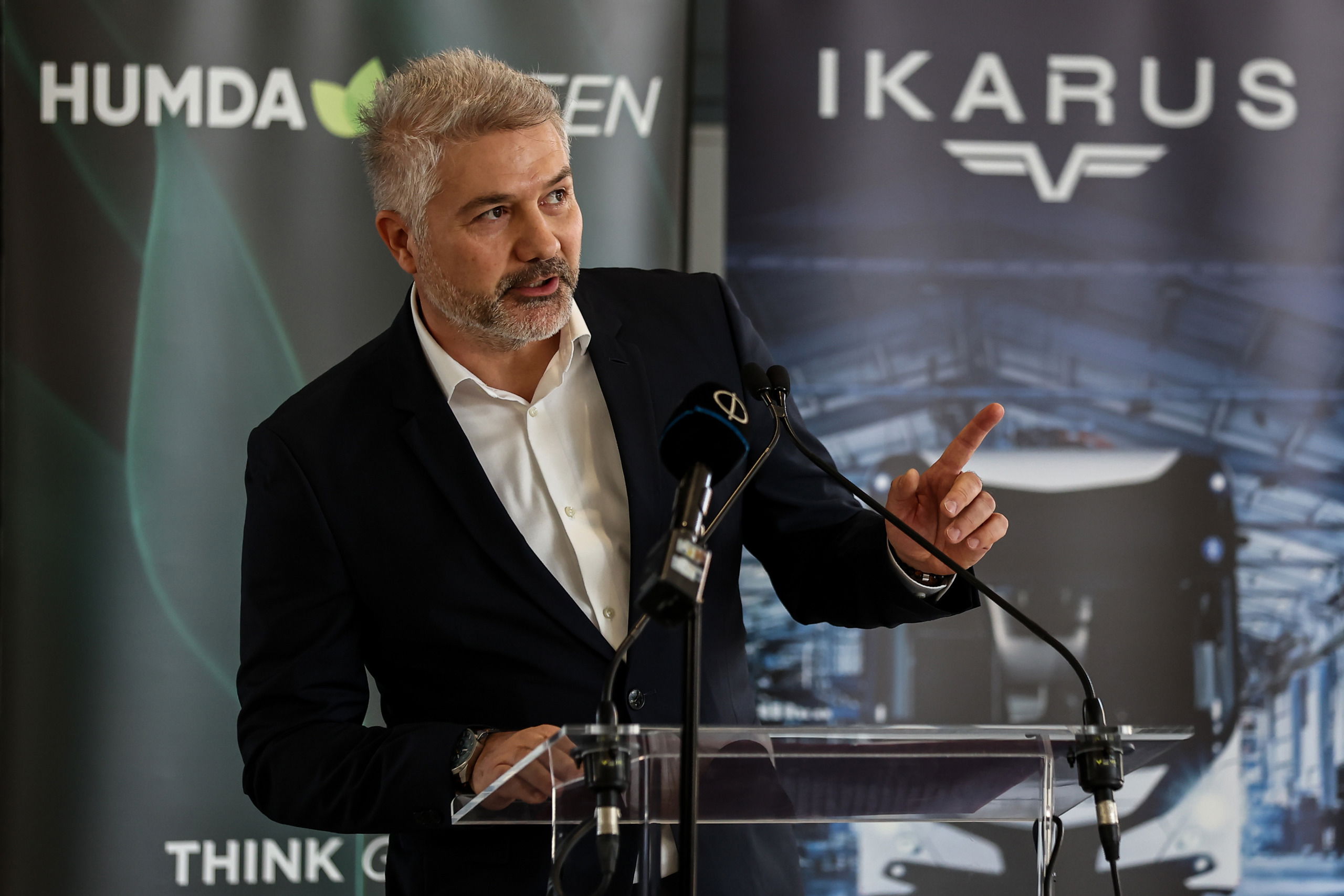
Roland Fehér, CEO of Ikarus, speaking at the Népliget press event
Ikarus has 12 months from the contract signing to deliver the ordered electric buses, with the possibility of earlier completion. Replacing diesel buses with these new vehicles is expected to reduce annual carbon dioxide emissions by 850 tons in the affected towns.
Under the Green Bus Program, Volánbusz has already deployed 100 electric buses in the Budapest metropolitan area and in the local transport systems of Székesfehérvár, Zalaegerszeg, Győr, Eger, Szolnok, and Szeged. This e-bus fleet currently reduces carbon dioxide emissions by about 5500 tons annually, equivalent to the yearly emissions of approximately 2000 passenger cars. Since entering service, the electric vehicles have collectively traveled nearly 10.3 million kilometers.
The cover image is an illustration, not an official rendering. Source: Gergő Garamvölgyi
 Related Articles


